
What Temperature Should a Fridge Be? 37°F3°C Is Ideal
Quick Answer
Keep your fridge between 35°F2°C and 38°F2–3°C, ideally at 37°F3°C. 40°F4°C is the maximum safe temperature, not the target. Verify with an appliance thermometer on the middle shelf — the dial numbers aren't degrees.
The optimal fridge temperature is 37°F3°C, and the acceptable range is 35°F2°C to 38°F3°C. Anything above 40°F4°C is too warm for safe food storage; anything below 32°F0°C starts freezing produce and drinks.
A fridge that is too warm lets bacteria multiply and speeds up spoilage. One that is too cold freezes lettuce and wastes energy. The dial numbered 1–5 or 1–9 doesn't tell you which you have — only a thermometer does.
The Ideal Fridge Temperature Range
According to the Food and Drug Administration (FDA), your refrigerator must be kept at or below 40°F4°C. However, "below 40°F4°C" is a safety limit, not necessarily the target for optimal freshness.
The sweet spot for the ideal fridge temperature is between 35°F2°C and 38°F3°C.
Target Setting: Aim for 37°F3°C. This provides a safety buffer. If the door is opened frequently, the temperature might rise briefly to 40°F4°C but will quickly recover, whereas a fridge set to exactly 40°F4°C will dip into the Danger Zone (40°F4°C–140°F60°C) every time you grab the milk.
Why Not Lower?
Setting your fridge below 32°F0°C causes liquids to freeze and delicate produce like lettuce and cucumbers to wilt and become mushy. While frozen food is safe, accidentally freezing fresh ingredients ruins their texture and flavor.
Why Not Higher?
As soon as the temperature crosses 40°F4°C, bacteria like Listeria and Salmonella begin to multiply exponentially. Milk spoils faster, leftovers become unsafe, and meat rots.
Listeria monocytogenes is a particularly nasty bacterium because, unlike many others, it can still grow (albeit slowly) at refrigerator temperatures. Keeping your fridge strictly below 40°F4°C is essential to slow its growth to a crawl.
How to Measure Your Fridge Temperature (Don't Trust the Dial!)
Most modern fridges have a digital display, but older or budget models often feature a dial with numbers 1–5 or 1–9. These numbers do not correspond to degrees. They are simply power levels. Level 5 might make your fridge 30°F-1°C, or it might make it 42°F6°C, depending on the ambient temperature of your kitchen and how full the fridge is.
To know the truth, you need a dedicated appliance thermometer.
- Purchase a thermometer: They are inexpensive, stainless steel, and designed to hang from a wire rack.
- Place it correctly: Put the thermometer in the center of the middle shelf. Do not shove it against the back wall (where it is coldest) or in the door (where it is warmest).
- Wait 24 hours: Allow the thermometer to acclimate to the fridge's temperature.
- Check the reading: If it is above 38°F3°C, turn the dial to a colder setting. If it is below 34°F1°C, turn it warmer.
- Repeat: Adjust in small increments and wait another 24 hours before checking again.
Fridge Zones: The Science of Organization
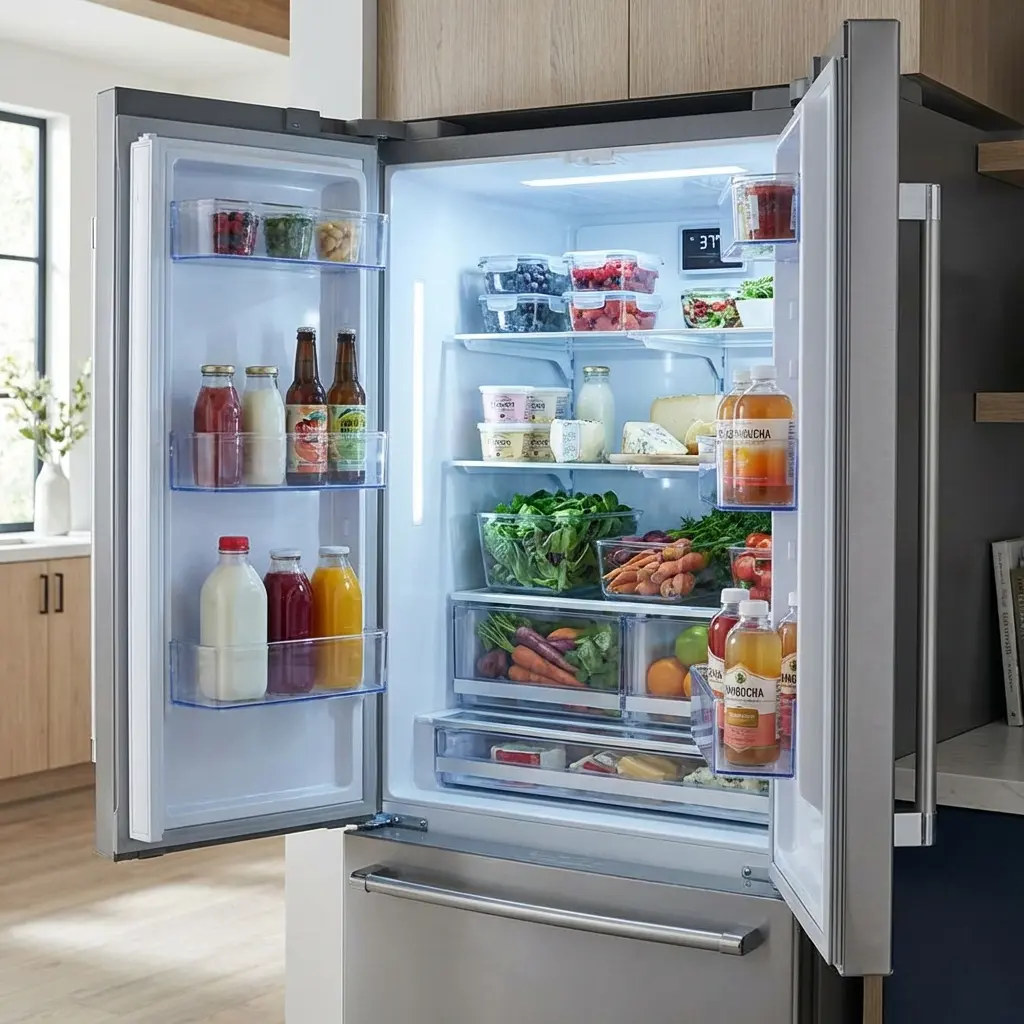
Not all spots in your fridge are created equal. Since cold air sinks and warm air rises (and enters through the door), different zones maintain different temperatures. Organizing your groceries based on these zones is a pro move for food safety. For detailed organization tips, see our fridge zones guide.
1. The Upper Shelves (Warmest Stability)
The top shelf is the most consistent temperature zone but slightly warmer than the bottom.
- Store: Ready-to-eat foods, leftovers, drinks, yogurt, and cheese.
- Avoid: Raw meat.
2. The Lower Shelves (Coldest Zone)
Cold air sinks, making the bottom shelf the coldest part of the main compartment.
- Store: Milk, eggs, and raw meat/poultry/fish.
- Safety Tip: Always store raw meat on the bottom shelf to prevent juices from dripping onto other foods (cross-contamination).
3. The Crisper Drawers (Humidity Control)
These drawers produce a microclimate.
- High Humidity: For wilting vegetables (spinach, lettuce, herbs). Closes the vent to keep moisture in.
- Low Humidity: For rotting fruits (apples, pears, avocados) that release ethylene gas. Opens the vent to let gas escape.
4. The Door (The Danger Zone)
The door is the warmest part of the fridge and experiences the most temperature fluctuation. Every time you open the fridge, the door contents are exposed to room air.
- Store: Condiments, salad dressings, jams, sodas.
- Avoid: Milk and eggs! Despite the built-in egg rack, the door is the worst place for them. Store milk on the bottom shelf near the back.
Troubleshooting: Why Is My Fridge Warm?
If your thermometer reads above 40°F4°C, don't panic. Before calling a repair technician, run through this checklist. For a complete troubleshooting guide, see what to do when your fridge is too warm.
- Blocked Air Vents: Fridges circulate cold air from the freezer into the fridge compartment. If you have stuffed the fridge too full and blocked the vents (usually at the top back), the cold air cannot circulate. Rearrange items to allow for airflow.
- Dirty Condenser Coils: Dust and pet hair can build up on the coils (usually under or behind the fridge), causing the compressor to overheat and fail. Vacuum these coils once every 6 months.
- Broken Door Gasket: The rubber seal around the door keeps cold air in. If it is cracked or brittle, cold air is leaking out. Test it by closing the door on a dollar bill. If you can pull the bill out easily, the seal is loose and needs replacing.
- Ambient Temperature: Is your fridge in a hot garage? Most standard fridges are rated for room temperatures between about 50°F10°C and 110°F43°C. A garage that gets hotter or colder than that can stop the fridge from holding a safe internal temperature.
Energy Efficiency Tips
A fridge running at optimal efficiency keeps food safer and lowers your electricity bill.
- Keep it Full (But Not Packed): A full fridge retains cold better than an empty one. The cold food items help absorb and maintain the low temperature. If your fridge is empty, fill jugs with water to occupy space.
- Chill Leftovers Fast: A big pot of hot food raises the fridge temperature and makes the compressor work overtime. Don't let leftovers cool on the counter first — refrigerate them within 2 hours, split into shallow containers so they chill fast without warming everything around them. See our cooling food safely guide for proper techniques.
- Check the Seal: As mentioned above, a tight seal is crucial.
Table: Temperature Impacts on Common Foods
| Food Item | Ideal Temp | Consequence of Too Warm | Consequence of Too Cold |
|---|---|---|---|
| Milk | 35°F2°C–38°F3°C | Sours quickly, clumps | Separates, texture ruined |
| Lettuce | 34°F1°C–36°F2°C | Wilts, becomes slimy | Freezes, becomes translucent mush |
| Meat (Raw) | 32°F0°C–38°F3°C | Bacterial growth, spoilage | Safe, but texture may degrade if frozen |
| Cheese | 35°F2°C–40°F4°C | Mold growth, oil separation | Hardens, loses flavor |
| Leftovers | 35°F2°C–38°F3°C | Bacterial growth (risk of poisoning) | Texture damage |
Frequently Asked Questions (FAQ)
Q: My fridge dial says 1 to 9. Which is coldest?
A: On almost every refrigerator, the higher the number, the colder the setting. So 9 is the coldest, and 1 is the warmest. However, this is not universal. Consult your manual or, better yet, use a thermometer to be 100% sure.
Q: Why is there frost on the back wall of my fridge?
A: This often indicates a defrost problem or a door left ajar. Humidity enters, hits the cold back wall, and freezes. If it persists, the automatic defrost system (heater) might be broken.
Q: Can I put a hot turkey in the fridge?
A: No. A large mass like a whole turkey acts as a heat radiator. It can warm up the milk and eggs next to it into the danger zone. Break the turkey down into smaller containers to cool it quickly, or use an ice bath before refrigerating.
More Questions
What is the ideal temperature for a refrigerator?
The ideal fridge temperature is between 35°F2°C and 38°F3°C (1°C–3°C), with 37°F3°C as the optimal target. The FDA sets 40°F4°C as the maximum safe temperature, but aiming for 37°F3°C gives you a buffer so the fridge stays safe even when the door is opened frequently.
What is the best temperature setting for a fridge?
Set your fridge to 37°F3°C. This is cold enough to slow bacterial growth and keep food fresh, but warm enough to prevent accidentally freezing produce like lettuce or cucumbers. Use an appliance thermometer to verify — most dial settings (1–5 or 1–9) are not calibrated to degrees.
Is 42°F6°C safe for a fridge?
No. 42°F6°C is in the USDA danger zone (40°F4°C–140°F60°C). Bacteria like Salmonella and Listeria multiply significantly faster at 42°F6°C than at the recommended 37°F3°C. Adjust your fridge temperature down immediately.
How long will food stay safe in the fridge if the power goes out?
With the door kept closed, a refrigerator will keep food safe for approximately 4 hours. After that, perishable items (meat, dairy, leftovers) should be discarded if they rose above 40°F4°C for more than 2 hours.
What number should a fridge be set at (1–5 dial)?
On most refrigerators, higher numbers = colder settings. On a 1–5 dial, setting 3 or 4 is typically around 37°F3°C. However, this varies by brand and ambient kitchen temperature. Always verify with an appliance thermometer for accuracy.
What is the coldest part of the refrigerator?
The back of the bottom shelf is the coldest spot because cold air sinks and the back wall is furthest from the warm door opening. This is the best location for raw meat, fish, and milk.