
Cooling Food Safely: The Two-Stage Method & Time Limits
You’ve cooked a delicious meal, but now you have a giant pot of chili or a whole roast left over. What do you do?
Most people make one of two dangerous mistakes:
- They leave it on the stove to cool overnight (Bacteria Heaven).
- They put the steaming hot pot directly into the fridge (Danger to the Fridge).
Proper cooling is critical because harmful bacteria grow fastest between 125°F52°C and 70°F21°C. Passing through this temperature range quickly is the key to safe leftovers.
Improper cooling is a leading cause of foodborne illness in the home. "I left it out all night and I was fine" is a survivor's bias, not a safety standard.
The 2-Stage Cooling Method
Professional chefs and food safety experts use the 2-Stage Cooling Method to ensure food passes through the Danger Zone safely.
| Stage | Temp Drop | Time Limit | Notes |
|---|---|---|---|
| Stage 1 | From 135°F57°C down to 70°F21°C | Within 2 Hours | The most critical rapid drop. |
| Stage 2 | From 70°F21°C down to 41°F5°C | Within 4 Hours | The final chill in the fridge. |
| Total | Start to Fridge-Safe | 6 Hours Max |
Why these numbers?
Bacteria multiply exponentially at warm temperatures. Usually, food cools quickly from 212°F100°C down to 135°F57°C, but it stalls in the lukewarm range. If food sits at 90°F32°C for hours, clear pathogens like Clostridium perfringens can explode in population.
Speeding Up the Cooling Process
You cannot just leave a large pot on the counter and hope for the best. Dense foods (chili, mashed potatoes, stews) hold heat for hours.
- Divide and Conquer: Never cool a large pot whole. Pour soups or stews into shallow containers (no more than 2-3 inches deep). This increases surface area.
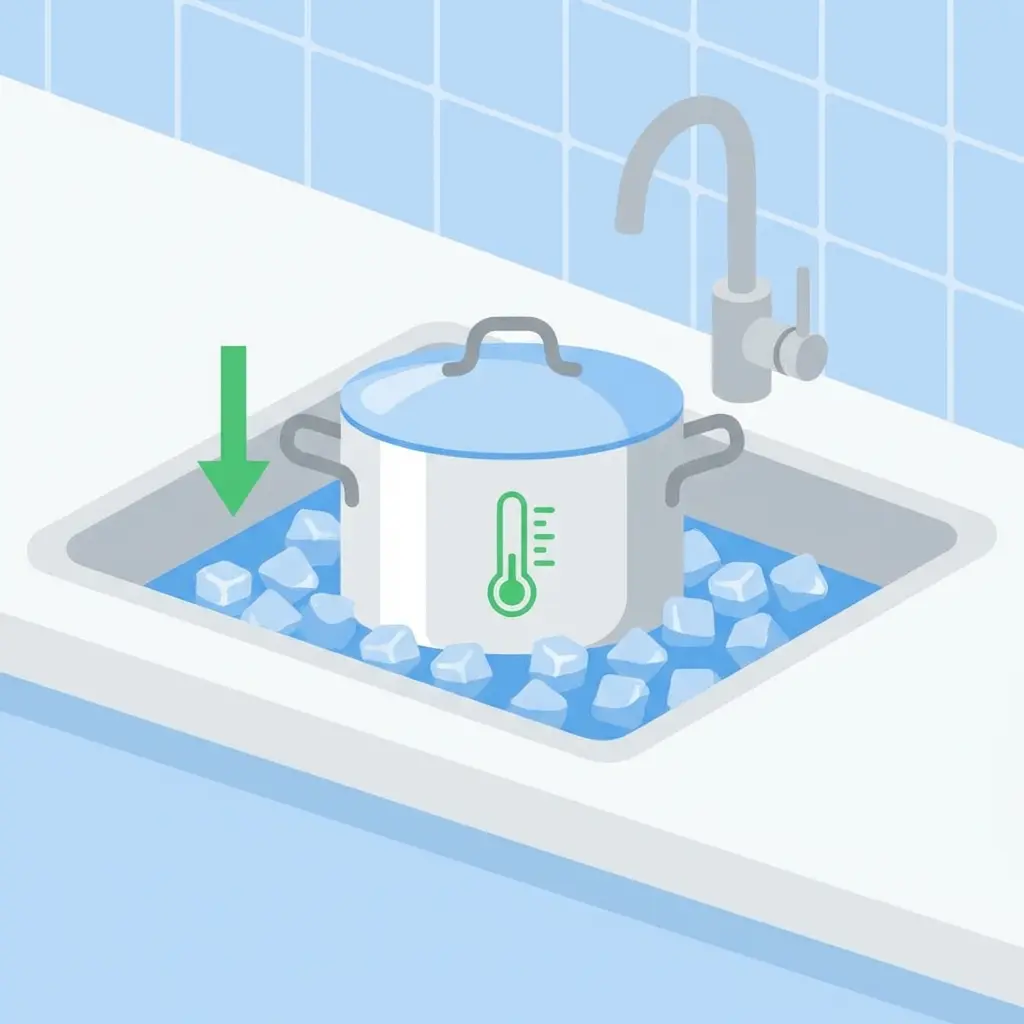
- Ice Bath: Fill your sink with ice and water. Place the pot in the ice bath (making sure water doesn’t get in the food). Stir frequently to release heat.
- Ice Paddle: For large batches of soup, use a frozen cooling paddle (a plastic bottle filled with frozen water works in a pinch).
- Vent: Leave container lids loosely ajar while cooling on the counter for the first hour to let steam escape, then seal before refrigerating.
The "Hot Food in Fridge" Myth
Myth: "You should never put hot food in the fridge because it will spoil."
Fact: You can put hot food in the fridge, but there is a catch.
- Small amounts: Perfectly safe to put directly in the fridge.
- Large amounts: Dangerous. A 5-gallon pot of hot soup acts like a radiator. It will raise the temperature of your entire fridge, potentially spoiling the milk and meat on the shelf next to it.
Cool large batches on the counter using the shallow container method until they reach room temperature (around 70°F21°C), then refrigerate immediately.
Frequently Asked Questions (FAQ)
Q: Can I leave pizza out overnight?
A: No. Perishable food should not be left out for more than 2 hours (or 1 hour if it's over 90°F32°C outside). The cheese and toppings can harbor bacteria. See our guide on how long food can sit out for more details.
Q: Why shallow containers?
A: Heat takes a long time to travel from the center of a dense mass to the surface. A 5-inch deep pan of lasagna might stay hot in the middle for 8 hours even in a fridge. Cutting it into smaller pieces allows the cold air to penetrate faster.
Q: What if I fell asleep and the food sat out for 5 hours?
A: When in doubt, throw it out. Reheating it usually kills the bacteria, but it does not kill the heat-stable toxins some bacteria (like Staphylococcus aureus) leave behind. You can still get sick from "cooked" dead bacteria toxins.
Q: Does a blast chiller help?
A: Absolutely. Commercial kitchens use blast chillers to freeze/cool food instantly. While rare in homes, using the "Power Cool" feature on modern fridges is a generic alternative.