
Food Temperature Danger Zone: 40°F4°C–140°F60°C (USDA Food Safety Guide)
Quick Answer
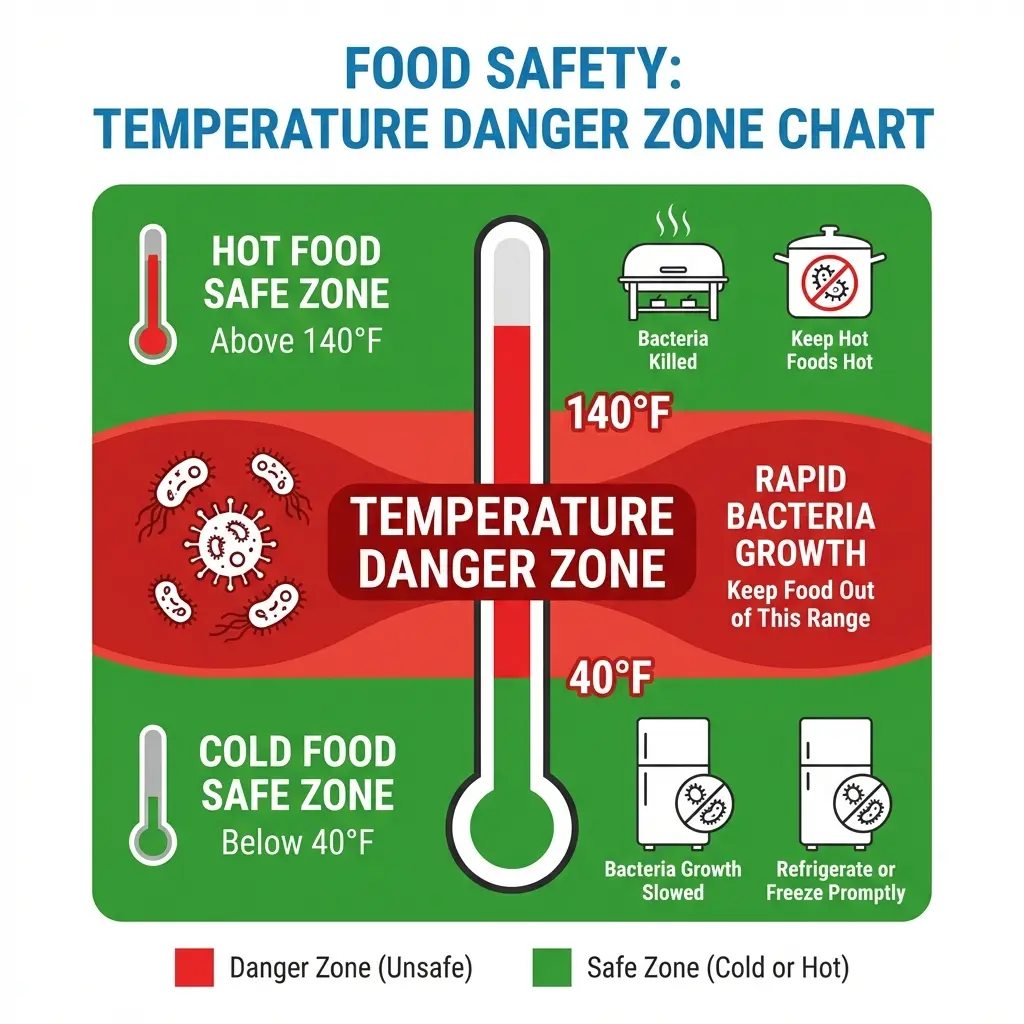
The danger zone is 40–140°F4–60°C, where bacteria double every 20 minutes. Keep cold food below 40°F4°C, hot food above 140°F60°C, and discard perishable food left in the zone for more than 2 hours (1 hour above 90°F32°C).
When it comes to food safety, there is one range of temperatures you absolutely must avoid: The Danger Zone. It sounds dramatic, but for bacteria, this range is paradise.
Understanding The Danger Zone is the cornerstone of keeping yourself and your family safe from foodborne illness. It dictates how we cook, cool, store, and reheat virtually every type of perishable food. Whether you are a home cook, a professional chef, or just someone reheating leftovers, this guide will explain exactly what the danger zone is and how to navigate it safely.
In this detailed guide, we will explore the science behind bacterial growth, the critical "2-Hour Rule," and the specific strategies you need to employ for heating, cooling, and storing food to ensure it never becomes a hazard.
What Exactly Is the "Danger Zone"?
The Danger Zone is the temperature range between 40°F4°C and 140°F60°C.
In this specific window, bacteria grow most rapidly. In fact, they can double in number in as little as 20 minutes. This exponential growth means that a single bacterium can multiply into thousands within just a few hours.
If a single bacterium divides every 20 minutes, after 6 hours, that one cell can become over 262,000 bacteria. This is why time is just as critical as temperature.
Perishable foods left in the Danger Zone for more than 2 hours should be discarded. If the ambient temperature is above 90°F32°C, food should not be left out for more than 1 hour.
Why This Range?
Bacteria, like all living organisms, have optimal conditions for growth.
- Below 40°F4°C: Bacterial growth slows significantly. This is why we refrigerate food. Freezing stops growth almost entirely, though it doesn't necessarily kill the bacteria.
- Above 140°F60°C: Heat begins to kill bacteria. This is why hot holding temperatures are set at 140°F60°C or higher.
- The Sweet Spot: Between 40°F4°C and 140°F60°C, conditions are perfect for enzymatic activity and reproduction. Nutrients in the food + moisture + warmth = rapid multiplication.
The 2-Hour Rule Breakdown
The "2-Hour Rule" is a standard safety guideline used by food safety agencies worldwide, including the USDA and FDA. It is your primary defense against food poisoning when dealing with buffets, picnics, and family dinners.
- 0 to 2 Hours: Use immediately or store properly. If food is kept in the danger zone for less than 2 hours, it is generally considered safe to consume or put back in the refrigerator.
- After 2 Hours: The risk of bacterial growth becomes significant. Pathogens like Salmonella, Staphylococcus aureus, and E. coli can reach dangerous levels.
- The Exception: On hot days (over 90°F32°C), holding time drops to 1 hour. Bacteria grow even faster at these higher temperatures.
This rule applies to cumulative time. If you take cold cuts out for 30 minutes to make a sandwich and put them back, you have "used" 30 minutes of their safety window. If you do this four times, the meat is now unsafe.
Keeping Hot Food Hot
Once you've cooked a meal, you need to keep it out of the danger zone until it's served. This is called Hot Holding. For complete guidance, see our hot holding temperature guide.
- Target: Keep hot food at 140°F60°C or hotter.
- Tools: Use warming trays, slow cookers, or chafing dishes.
- Monitoring: Use a food thermometer to check the food's internal temperature regularly.
If you are hosting a party or buffet, stir the food often to distribute heat evenly and prevent cool spots where bacteria could survive. The edges of a dish might be 145°F63°C, but the center could drop to 110°F43°C if not stirred.
Keeping Cold Food Cold
Just as critical is Cold Holding. This is especially important for salads, dairy products, and raw meats.
- Target: Keep cold food at 40°F4°C or colder.
- Technique: Nest serving dishes in bowls of ice. Keep lids on to retain cold air.
- Storage: Verify your refrigerator is actually set to 40°F4°C or below. Use an appliance thermometer to be sure. Learn more in our ideal fridge temperature guide.
If you are transporting food for a picnic, use a cooler with plenty of ice or frozen gel packs. Limit the number of times the cooler is opened. A full cooler stays cold longer than a half-empty one.
Cooling Food Safely: The Tricky Part
One of the most common mistakes occurs when putting hot leftovers into the fridge. If you put a large pot of hot chili directly into the refrigerator, it can take days to cool to a safe temperature in the center. During that time, the bacteria in the middle are thriving in the danger zone, turning your leftovers into a biological hazard. For detailed methods, see our cooling food safely guide.
Proper Cooling Methods
To cool food rapidly through the danger zone:
- Divide and Conquer: Split large batches of food into shallow containers (no more than 2-3 inches deep). This increases surface area and allows heat to escape faster.
- Ice Water Bath: Place the pot of hot food into a sink or large bowl filled with ice and water. Stir constantly to cool the food down before refrigerating.
- Blast Chillers: Commercial kitchens use these, but at home, identifying the coldest part of your fridge (usually the back) helps.
Do not cover the containers tightly until the food has fully cooled. A loose cover allows heat to escape, whereas a tight lid traps heat and moisture, creating a bacterial incubator.
Reheating Leftovers
When reheating food that has been refrigerated, you must bring it quickly through the danger zone to a temperature that kills any bacteria that may have multiplied during storage.
- Target: Reheat all leftovers to an internal temperature of 165°F74°C. For complete guidance, see our reheating leftovers temperature guide.
- Method: Use a stove, oven, or microwave.
- Microwaving: Cover the food to retain moisture and rotate/stir halfway through to ensure even heating. Let it stand for a minute to allow heat to distribute.
Do not use slow cookers to reheat leftovers. Slow cookers heat food too slowly, keeping it in the danger zone for too long. Only put already hot food into a slow cooker for holding.
Common Foods at Risk
Certain foods are more susceptible to bacterial growth than others. These require extra vigilance.
- Meat and Poultry: High protein and moisture content make them ideal hosts.
- Dairy Products: Milk, cheese, cream sauces.
- Cooked Rice and Pasta: Often overlooked! Bacillus cereus spores can survive cooking and multiply if rice is left at room temperature.
- Cut Melons and Tomatoes: Yes, produce! Once the protective skin is broken, the moist interior is a breeding ground.
- Sprouts: The warm, humid conditions needed to grow sprouts are also perfect for bacteria.
Checking Temperatures: Your Best Defense
You cannot see, smell, or taste the bacteria that cause food poisoning. The only way to know if food is safe is to check its temperature.
- Calibrate: Ensure your thermometer is accurate using an ice water bath (should read 32°F0°C). Learn how in our thermometer calibration guide.
- Check: Insert the probe into the thickest part of the food.
- Repeat: Check in multiple spots for large items.
Table: Safe Time Limits in Danger Zone
| Ambient Temperature | Time Limit | Action |
|---|---|---|
| Below 90°F32°C | 2 Hours | Refrigerate or discard |
| Above 90°F32°C | 1 Hour | Refrigerate or discard |
| 40°F4°C to 140°F60°C | Constant | DANGER ZONE - Bacteria Growing |
Conclusion
The "Danger Zone" is a simple concept with profound implications for your health. By keeping hot foods hot (above 140°F60°C), cold foods cold (below 40°F4°C), and moving food rapidly through the range in between, you dramatically reduce the risk of foodborne illness.
Always err on the side of caution. If you aren't sure how long that potato salad has been sitting out in the sun, remember the old adage: When in doubt, throw it out.
Frequently Asked Questions (FAQ)
Q: Can I leave pizza out overnight and eat it in the morning?
A: No. Pizza contains cheese, sauce, and often meat, all of which are perishable. If it has been at room temperature for more than 2 hours, it is in the danger zone and should be discarded to avoid the risk of food poisoning.
Q: Does freezing food kill bacteria?
A: No. Freezing puts bacteria into a dormant state. They stop growing, but they do not die. Once the food thaws and enters the danger zone, the bacteria can "wake up" and begin multiplying again.
Q: Is the danger zone different for different foods?
A: Technically, the temperature range where bacteria grow is the same (40°F4°C–140°F60°C). However, some foods (like dry crackers or highly acidic pickles) are less hospitable to bacteria due to low moisture or pH, so the risk is lower compared to meat, dairy, or cooked grains.
Q: How long can cooked chicken sit out?
A: Cooked chicken should not sit out at room temperature for more than 2 hours. If the room is hot (above 90°F32°C), the limit is 1 hour. For complete chicken safety guidance, see our chicken internal temperature guide.
Q: My refrigerator thermometer says 45°F7°C. Is that okay?
A: No. Your refrigerator should be set to maintain a temperature of 40°F4°C or below. At 45°F7°C, your food is technically in the danger zone, and spoilage will happen much faster. Adjust your settings immediately.
Q: Can I put hot food in the fridge if it's still steaming?
A: It is better to let it cool slightly (until it stops steaming) to avoid raising the fridge's ambient temperature, but do not leave it out for hours. Using shallow containers is the best way to speed this up safely.
More Questions
What is the food temperature danger zone?
The food temperature danger zone is 40°F4°C to 140°F60°C (4°C to 60°C), as defined by the USDA and FDA. In this range, bacteria like Salmonella and E. coli can double in number every 20 minutes. Perishable food should never remain in this zone for more than 2 hours total (or 1 hour if the ambient temperature is above 90°F32°C).
What is the danger zone temperature for food in Canada?
Canada’s food safety guidelines (CFIA) define the same danger zone as the US: 4°C to 60°C (40°F4°C to 140°F60°C). Canadian food safety rules follow the same 2-hour limit for perishable food left at room temperature, and recommend keeping cold food below 4°C and hot food above 60°C.
How long can food stay in the temperature danger zone?
According to USDA guidelines, perishable food should not remain in the danger zone (40°F4°C–140°F60°C) for more than 2 hours total. If the temperature is above 90°F32°C — such as at an outdoor barbecue — that limit drops to 1 hour. After that, discard the food. The clock does not reset when food is refrigerated temporarily.
What temperature kills bacteria in food?
Cooking food to 165°F74°C kills most harmful bacteria instantly, including Salmonella, E. coli, and Listeria. At 145°F63°C with a 3-minute rest, most bacteria in whole-muscle meats are destroyed. The USDA recommends 165°F74°C for all poultry and reheated leftovers.
What is the 40-140 rule in cooking?
The 40-140 rule (also called the 4-hour rule or 2-hour rule) states that food should not stay between 40°F4°C and 140°F60°C for more than 2 hours. These are the temperatures at which bacteria thrive. Keep cold food below 40°F4°C and hot food above 140°F60°C to stay outside the danger zone.