
When Is Chicken Done? 165°F74°C Internal (160 vs. 165 Explained)
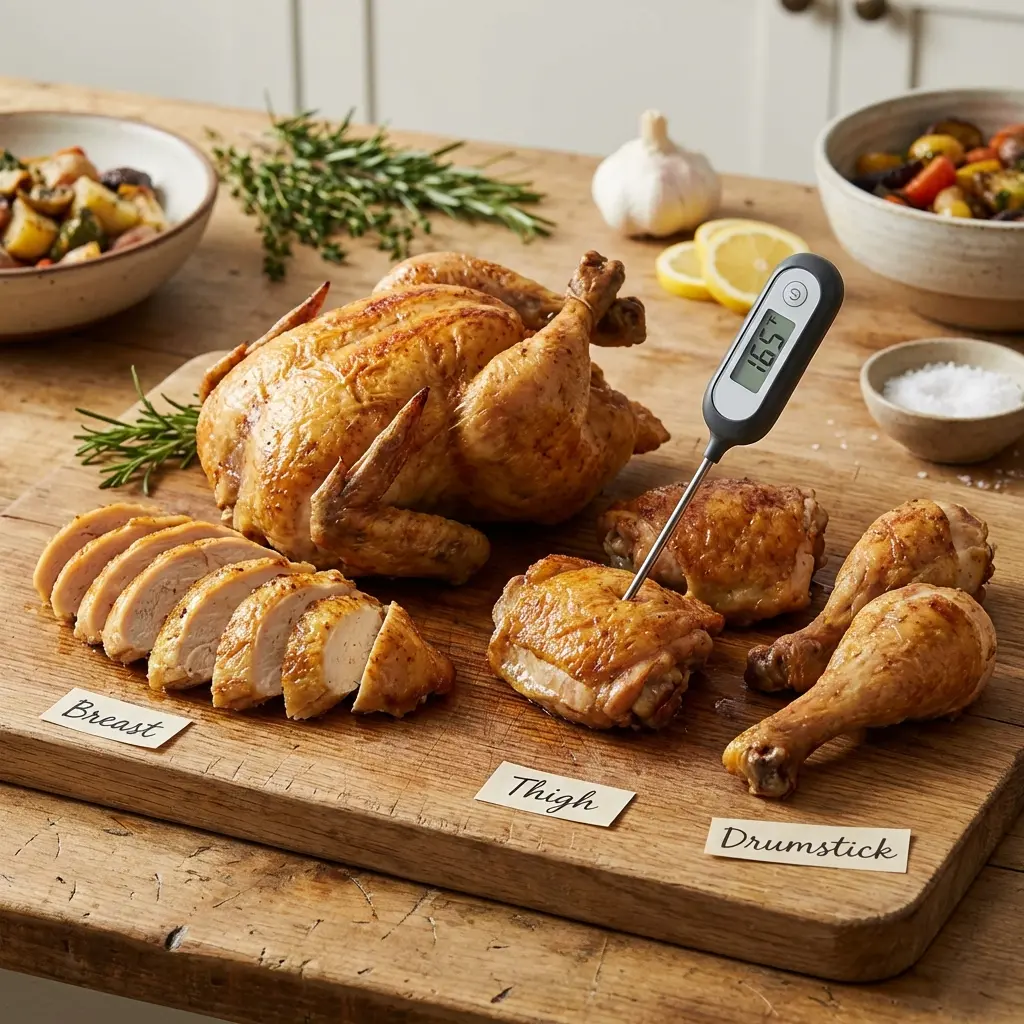
Quick Answer
Chicken breasts: pull at 160°F71°C, rest 5 min (reaches 165°F74°C safely). Thighs and drumsticks: cook to 175–180°F79–82°C for best texture. Wings: 175–185°F79–85°C for crispy skin. All poultry must reach 165°F74°C per USDA.
Chicken is done when the thickest part reads 165°F74°C — the USDA safe minimum for all poultry. That's the number to remember, but not always the number to pull at: breasts come off the heat at 160°F71°C and finish at 165°F74°C while resting, and thighs and drumsticks taste best at 175°F79°C–180°F82°C.
160 or 165 for chicken? Both, at different moments. Pull a breast at 160°F71°C and carryover heat takes it to 165°F74°C during a 5-minute rest. Cook it to 165°F74°C before pulling and it ends up near 170°F77°C — safe, but dry.
The Golden Safety Standard: 165°F74°C
Let's start with the non-negotiable science. The USDA Food Safety and Inspection Service recommends cooking all poultry to an internal temperature of 165°F74°C.
Why this number? At 165°F74°C, bacteria such as Salmonella and Campylobacter—the primary pathogens in raw poultry—are destroyed almost instantly (in less than 10 seconds). It is the "instant kill" temperature. This is the critical threshold that keeps food out of the temperature danger zone.
However, safety is a function of both temperature and time. You can actually kill pathogens at lower temperatures if you hold the meat there for longer (pasteurization), but for home cooks using standard methods, hitting 165°F74°C is the safest, most foolproof advice.
The Two Types of Chicken Meat
To cook chicken perfectly, you must treat the breast and the thigh as two completely different ingredients. They have different muscle structures, different fat contents, and different ideal temperatures.
1. Chicken Breast (White Meat)
The breast is lean muscle with very little connective tissue. For detailed guidance on this specific cut, see our complete chicken breast temperature guide.
- The Challenge: It dries out instantly. At 150°F66°C, moisture loss begins to accelerate. By 170°F77°C, the muscle fibers contract tightly, squeezing out almost all the juice.
- The Target: You want the breast to reach exactly 165°F74°C—but not a degree over.
- The Chef's Trick: Pull the chicken breast off the heat when it reaches 160°F71°C. Tent it with foil and let it rest. The residual heat will carry the temperature up to 165°F74°C while the juices redistribute. Learn more about this technique in our carryover cooking guide.
If you leave a chicken breast in the oven until it reads 165°F74°C, it will rise to 170°F77°C or 172°F78°C while resting, resulting in dry meat. Carryover cooking is real.
2. Chicken Thighs & Legs (Dark Meat)
Dark meat is a working muscle. It is loaded with connective tissue (collagen) and fat. For specific thigh guidance, check our chicken thigh temperature guide.
- The Challenge: While dark meat is safe to eat at 165°F74°C, the texture can be rubbery and tough because the collagen hasn't dissolved yet. Also, the blood vessels near the bone might still look frighteningly crimson.
- The Target: Dark meat enters its prime between 175°F79°C and 180°F82°C.
- The Result: At these higher temperatures, the collagen melts into gelatin, basting the meat from the inside. The meat becomes "fall-off-the-bone" tender. Unlike breast meat, thighs are forgiving; you can accidentally take them to 185°F85°C and they will still be delicious.
Cooking a Whole Chicken
Roasting a whole bird presents a dilemma: How do you cook the legs to 175°F79°C without drying the breast out at 165°F74°C? For detailed whole bird guidance, see our whole chicken temperature guide.
Strategies for Success:
- Trussing: Tying the legs close to the body protects the breast slightly.
- Positioning: Point the legs toward the back of the oven (usually the hottest part).
- The Probe Spot: Where do you measure? Insert the thermometer into the thickest part of the thigh, avoiding the bone. For proper technique, see our thermometer placement guide. Because the thigh takes longer to cook, if the thigh is safe, the breast is definitely safe (and possibly overcooked, which is the trade-off with whole birds).
How to Probe a Whole Chicken:
- Find the hip joint where the leg attaches to the body.
- Insert the probe into the meaty part of the thigh.
- Push through past the center and slowly pull back to find the lowest reading.
- Ensure you do not hit the thigh bone or the darker, hollow cavity.
The "Pink Chicken" Myth
Can cooked chicken be pink?
Yes. The USDA confirms that fully cooked poultry can sometimes show a pinkish tinge in the meat and juices. This comes from hemoglobin in the tissues, which can form a heat-stable pink color. Smoked chicken, in particular, often has a permanent "smoke ring" of pink meat just under the skin.
Do not trust your eyes.
- If the thermometer says 165°F74°C, it is safe, even if it looks slightly pink.
- If the juices run clear but the temp is 150°F66°C, it is NOT safe.
Visual cues are dangerous. Thermometers are definitive. Learn how to use a meat thermometer correctly to ensure accurate readings every time.
Detailed Chicken Temperature Chart
| Cut of Chicken | Pull Temp | Final Rested Temp | Texture Qualities |
|---|---|---|---|
| Breast (Boneless/Bone-In) | 160°F71°C | 165°F74°C | Juicy, tender, strict safety minimum |
| Thighs (Dark Meat) | 170°F77°C | 175°F79°C | Tender, collagen begins to melt |
| Drumsticks / Legs | 175°F79°C | 180°F82°C | Fall-off-the-bone, non-rubbery |
| Wings | 170°F77°C | 175°F79°C | Crispy skin, meat pulls from bone |
| Ground Chicken | 165°F74°C | 165°F74°C | Must be fully cooked immediately |
| Stuffing (Inside Bird) | 165°F74°C | 165°F74°C | Only safe when center reaches temp |
Cooking stuffing inside a bird is traditional but risky. By the time the stuffing in the center reaches 165°F74°C, the breast meat is often at 185°F85°C and hopelessly dry. We recommend cooking stuffing in a separate casserole dish for safety and quality.
What Oven Temperature to Cook Chicken
The internal temperature tells you when chicken is done; the oven temperature decides how long it takes and how crisp the skin gets. Start checking a few minutes before the low end of each range.
| Cut | Oven Temp | Approx. Time | Done At |
|---|---|---|---|
| Boneless breast | 425°F218°C | 18–22 min | Pull 160°F71°C, rest to 165°F74°C |
| Bone-in, skin-on breast | 425°F218°C | 30–35 min | Pull 160°F71°C, rest to 165°F74°C |
| Bone-in thighs | 400°F204°C | 35–45 min | 175°F79°C |
| Drumsticks | 425°F218°C | 35–45 min | 175°F79°C–180°F82°C |
| Wings | 425°F218°C | 40–50 min | 175°F79°C+ |
| Whole chicken (4–5 lb) | 425°F218°C | 15–17 min per lb | 165°F74°C breast, 175°F79°C thigh |
More detail in our guides to baked chicken breast, baked chicken thighs, and air fryer chicken.
Common Cooking Methods & Temperature Tips
Grilling
Grilling uses high direct heat, which can burn the outside before the inside reaches 165°F74°C.
- Tip: Sear the chicken over high heat for color, then move it to the "cool side" of the grill (indirect heat) to finish bringing the internal temp up slowly. This prevents the char-on-the-outside, raw-on-the-inside disaster.
Frying
When frying chicken, the oil temperature matters too. Keep oil around 350°F177°C. If the oil is too hot, the breading burns; too cool, and the chicken absorbs grease.
- Probe Tip: Measuring a fried drumstick is tricky. Puncture the crust gently so you don't crack the beautiful coating, and aim deep for the bone.
Sous Vide
Sous vide allows you to pasteurize chicken at lower temps. You can safely cook a chicken breast at 140°F60°C if the center is held at that temperature for about 35 minutes (per USDA time-temperature tables). The texture is incredibly soft—almost buttery. However, for traditional roasting/baking, stick to 165°F74°C.
Frequently Asked Questions (FAQ)
Q: Why is my chicken rubbery?
A: If it is breast meat, you likely overcooked it way past 165°F74°C, causing the proteins to seize up. If it is dark meat, you likely undercooked it (pulled it at 165°F74°C instead of 175°F79°C), so the connective tissue is still tough.
Q: Is it better to cook chicken fast or slow?
A: Low and slow generally yields more tender results and gives you a wider window to hit the perfect temperature. High heat (like broiling) gives crispy skin but requires split-second timing to avoid overcooking.
Q: Can I eat chicken at 160°F71°C?
A: Technically, yes, if it stays at 160°F71°C for about 14 seconds. Since resting usually keeps it hot for minutes, pulling at 160°F71°C and resting is a safe strategy, consistent with USDA time-temperature guidance, for home cooks who understand carryover cooking.
Q: How do I measure thin chicken cutlets?
A: Insert the thermometer probe horizontally through the side of the cutlet rather than from the top down. This ensures the entire sensor is covered by meat and not touching the unheated pan.
Q: What if I touch the bone with the thermometer?
A: Bones conduct heat. If you touch the bone, the reading might jump up by 10°F5°C degrees instantly, giving you a false sense of security. Pull the probe back slightly into the meat to get the true reading.