
Carryover Cooking: How Much Temp Does Meat Rise After Resting?
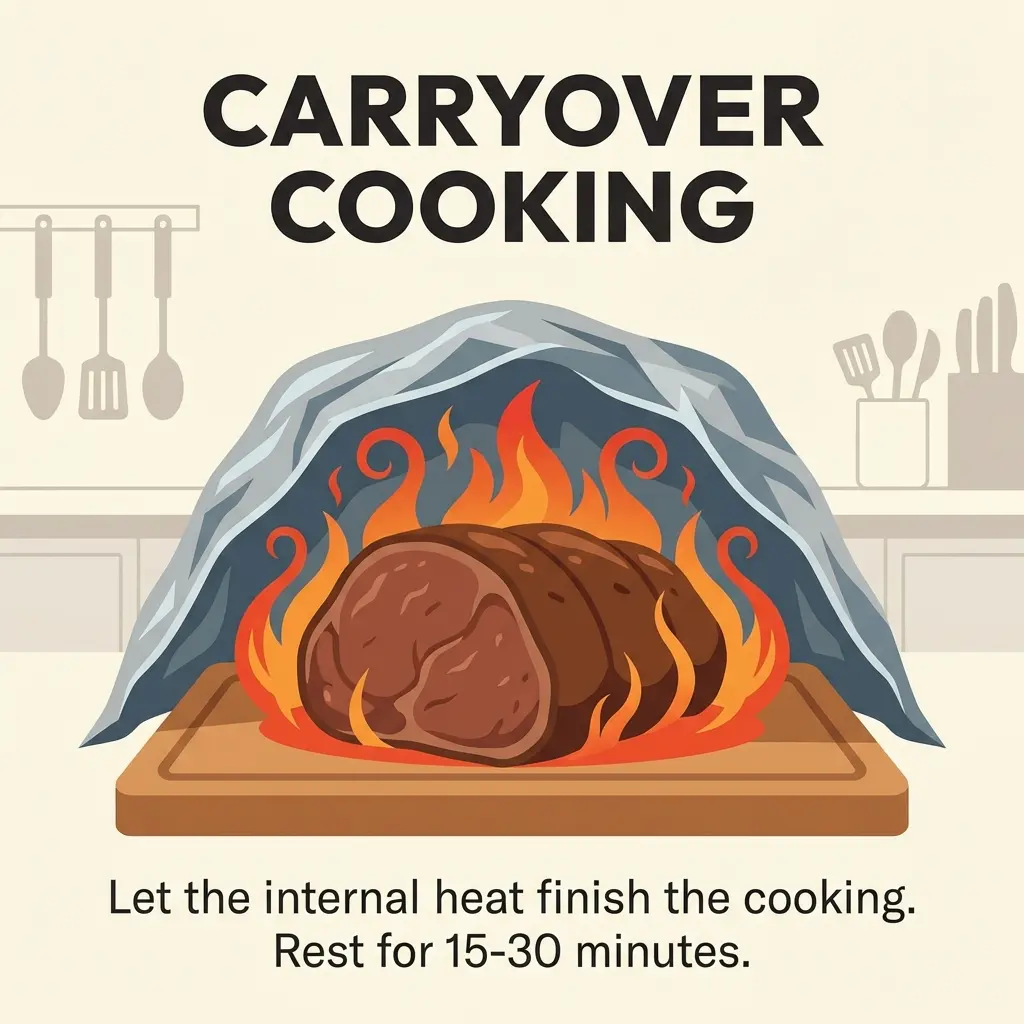
Quick Answer
Meat keeps cooking after leaving the heat: thin steaks rise about 5°F3°C, thick roasts 10–15°F6–8°C. Pull meat below your target — a 135°F57°C medium-rare steak comes off at 130°F54°C — and let resting finish the job.
Every recipe that says "remove from heat and rest for 5 minutes" is relying on carryover cooking. This isn't just about letting juices redistribute — it's a precise temperature management technique that determines whether your steak hits 135°F57°C or 140°F60°C from the same grill.
How Carryover Cooking Works
When meat cooks, the exterior reaches much higher temperatures than the interior. On a 500°F260°C grill surface, the outer edge of a steak can be 300°F149°C while the center is still 120°F49°C. When you remove the steak from heat, the temperature gradient causes heat to flow from the hot exterior toward the cooler center — the steak keeps cooking itself.
The physics: heat always flows from high temperature to low temperature until equilibrium is reached. The only way to stop carryover cooking is to immediately chill the exterior (ice bath for blanched vegetables, for example).
Carryover Temperature Rise by Cut
| Cut | Cooking Method | Pull Early By | Carryover Rise |
|---|---|---|---|
| Thin steak (0.75") | High-heat grill | 3–5°F-16–-15°C early | 3–5°F-16–-15°C |
| Standard steak (1") | Direct grill/pan | 5°F-15°C early | 5–8°F-15–-13°C |
| Thick steak (1.5"+) | Direct + rest | 8°F-13°C early | 8–10°F-13–-12°C |
| Pork chop (1") | Pan/grill | 5°F-15°C early | 5–8°F-15–-13°C |
| Chicken breast | Oven/air fryer | 5°F-15°C early | 5°F-15°C |
| Whole chicken (4lb) | Oven | 10°F-12°C early | 10–12°F-12–-11°C |
| Pork loin roast | Oven | 10°F-12°C early | 10–12°F-12–-11°C |
| Leg of lamb | Oven | 12°F-11°C early | 12–15°F-11–-9°C |
| Prime rib / beef roast | Oven | 10–15°F-12–-9°C early | 10–15°F-12–-9°C |
| Turkey (12lb) | Oven | 15°F-9°C early | 12–15°F-11–-9°C |
Practical Pull Temperatures
| Target Doneness | Target Final Temp | Pull At |
|---|---|---|
| Steak rare | 125°F52°C | 118–120°F48–49°C |
| Steak medium-rare | 135°F57°C | 128–130°F53–54°C |
| Steak medium | 145°F63°C | 138–140°F59–60°C |
| Chicken breast | 165°F74°C | 158–160°F70–71°C |
| Roast chicken | 165°F74°C breast | 150–155°F66–68°C |
| Pork chops | 145°F63°C | 138–140°F59–60°C |
| Turkey breast | 165°F74°C | 150–155°F66–68°C |
| Beef roast (medium-rare) | 135°F57°C | 120–125°F49–52°C |
Why Low-and-Slow Has Less Carryover
When cooking at 225°F107°C in a smoker, the temperature gradient between the exterior and interior is small — they're both closer together in temperature. A brisket in a 225°F107°C smoker may only rise 3–5°F-16–-15°C after being pulled, because the exterior was only slightly hotter than the interior.
Conversely, a steak on a 550°F288°C grill has an enormous gradient — the exterior can be 380°F193°C while the center is 120°F49°C — leading to significant carryover during rest.
The rest period also redistributes moisture. During cooking, muscle fibers contract from heat and squeeze juices toward the center. During rest, the fibers relax and reabsorb those juices. A steak cut immediately after grilling loses 30–40% of its moisture onto the cutting board. A rested steak loses almost nothing.
The Resting Environment Matters
- Loosely tented foil: Slows surface heat loss without steaming — ideal for steaks
- Cutting board: Room-temperature wood or plastic is fine for 5–10 minutes
- Cooler (for roasts): Wrap a large roast in foil then a towel and place in a cooler — it will hold at 140°F60°C+ for up to 2 hours, making it ideal for timed meals
- Wire rack: Allows airflow under the meat, preventing the bottom from steaming — good for crispy-skinned chicken
For more on resting times by cut, see our steak resting time guide and meat resting temperature guide.
Frequently Asked Questions
What is carryover cooking?
Carryover cooking is the phenomenon where food continues to rise in internal temperature after being removed from the heat source. The exterior of the meat is much hotter than the center during cooking — when you remove the heat, that exterior heat migrates inward, raising the center temperature by 5–15°F3–8°C depending on the size and thickness of the cut.
How many degrees does meat rise after resting?
Carryover temperature rise depends on cut size and cooking temperature: thin steaks (0.75 inch) rise 3–5°F-16–-15°C, standard steaks (1 inch) rise 5–8°F-15–-13°C, thick steaks (1.5+ inch) rise 8–10°F-13–-12°C, large roasts and whole chickens rise 10–15°F-12–-9°C, and large briskets or pork shoulders can rise 5°F-15°C even after long low-and-slow cooking.
When should I pull meat from heat for carryover cooking?
Pull meat from heat when it is 5°F-15°C below your target temperature for steaks, 10°F-12°C below for medium-sized roasts, and 15°F-9°C below for large roasts. Example: for medium-rare steak (target 135°F57°C), pull at 128–130°F53–54°C. For a roast chicken (target 165°F74°C), pull at 150–155°F66–68°C. Rest loosely tented with foil.
Does carryover cooking work in an air fryer?
Yes. Carryover cooking occurs regardless of the cooking method. Air fryer carryover is typically 3–7°F-16–-14°C for most cuts — slightly less than oven cooking because air fryers drop temperature faster when opened. The principle is the same: pull chicken at 158°F70°C, rest, and it will reach 165°F74°C.
Should I tent with foil during resting?
Loosely tent — do not wrap tightly. A loose foil tent slows heat loss without trapping steam. Tight wrapping creates a steam environment that softens the crust on steaks and makes chicken skin soggy. For large roasts, a tight wrap is acceptable because the crust isn't as critical as retaining moisture during a 20-minute rest.