
Freezer Temperature Log Template (Printable PDF)
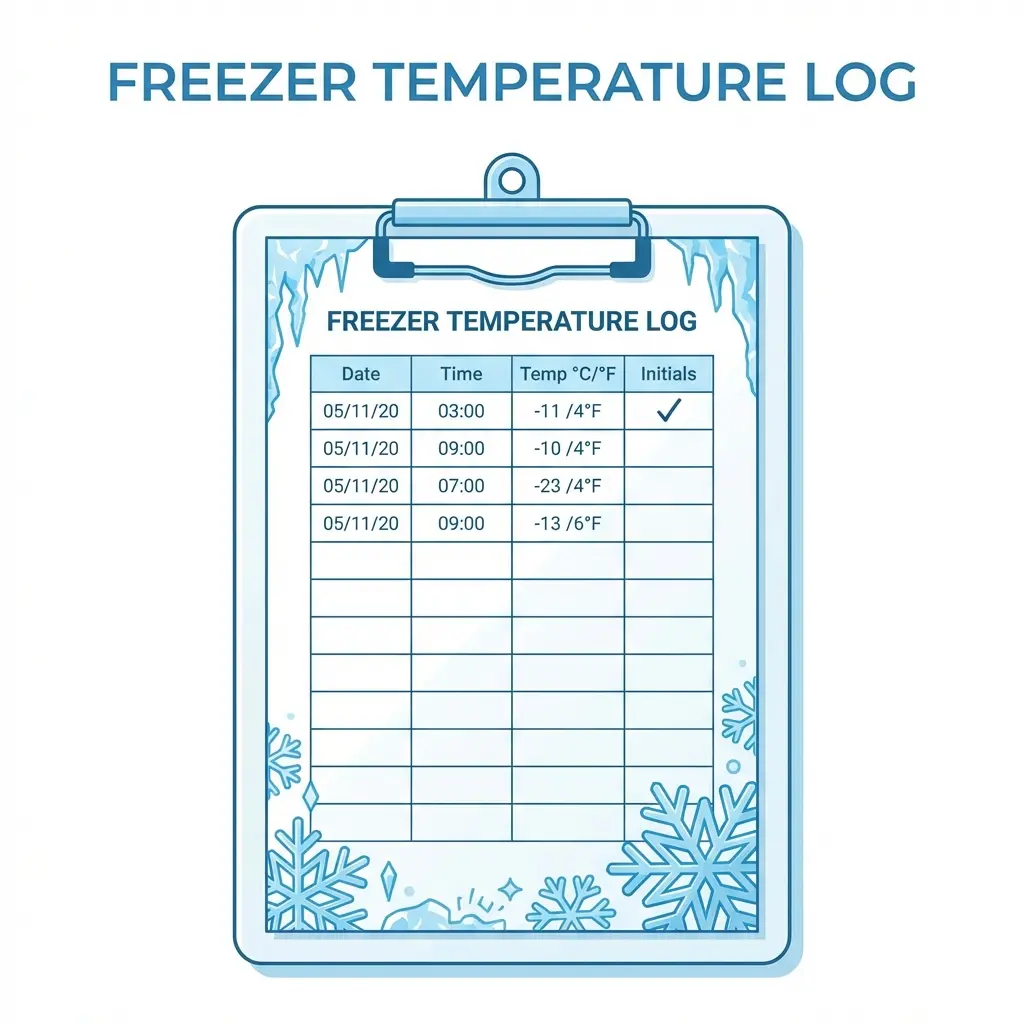
Freezers should maintain 0°F-18°C or below. Any warmer, and you risk food quality degradation. Above 5°F-15°C, and bacterial issues may begin upon thawing.
How to Use
- Check Daily: At least once per day.
- Log the Temps: Record Date, Time, Freezer ID, Temperature, and Initials.
- Corrective Action: If temp is above 0°F-18°C, log the action taken.
The Template
| Date | Time | Freezer ID | Temperature | Initials | Corrective Action |
|---|---|---|---|---|---|
| 01/15/26 | 8:00 AM | Freezer #1 | -5°F-21°C | JB | N/A |
| 01/16/26 | 8:00 AM | Freezer #1 | 8°F-13°C | JB | Gasket not sealing. Called maintenance. |
Target and Alert Thresholds
| Status | Temperature |
|---|---|
| Optimal | -5°F-21°C to 0°F-18°C |
| Acceptable | Up to 5°F-15°C |
| WARNING | Above 5°F-15°C – Check door seal, airflow, thermostat. |
Frequently Asked Questions (FAQ)
Q: Is ice buildup bad?
A: Yes. Excessive frost means moisture is entering (bad door seal) or the defrost cycle is broken. It also reduces efficiency.
Q: How long do logs need to be kept?
A: Typically 1 year for HACCP compliance. Check your local health department for specific requirements.
Why Freezer Temperature Logging Is Critical
A freezer may appear to be functioning normally while operating above the 0°F-18°C standard. At 15°F-9°C, most food remains frozen but quality degrades significantly faster — freezer burn accelerates, fats oxidize (rancidity), and protein texture degrades. More critically, if power failures or door seal failures push the freezer above 32°F0°C, the thaw event must be documented.
Legal requirements: Food service establishments typically must document freezer temperatures under HACCP plans. Health inspectors review these logs and can issue violations for missing or inadequate documentation.
Monthly and Seasonal Concerns
Summer: Hot kitchens put more load on freezer compressors. Freezers near heat-generating equipment (fryers, ovens) must work harder. Log more frequently in summer months.
Defrost cycles: Frost-free freezers run automatic defrost cycles that briefly raise internal temperature. Your log may show brief spikes of 5–10°F-15–-12°C during cycles — this is normal. Log the reading when the cycle ends, not during it.
After large restocking: Adding a large volume of room-temperature product can temporarily raise the freezer temperature by 5–15°F-15–-9°C. Log before restocking and check again 2 hours after to confirm recovery.
Reading Your Log for Trends
| Pattern | Likely Cause | Action |
|---|---|---|
| Gradual rise over weeks | Dirty condenser coils, aging compressor | Service the unit |
| Daily spikes from baseline | Defrost cycle or door being held open | Check door protocol |
| Consistent running 5–8°F-15–-13°C high | Thermostat calibration drift | Adjust thermostat |
| Spike during known power outage | Power event | Assess per power outage protocol |
| Random spikes | Door seal failing | Replace gasket, test by paper test |
The 48/24-Hour Rule for Freezer Power Outages
Per USDA guidelines:
- Full freezer: Stays safe for 48 hours (door closed)
- Half-full freezer: Stays safe for 24 hours (door closed)
Log the start time of the outage, the end time, and the temperature reading when power returns. If food still has ice crystals and the reading is 40°F4°C or below, it can be refrozen. If it fully thawed and reached above 40°F4°C, discard perishable raw proteins.
For complete freezer management, see our freezer temperature guide and power outage food safety guide.