
Power Outage Food Safety: Fridge & Freezer 4-Hour & 48-Hour Rules
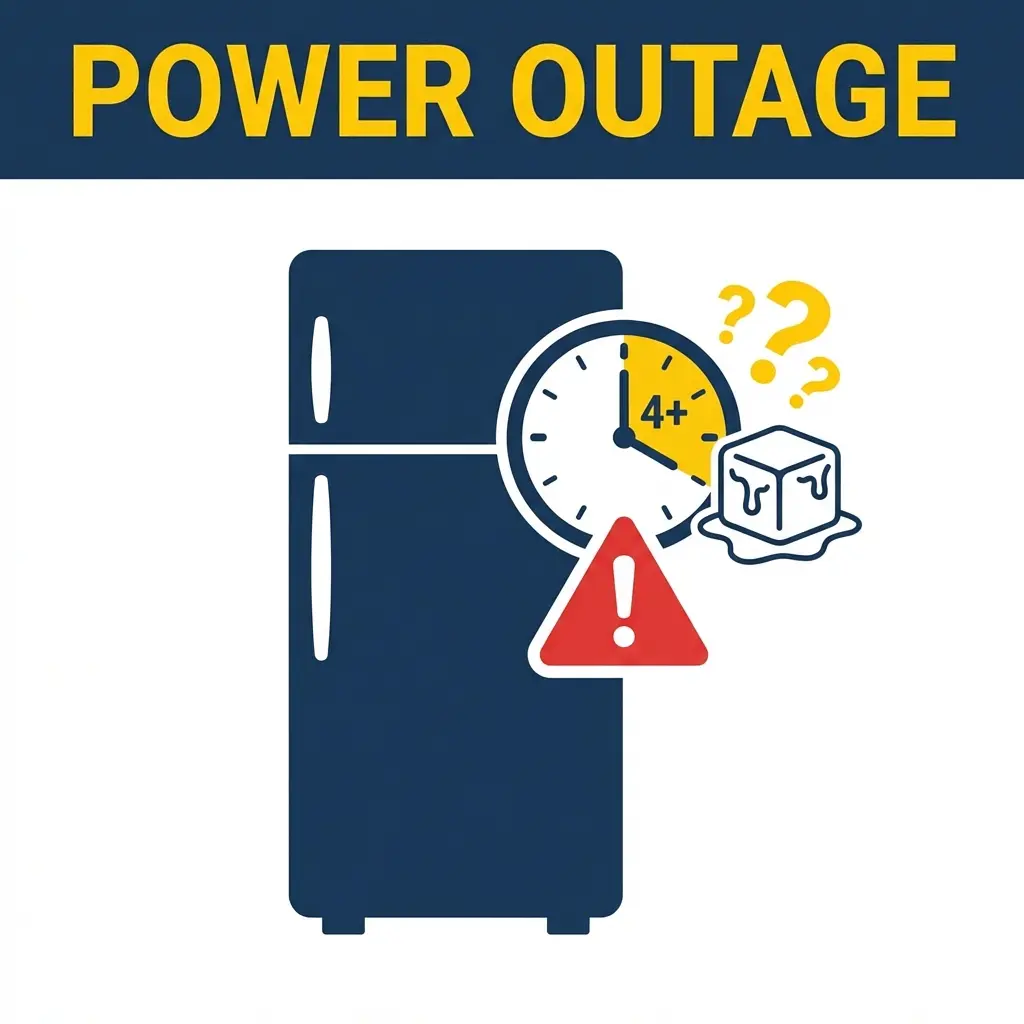
A power outage doesn't immediately mean a refrigerator full of wasted food — but the clock starts ticking immediately. The USDA has clear guidelines on timing, and understanding them helps you make accurate decisions about what's safe and what must be discarded.
The Core Rules
| Appliance | Door Closed | Door Occasionally Opened |
|---|---|---|
| Refrigerator | Safe 4 hours | Safe 1–2 hours |
| Full Freezer | Safe 48 hours | Safe 24–36 hours |
| Half-Full Freezer | Safe 24 hours | Safe 12–16 hours |
The critical variable is keeping the door closed. Every time you open the refrigerator during an outage, cold air spills out and warm room air enters. A refrigerator opened 3–4 times per hour will reach unsafe temperatures within 1–2 hours.
What Happens Inside During an Outage
Your refrigerator runs at 35–40°F2–4°C. When power fails, the internal temperature begins rising toward room temperature (~70°F21°C). The rate depends on:
- How full it is — food mass retains cold better than empty air
- Ambient room temperature — summer outages are more dangerous than winter
- Insulation quality — newer, better-insulated fridges hold temperature longer
Once internal temperature exceeds 40°F4°C, perishable food enters the bacterial danger zone where bacteria double every 20 minutes.
Keep vs. Discard: Decision Guide
🔴 Discard After 2 Hours Above 40°F4°C
- Raw or cooked meat, poultry, and seafood
- Milk, cream, yogurt, and soft cheeses
- Cooked pasta, rice, and potatoes
- Scrambled eggs and egg-based dishes
- Opened mayonnaise and salad dressings
- Cream pies, custard desserts
- Cut fruits and vegetables
🟢 Generally Safe to Keep
- Hard and processed cheeses (Cheddar, Parmesan, Swiss)
- Butter and margarine
- Whole fruits and vegetables (uncut)
- Fruit juice
- Bread, rolls, and baked goods (no custard)
- Jams, jellies, and peanut butter
- Vinegar-based condiments (ketchup, mustard, relish)
- Commercially packaged fruit juices
When in doubt, throw it out. Food poisoning from Salmonella, E. coli, or Listeria can cause severe illness requiring hospitalization. The cost of replacing perishable food is far less than medical treatment. Never taste food to determine safety — dangerous bacteria produce no detectable taste, smell, or appearance.
Preparing Before an Outage
If a storm or planned outage is anticipated:
- Set fridge to coldest setting — start from a lower temperature so you have more buffer
- Fill water bottles and place in the freezer — they freeze into ice packs that keep the temperature lower longer
- Get dry ice — 25 lbs of dry ice keeps a 10 cubic foot freezer at 0°F-18°C for 2–3 days
- Keep an appliance thermometer in both the fridge and freezer — you need objective data when power returns, not guesswork
When Power Returns: How to Assess What to Keep
Use a refrigerator thermometer placed inside (not digital readout on the door — that may be inaccurate after the disruption):
- 40°F4°C or below: Food is safe — you were within the 4-hour window
- Above 40°F4°C for less than 2 hours: Most non-perishables safe; rely on the Keep/Discard list above
- Above 40°F4°C for more than 2 hours: Discard all perishables listed above
- Freezer food has ice crystals: Safe to refreeze (quality may suffer slightly)
- Freezer food fully thawed, at room temp: Discard raw meat/poultry/seafood; cook other thawed food immediately
For more on safe food temperature zones, see our food temperature danger zone guide.
Frequently Asked Questions
How long does a refrigerator stay cold during a power outage?
A refrigerator will keep food safe for up to 4 hours during a power outage, provided the door remains closed. After 4 hours, the internal temperature will rise above 40°F4°C and perishable food enters the danger zone. Open the door only when absolutely necessary — each opening shortens the safe window.
How long does a freezer stay frozen during a power outage?
A full freezer will stay frozen for approximately 48 hours during a power outage with the door kept closed. A half-full freezer lasts about 24 hours. Food with ice crystals remaining or that is 40°F4°C and below when power is restored is safe to refreeze or consume. Food that has fully thawed and reached room temperature should be discarded.
What food should I throw out after a power outage?
Discard these perishables if they were above 40°F4°C for more than 2 hours: raw or cooked meat/poultry/seafood, milk, eggs, soft cheeses, yogurt, opened mayonnaise, cooked pasta/rice, cut fruits and vegetables, and any food with unusual smell or texture. Keep: hard cheeses, raw vegetables, fruit juices, bread, and commercially shelf-stable items.
Is it safe to refreeze food after a power outage?
Food that still contains ice crystals or is at 40°F4°C or below when the freezer power is restored is safe to refreeze. Some quality loss (texture, flavor) may occur from partial thawing and refreezing, but it remains safe. Never refreeze food that has been completely thawed or reached room temperature.
How can I stay safe during a long power outage?
Keep the refrigerator and freezer closed as much as possible. Buy bags of ice or dry ice to place in the refrigerator and freezer — dry ice maintains 0°F-18°C in a full 18 cu. ft. freezer for 2–3 days. Fill empty freezer space with water bottles or ice packs before an anticipated outage. Use a refrigerator thermometer to accurately monitor temperature when power returns.