
Chicken Breast Temperature: Pull at 160°F71°C, Not 165°F74°C (Here's Why)
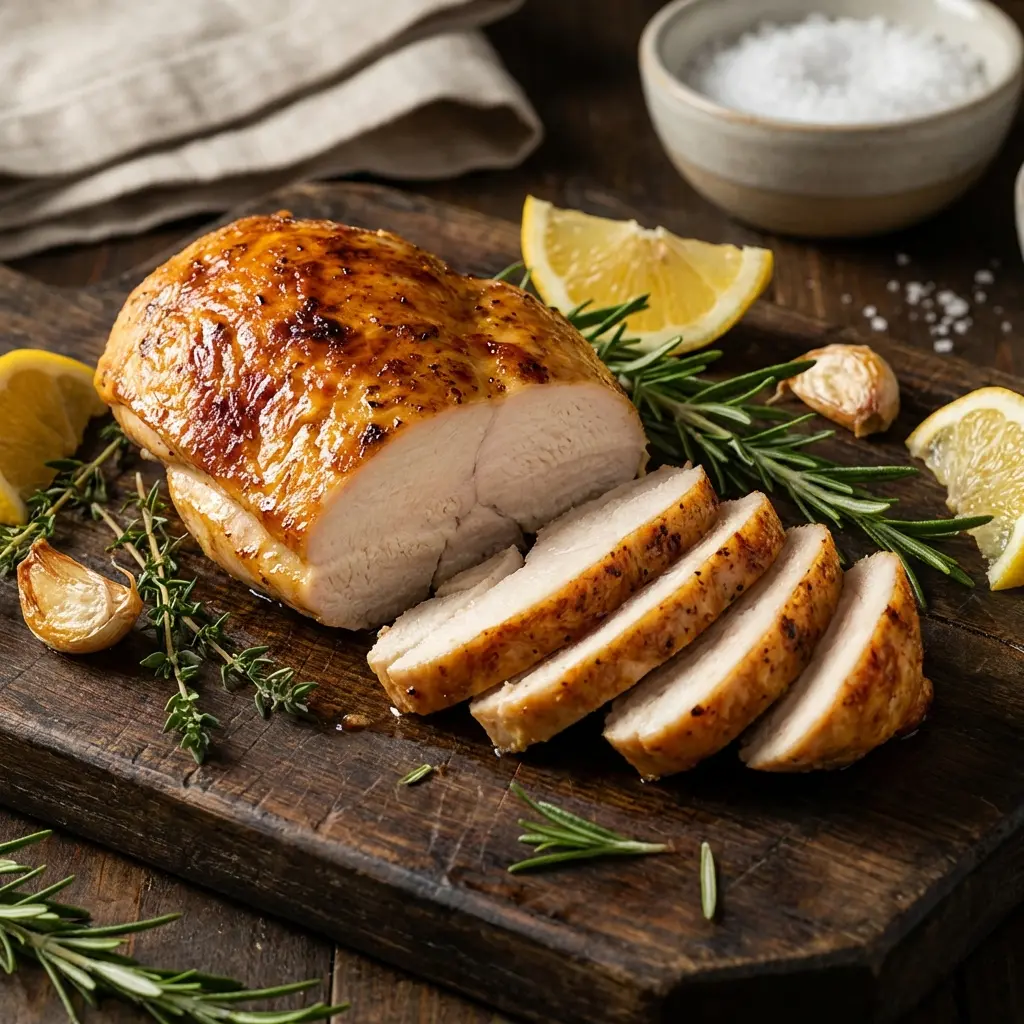
The boneless, skinless chicken breast is the most popular cut of meat in the Western world. It is also the most abused. Because it has almost zero fat protection, the window of perfection is incredibly small.
Cook it to 155°F68°C, and it might be safe if held there, but most people fear the pink. Cook it to 165°F74°C, and it is technically perfect. Cook it to 170°F77°C, and it becomes stringy and chalky.
That is a 5°F3°C degree margin of error.
In this dedicated guide to white meat perfection, we explore the precise temperature targets, physical preparation techniques, and the controversial "Woody Breast" syndrome affecting modern poultry.
The USDA vs. The Chef's Standard
The Official Rule: The USDA FSIS recommends cooking chicken breast to 165°F74°C instantaneous internal temperature.
The Culinary Reality: If you pull a chicken breast out of the oven at 165°F74°C, the residual heat will push it to 170°F77°C or 172°F78°C while you set the table due to carryover cooking. The result is dry meat.
The "Pull and Rest" Technique
To stay safe and juicy, we use the principle of thermal inertia.
- Target: Stop cooking at 160°F71°C.
- Action: Remove from heat immediately. Tent loosely with foil.
- Wait: Let it rest for 5 minutes.
- Result: The temperature continues to rise to 165°F74°C (killing the bacteria) and then stabilizes, leaving the juices locked in the fibers.
Safety Caveat: If you pull at 160°F71°C, you MUST let it rest. If you cut into it immediately at 160°F71°C, you have not allowed the "kill time" for bacteria (which takes about 14 seconds at that temp) to accumulate effectively, nor has it reached the instant-kill threshold of 165°F74°C. The rest is part of the cooking process.
Preparation: The Secret to Even Cooking
A chicken breast is naturally uneven. It is 1.5 inches thick at one end and 0.2 inches thick at the tail. By the time the thick end reaches 165°F74°C, the tail is basically jerky.
Solution: Pounding Standardizing the shape is as important as the temperature.
- Place the breast between two sheets of plastic wrap.
- Use a meat mallet (or a heavy pan) to gently pound the thick end.
- Aim for an even 3/4-inch thickness across the whole cut.
- Result: The entire piece reaches 165°F74°C at the exact same moment.
Woody Breast Syndrome
Have you ever cooked a chicken breast perfectly to 165°F74°C, only to bite into it and find the texture crunchy, hard, or rubbery?
This is called Woody Breast Syndrome. It is not a cooking error. It is a muscle abnormality in modern, fast-growing broiler chickens. The muscle fibers become stiff and woody.
How to spot it:
- Look for white striping on the raw meat.
- The raw breast feels hard to the touch, not pliable.
The Fix: Temperature cannot fix woody breast. However, physical intervention can help.
- Brining: Soaking in salt water breaks down some proteins.
- Slicing: Cut the breast against the grain into thin strips for stir-fry instead of roasting it whole.
- Slow Cooking: Braising can sometimes soften the fibers, though white meat generally doesn't braise well.
Cooking Methods & Temps
1. Oven roasting (The Classic)
- Temp: Bake at 400°F204°C or 425°F218°C.
- Why High Heat? High heat cooks the chicken faster (15-18 mins), meaning less time for the juices to evaporate. Low heat (350°F177°C) takes longer, drying the meat out slowly.
- Pull Temp: 160°F71°C.
2. Pan Searing
- Method: 6 minutes on one side, flip, 4 minutes on the other.
- Risk: Burning the outside before the center is done.
- Fix: Pound the chicken thin!
3. Poaching
- Method: Simmer in water/broth at 170°F77°C–180°F82°C.
- Result: The gentlest method. If you keep the water at 170°F77°C, it is physically impossible for the chicken to exceed 170°F77°C. This yields the softest texture for chicken salads.
How to Probe a Chicken Breast
- Angle: Do not go straight down from the top. You might poke through to the pan.
- Horizontal: Insert the probe horizontally through the thickest part of the breast.
- Depth: Ensure the tip is in the geometric center of the meat.
Frequently Asked Questions (FAQ)
Q: Why is my chicken breast dry even at 165°F74°C?
A: You might have purchased "air-chilled" chicken that had very little water content to begin with, or you didn't rest it. Also, check your thermometer calibration. If it reads 5°F3°C degrees low, you might actually be cooking to 170°F77°C.
Q: Is chicken breast done at 150°F66°C?
A: Not instantly. Pasteurized safety can be achieved at 150°F66°C if you hold the chicken at that temperature for 3 minutes. This is common in Sous Vide cooking. However, the texture at 150°F66°C is very soft and slightly jelly-like, which many people find unappetizing. 160°F71°C–165°F74°C provides the firm, white texture we expect.
Q: Can I cook frozen chicken breasts?
A: Yes. Bake at 350°F177°C for about 50% longer time (30-40 mins). Warning: They likely won't brown well because of the melting ice steam. Ensure internal temp reaches 165°F74°C.
Q: Color Check: Is white meat ever pink?
A: Rarely. Unlike dark meat, breast meat has very little myoglobin. It should be opaque and white. If it is translucent or glossy pink, it is likely undercooked.
Q: Dry Rub vs. Marinade for moisture?
A: Marinades (specifically salty ones) are better for moisture because the salt denatures proteins to hold water. Dry rubs are for flavor and crust. For the juiciest breast, use a Wet Brine (water + salt) for 30 minutes before cooking.