
How to Use a Meat Thermometer: Placement Guide for Every Cut
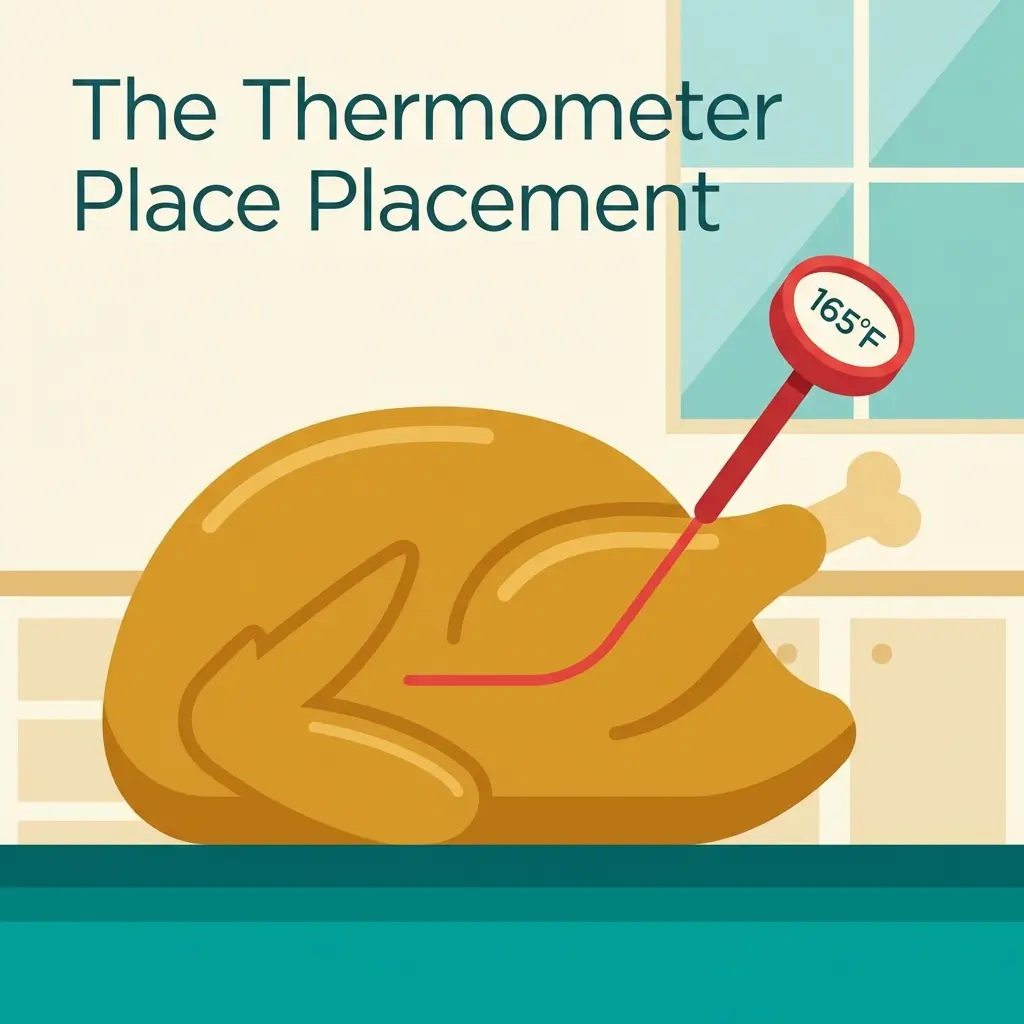
A meat thermometer is only as accurate as its placement. Even a premium instant-read thermometer gives wrong readings if inserted in the wrong position — near a bone, near fat, at an angle that misses the center, or too shallow to reach the coldest point.
The Three Placement Rules
- Thickest part — the center of the thickest section takes longest to heat. That's the last point to reach temperature and the one that determines doneness
- Away from bone — bone conducts heat 2–4x faster than meat. A probe near bone reads higher than the surrounding meat, giving a false "done" reading
- Away from fat — fat heats faster than protein. Probing through a thick fat cap gives an inflated reading
Cut-by-Cut Placement Guide
Chicken Breast (Boneless)
- Entry point: Through the thickest side, horizontally
- Depth: Until the probe tip reaches the center (usually 1–1.5 inches)
- Target: 165°F74°C
- Mistake to avoid: Entering from the top — the probe slides flat along the inside and misses the center
Chicken Breast (Bone-In)
- Entry point: Through the thick, meaty side
- Depth: Until 0.5 inch from the bone
- Target: 165°F74°C
- Note: Bone gives false high readings — keep the probe tip in muscle tissue
Chicken Thigh (Bone-In)
- Entry point: Into the thickest fleshy part, parallel to the bone, not touching it
- Target: 175°F79°C for best texture
- Why: The joint area stays coolest — probe the fattest meatiest section
Whole Chicken or Turkey
- Primary probe: Thickest part of the thigh (inner portion, near joint but not touching bone)
- Secondary probe: Deepest part of the breast (from the side)
- Both must reach: 165°F74°C — if one is below, continue cooking
- Target: The breast almost always finishes first
Steak
- Entry point: Through the side (edge) of the steak, horizontal to the cooking surface
- Depth: Until the tip is in the center of the steak, halfway between top and bottom
- Target: See steak doneness chart
- Mistake to avoid: Entering from the top — the probe may exit the far side into the pan
Thick Burger Patty (1"+)
- Entry point: Through the side edge of the burger
- Depth: Until the probe tip is in the center
- Target: 160°F71°C — always, no exceptions for ground beef
Pork Chop
- Entry point: Through the side, angled slightly toward the center
- Target: 145°F63°C with 3-minute rest
- Avoid: Near the bone on bone-in chops
Roast (Beef or Pork)
- Entry point: Into the geometric center of the thickest portion, from the side
- Depth: Until the probe tip is in the absolute center
- Target: Depends on desired doneness (beef) or 145°F63°C (pork)
Ground Meat Loaf or Casserole
- Entry point: Insert probe horizontally into the center from the shorter end
- Target: 160°F71°C
- Check multiple spots — dense loaves can have cool pockets
Fish Fillet
- Entry point: Through the thickest part at an angle
- Target: 145°F63°C or 125°F52°C for medium (chef's preference)
- Alternative: Fork-flake test — flesh separates into opaque flakes when done
Instant-Read vs. Leave-In Thermometer Placement
| Type | When to Insert | Remove When |
|---|---|---|
| Instant-read | Near the end of cooking, for spot checks | After each reading |
| Leave-in probe | Before cooking begins | After meat is plated and rested |
After each use with raw meat, clean your thermometer probe with hot soapy water or a sanitizing wipe before using it to check cooked food. A probe that touched raw chicken can contaminate otherwise safely cooked meat at 165°F74°C.
Calibrating Your Thermometer
Verify accuracy monthly with the ice water test: fill a glass with crushed ice and water, insert the probe, wait 30 seconds. It should read 32°F0°C. If not, adjust per the manufacturer's calibration instructions. An inaccurate thermometer is worse than no thermometer — it gives false confidence. See our full thermometer calibration guide.
Frequently Asked Questions
Where do you put a meat thermometer in a chicken breast?
Insert the thermometer through the thickest side of the chicken breast, aiming for the geometric center. Do not insert from the top — the probe may slide along the inside of the breast and exit without properly measuring the center. For bone-in breasts, ensure the probe tip is at least 0.5 inches away from the bone, which conducts heat faster than meat and gives falsely high readings.
Where do you put a meat thermometer in a whole chicken?
Insert the thermometer into the thickest part of the thigh without touching bone. The thigh is the last part of a whole chicken to reach temperature. Also check the breast — target 165°F74°C in both zones. If the thigh reads 165°F74°C but the breast is only 155°F68°C, continue cooking and check the breast separately.
How deep should a meat thermometer probe go?
The temperature sensing element of an instant-read thermometer is at the tip — insert the probe deep enough that the tip is in the center of the thickest part of the meat. For most cuts, this means inserting 1–2 inches deep. For thin burgers or chicken breasts, enter from the side so you can reach the center without the probe exiting the other side.
Where do you insert a thermometer in a burger?
For a burger patty, insert the thermometer horizontally through the edge of the patty to the center. Do not insert from the top — the tip will pass through the thin patty into the air gap below, giving you the temperature of the pan, not the meat. Enter sideways so the probe tip sits in the geometric center.
Should you put a thermometer in the oven while cooking?
Leave-in probe thermometers are designed for exactly this purpose. Insert the probe before placing the meat in the oven, route the cable through the door seal, and monitor the display outside the oven. This avoids repeatedly opening the oven door (which drops temperature 25–50°F-4–10°C each time) to check doneness. Instant-read thermometers are not designed for prolonged oven exposure.