
Hot Holding Temperature: 135°F57°C Minimum (FDA Food Code)
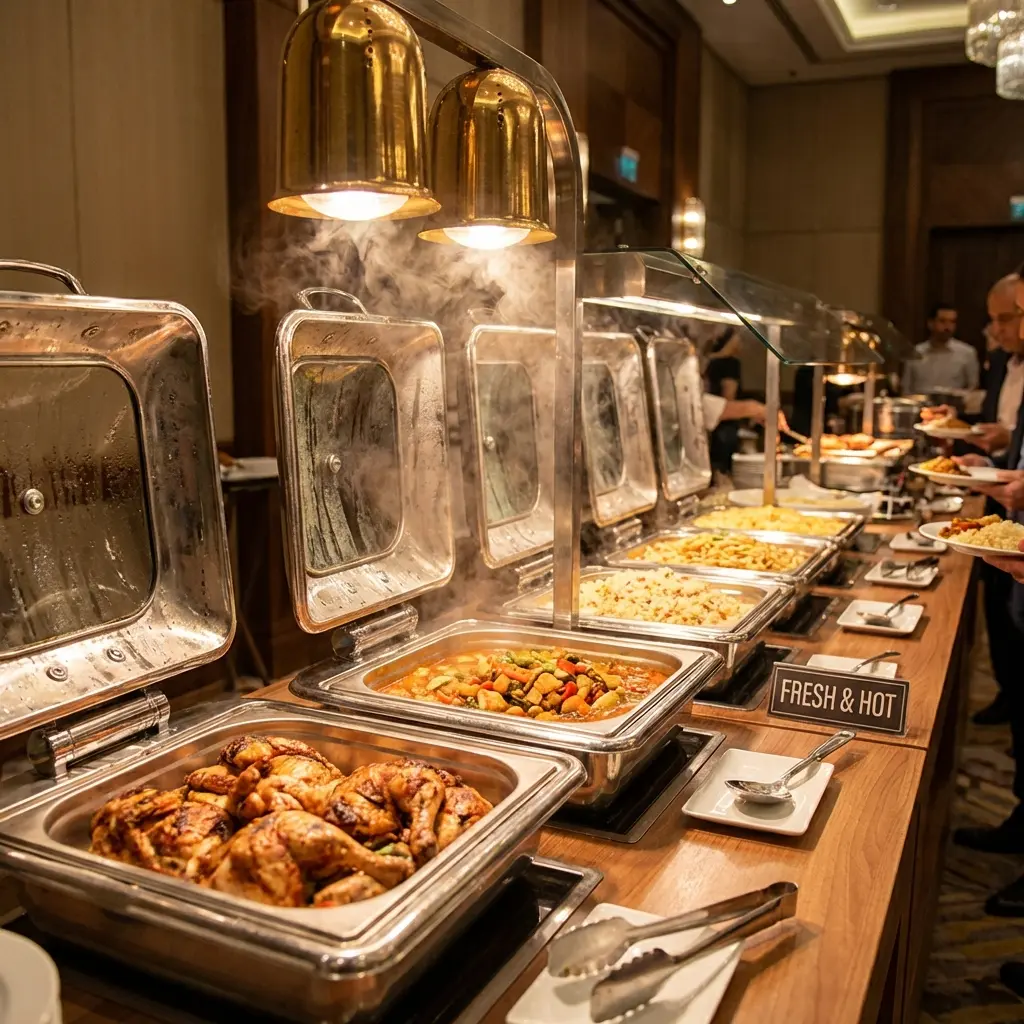
Quick Answer
Hot food must be held at 135°F57°C or above under the FDA Food Code — the standard for restaurants, buffets, and food handler exams. USDA consumer guidance uses 140°F60°C for home cooks. Food that drops below 135°F57°C must be reheated to 165°F74°C or discarded.
You cook the food safely. Then you put it on the table. Now the clock starts. Unless you keep it hot.
"Hot Holding" is the food safety term for keeping cooked food warm for service (buffets, potlucks, slow cookers). If the temperature drops, you enter the Danger Zone.
The Magic Number: 135°F57°C (or 140°F60°C)
The FDA Food Code states that hot food must be held at a minimum of 135°F57°C.
However, most health inspectors and restaurants aim for 140°F60°C as a safety buffer. If you set your warmer to 135°F57°C and a draft hits it, you might drop to 130°F54°C.
- Above 135°F57°C: Bacteria (like Clostridium perfringens) cannot multiply. They don't necessarily die, but they don't grow.
- Below 135°F57°C: Growth begins. The food is now on the "2-Hour Timer."
Food Handler Exam Quick Reference
These are the FDA Food Code numbers that food handler and ServSafe-style exams test:
| Question | Answer |
|---|---|
| Minimum hot holding temperature (steam table, buffet, carving station) | 135°F57°C |
| Reheating cooked-and-cooled food for hot holding | 165°F74°C for 15 seconds, within 2 hours |
| Hot-held casserole reads 146°F63°C — can it be served? | Yes — anything at or above 135°F57°C is in safe hot holding |
| Hot-held food reads 128°F53°C | Reheat to 165°F74°C if out of temperature under 2 hours; otherwise discard |
| How often to check hot-held food | At least every 2 hours |
| Minimum cold holding temperature | 41°F5°C or below |
Home cooks following USDA consumer guidance use 140°F60°C for hot food and 40°F4°C for cold — slightly stricter numbers, same principle.
Equipment for Hot Holding
1. Chafing Dishes (Sterno)
These use cans of gel fuel under a water pan.
- Risk: Wind can blow out the flame. The water can boil away.
- Protocol: Check water level every hour. Stir the food (heat rises, so the bottom burns while the top cools).
2. Slow Cookers (Crock Pots)
Excellent for home parties.
- Setting: "Warm" setting is usually designed to hold at 150°F66°C–160°F71°C. "Low" is 170°F77°C+.
- Tip: Keep the lid on! Taking the lid off drops the surface temp by 20°F10°C degrees instantly.
3. Warming Trays
Electric plates.
- Risk: They only heat the bottom layer. A pile of chicken wings might be 140°F60°C on the bottom and 110°F43°C on top. Do not pile food high.
How to Check
You cannot tell safe temperature by looking at steam. Use your instant-read thermometer.
- Check every 2 hours.
- If it is below 135°F57°C: Reheat immediately to 165°F74°C, then put back in warmer.
- If it has been below 135°F57°C for more than 4 hours: Discard.
Top 5 Hot Holding Mistakes
- Using the warmer to cook: Never put cold food in a slow cooker to warm it up for a party. It spends too long in the Danger Zone. Cook it on the stove first, then transfer.
- Missing water: Chafing dishes work by steam. No water = dry, burnt food that is cold on top.
- Overfilling: If you heap chilli above the rim of the pot, the top layer is room temp.
- No lids: Heat escapes rapidly. Keep covered.
- Adding fresh to old: Never pour a new batch of fresh soup into the half-empty pot of old soup. You contaminate the new batch. Use a new pan.
Frequently Asked Questions (FAQ)
Q: Can I keep food hot all day?
A: Safety-wise? Yes. Quality-wise? No. After 4–6 hours at 140°F60°C, vegetables turn to mush and meat dries out.
Q: What about pizza?
A: Dry holding (heat lamps) works for pizza. The target is still the same, but it's hard to measure crust temp. Pizza is usually managed by "Time Control" (throw away after 4 hours) rather than temp.
Q: Is 135°F57°C actually hot?
A: It is "mouth hot" (coffee is usually 160°F71°C). It is warm enough to be pleasant eating temperature.
More Questions
What is the minimum hot holding temperature?
The FDA Food Code requires hot-held food to stay at 135°F57°C or above — this is the answer for restaurants, steam tables, carving stations, and food handler exams. USDA consumer guidance uses 140°F60°C, and many kitchens target 140°F60°C as a safety buffer. Below 135°F57°C, Clostridium perfringens, Bacillus cereus, and other heat-tolerant bacteria can grow. Always check with a probe thermometer — steam or bubbling doesn't confirm the temperature throughout.
What equipment is used for hot holding food?
Hot holding equipment includes: steam tables and hot wells (commercial standard, uses steam to maintain 140–180°F60–82°C), chafing dishes with Sterno fuel (home catering and buffets, 160–180°F71–82°C), slow cookers set to 'Warm' (~165°F74°C), warming ovens (typically 160–170°F71–77°C), heat lamps (for plated food, maintains surface temp but not internal), and insulated hot food transport carriers for catering delivery.
How long can food be hot held?
From a safety standpoint, food held continuously at 135°F57°C or above can be kept for an extended period — bacteria are not actively growing. Quality is the limit: textures soften, flavors flatten, and delicate proteins overcook. Commercial operations typically discard hot-held food after 4–6 hours. Check the internal temperature of the food (not just the equipment) at least every 2 hours — checking every 2 hours leaves time to correct a problem before food has been out of temperature for 4 hours.
What if hot held food drops below 135°F57°C?
If hot-held food drops below 135°F57°C, reheat it to 165°F74°C for 15 seconds before returning it to hot holding — not just back to 135°F57°C. If you can't confirm how long it has been below 135°F57°C, or it has been out of temperature for 4 hours or more, discard it. Don't reheat in the steam table or chafing dish — that equipment is for holding, not reheating. Reheat on the stovetop or in the oven, verify with a thermometer, then return it to holding.
What foods require hot holding?
All cooked, perishable foods require hot holding when served at buffets, catering events, or from steam tables: cooked poultry and meat, cooked seafood, cooked vegetables and starches (rice, pasta, potatoes), soups and sauces, gravies, and casseroles. Foods that are shelf-stable at room temperature (bread, certain baked goods) do not require hot holding unless they contain fillings or components that are perishable.