
How Long Do Leftovers Last in the Fridge? Full USDA Storage Chart
Is My Food Still Safe?
Answer two or three questions for a straight answer based on USDA food safety rules.
It's at the end of its 3–4 days fridge life. Freezing it now stops the clock.
Assumes your fridge is at 40°F4°C or colder. When in doubt, throw it out.
We have all done it. You stare at a Tupperware container of mystery stew in the fridge. "Is this from Tuesday... or last Tuesday?"
Eating old leftovers is a game of Russian Roulette with your stomach. Here is the definitive guide to how long food really lasts in the fridge (at 40°F4°C or below).
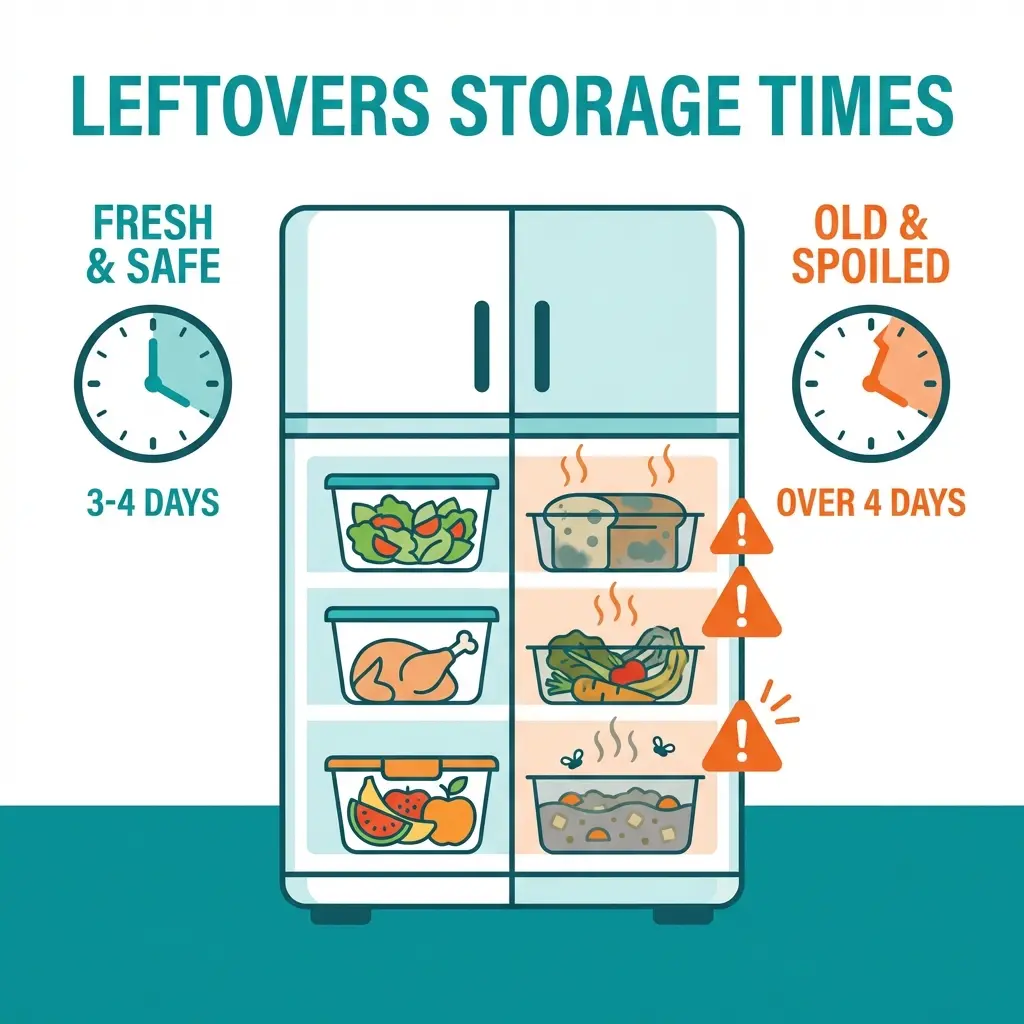
The Golden Rule: Leftovers generally last 3 to 4 days in the refrigerator. If you aren't going to eat it by day 4, freeze it immediately.
Common Leftovers Storage Chart
| Food Item | Fridge (40°F4°C) | Freezer (0°F-18°C) |
|---|---|---|
| Cooked Meat & Poultry | 3–4 Days | 2–6 Months |
| Pizza | 3–4 Days | 1–2 Months |
| Soups & Stews | 3–4 Days | 2–3 Months |
| Cooked Rice & Pasta | 3–5 Days | 1–2 Months |
| Luncheon Meat (Opened) | 3–5 Days | 1–2 Months |
| Hard Boiled Eggs | 1 Week | Don't Freeze |
| Mayonnaise-based Salads | 3–4 Days | Don't Freeze |
Why 3-4 Days?
Pathogens (bacteria that make you sick) and spoilage bacteria (bacteria that make food smell bad) work differently.
- Spoilage happens slowly. Food might look fine on Day 5.
- Pathogens like Listeria can grow at fridge temperatures. By Day 7, colonies can be large enough to cause illness, even if the food smells normal.
Signs of Spoilage
Trust your senses, but don't rely on them 100%. If it smells off, has slime, or shows mold, it is definitely bad. However, safely-looking food can still be unsafe if it is too old.
- Texture Check: Slime on lunch meat or ham is a sure sign of bacterial growth.
- Smell Test: "Funky," sour, or ammonia-like smells mean toss it.
- Mold: On soft foods (bread, meat, cooked pasta), if you see a speck of mold, the "roots" of the mold are likely throughout the food. Throw the whole thing away. (Hard cheese is the exception; you can cut 1 inch around the mold).
Maximizing Shelf Life
You can extend the quality (not necessarily the safety) of your food with proper storage techniques:
- Air is the Enemy: Oxygen promotes bacterial growth and breakdown. Use airtight containers.
- Top Shelf vs. Bottom Shelf: Store leftovers on the top shelf (usually warmer) or middle. Store raw meat on the bottom to prevent juices dripping.
- Date It: Keep a roll of masking tape and a sharpie in a drawer. Write "Mon" or "10/12" on the lid. Your future self will thank you.
Frequently Asked Questions (FAQ)
Q: Can I reheat leftovers more than once?
A: Technically yes, if you heat it to 165°F74°C each time. However, the quality degrades massively. It's better to scoop out only what you need and reheat that portion. See our reheating leftovers guide for proper technique.
Q: My fridge was at 45°F7°C for a day. Are my leftovers safe?
A: Likely not. If food sits above 40°F4°C for more than 2 hours, bacteria multiply. This is the temperature danger zone in action. If your fridge died or was left open, err on the side of caution.
Q: Does freezing reset the clock?
A: No! Freezing pauses the clock. If you freeze chicken on Day 3, when you thaw it, you have 1 day left to eat it, not a fresh 4 days.
Q: Why does rice go bad so fast?
A: Rice can harbor Bacillus cereus spores that survive cooking. If rice is left at room temp too long before cooling, these spores produce toxins that reheating can't destroy. Always refrigerate rice quickly! Learn more in our rice safety guide.
More Questions
How long do leftovers last in the fridge?
Most cooked leftovers last 3–4 days in the refrigerator at 40°F4°C or below, per USDA guidelines. Cooked chicken and turkey: 3–4 days. Cooked beef, pork, lamb: 3–4 days. Cooked fish and seafood: 3–4 days. Casseroles and mixed dishes: 3–4 days. Soups and stews: 3–4 days. Cooked pasta and rice: 3–5 days. After 4 days, freeze what you can't use.
When should you throw out leftovers?
Throw out leftovers that: (1) have been in the fridge for more than 4 days; (2) smell off, sour, or unusual; (3) show any visible mold (do not cut around it — mold roots extend deeper than the visible surface in soft foods); (4) were not refrigerated within 2 hours of cooking; (5) have a slimy or tacky texture on previously smooth surfaces. Never taste-test suspected leftovers — harmful bacteria produce no detectable odor or flavor at dangerous concentrations.
Can you freeze leftovers to extend their life?
Yes. Leftovers can be frozen to extend safety indefinitely (from a bacterial standpoint). Best quality is maintained within: cooked meat and poultry dishes 2–3 months, soups and stews 2–3 months, cooked rice and pasta 1–2 months, casseroles 2–3 months. Freeze in small portions (individual meal sizes) in airtight containers or heavy-duty zip-lock bags. Label with the freezing date.
Is it safe to eat leftovers after 5 days?
The USDA recommends consuming cooked leftovers within 3–4 days. After 5 days, the risk of foodborne illness from bacterial growth increases significantly, even at proper refrigerator temperature. Unlike spoilage bacteria (which cause visible or olfactory changes), pathogenic bacteria (Listeria monocytogenes) can grow to dangerous levels at 40°F4°C with no visible or smell changes. Follow the 3–4 day rule strictly.
What is the best way to store leftovers to maximize the 4-day window?
To maximize leftover safety and quality: (1) refrigerate within 2 hours of cooking (1 hour if ambient temperature is above 90°F32°C); (2) store in shallow airtight containers (max 2 inches depth for rapid cooling); (3) cool rapidly using an ice water bath before refrigerating hot items; (4) store on upper-middle shelves (consistent temperature), not the door; (5) label every container with the date of preparation.