
Fahrenheit to Celsius Chart & Formula (°F to °C)
Quick Answer
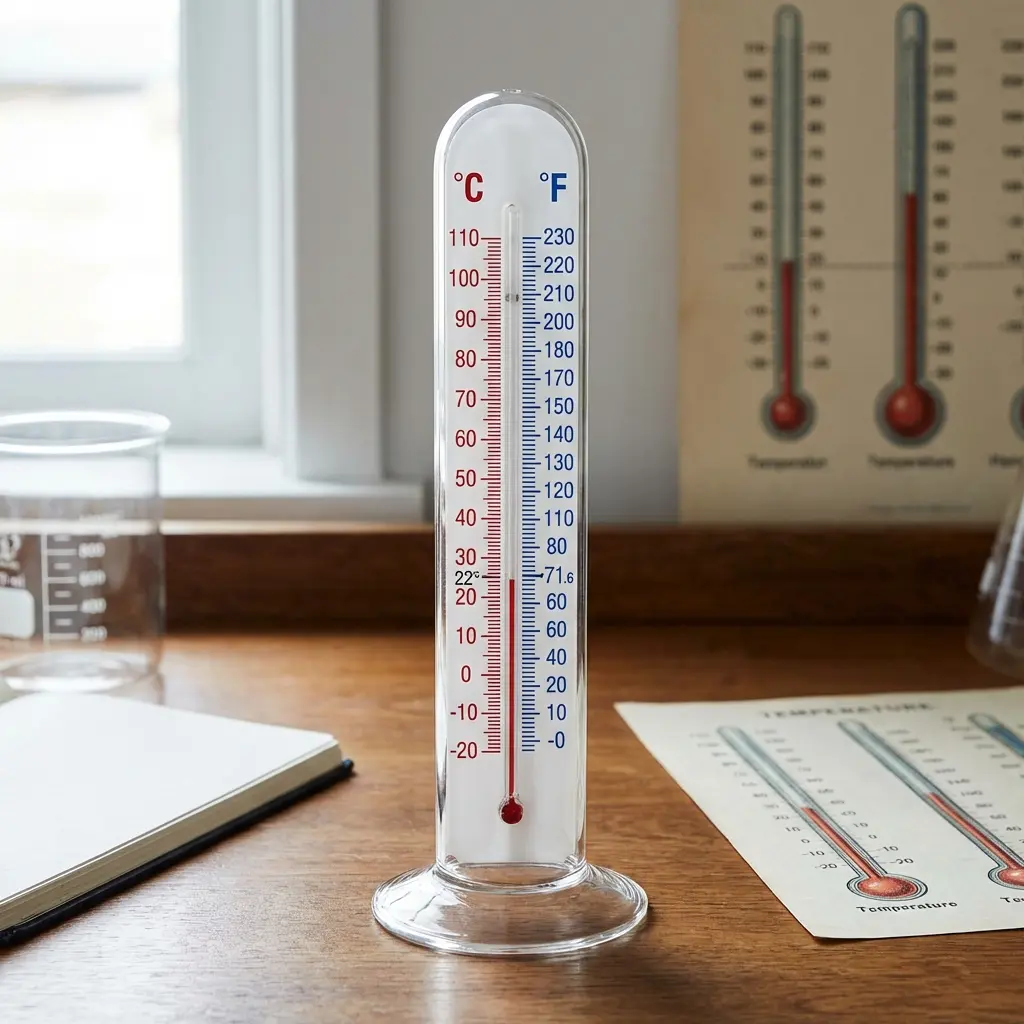
To convert Fahrenheit to Celsius, subtract 32, then multiply by 5/9 (or divide by 1.8): °C = (°F − 32) × 5/9. Examples: 0°F = -17.8°C, 32°F = 0°C, 70°F = 21.1°C, 350°F = 176.7°C.
To convert Fahrenheit to Celsius, subtract 32, then multiply by 5/9. The chart below covers everyday values from -50°F to 2000°F; the oven cheat sheet further down covers baking temperatures with gas marks. For the reverse conversion, see our Celsius to Fahrenheit guide.
Fahrenheit to Celsius Chart
| Fahrenheit (°F) | Celsius (°C) | Reference |
|---|---|---|
| -50°F | -45.6°C | Extreme cold |
| -40°F | -40°C | Where °F and °C meet |
| 0°F | -17.8°C | Freezer |
| 1°F | -17.2°C | |
| 32°F | 0°C | Water freezes |
| 50°F | 10°C | Cool day |
| 70°F | 21.1°C | Room temperature |
| 98.6°F | 37°C | Body temperature |
| 100°F | 37.8°C | Hot day |
| 110°F | 43.3°C | Extreme heat |
| 130°F | 54.4°C | Medium-rare steak |
| 150°F | 65.6°C | |
| 212°F | 100°C | Water boils |
| 350°F | 176.7°C | Standard baking |
| 450°F | 232.2°C | High-heat roasting |
| 500°F | 260°C | Broil / pizza |
| 1000°F | 537.8°C | Wood-fired oven |
| 1100°F | 593.3°C | |
| 1200°F | 648.9°C | Kiln / glass work |
| 1300°F | 704.4°C | |
| 2000°F | 1093.3°C | Pottery kiln |
The Formula
To convert Fahrenheit (°F) to Celsius (°C), the math is a bit more involved than the reverse because of the order of operations.
°C = (°F - 32) × 5/9
Or, dividing by 1.8: °C = (°F - 32) ÷ 1.8
The Critical Step: Subtract 32 First
You must subtract the 32 offset before doing the multiplication/division.
- Wrong: 100°F ÷ 1.8 - 32 = 23.5°C (Incorrect)
- Right: (100°F - 32) ÷ 1.8 = 37.8°C (Correct)
The Mental Math Hack
Doing precise division by 1.8 in your head is hard. Use this approximation instead:
Rule: Subtract 30, then divide by 2.
Example: Convert 70°F21°C (Room Temp)
- Exact Formula: (70 - 32) ÷ 1.8 = 21.1°C
- Mental Math: (70 - 30) = 40. 40 ÷ 2 = 20°C Result: Very close! Excellent for weather.
Example: Convert 350°F177°C (Oven Temp)
- Exact Formula: (350 - 32) ÷ 1.8 = 176.6°C (Rounds to 180°C)
- Mental Math: (350 - 30) = 320. 320 ÷ 2 = 160°C Result: A bit low. 160°C is a cool oven. For baking temps, you often need to add a "fudge factor" back in, or just memorize the benchmarks below.
Common Temperature Benchmarks
Here is how the world looks through both lenses.
| Description | Fahrenheit (°F) | Celsius (°C) |
|---|---|---|
| Water Freezes | 32 | 0 |
| Cool Fridge | 35 | 1.6 |
| Safe Fridge Max | 40 | 4.4 |
| Room Temperature | 68–72 | 20–22 |
| Danger Zone Start | 40 | 4.4 |
| Danger Zone End | 140 | 60 |
| Steak (Rare) | 125 | 52 |
| Steak (Medium) | 145 | 63 |
| Chicken (Done) | 165 | 74 |
| Water Boils | 212 | 100 |
Oven Conversion Chart (The "Cheat Sheet")
Print this out and tape it to the inside of your cabinet door. This covers 99% of all baking recipes.
| Fahrenheit (°F) | Celsius (°C) | Gas Mark | Typical Use |
|---|---|---|---|
| 225°F | 110°C | 1/4 | Meringues, Slow Cooking |
| 250°F | 120°C | 1/2 | Slow BBQ |
| 275°F | 140°C | 1 | Slow Roasting |
| 300°F | 150°C | 2 | Gentle Baking, Cheesecakes |
| 325°F | 160°C | 3 | Roasting Chicken, Cakes |
| 350°F | 180°C | 4 | The "Standard" Temp (Cookies, Bread) |
| 375°F | 190°C | 5 | Baking slightly faster |
| 400°F | 200°C | 6 | Roasting Vegetables, Potato Wedges |
| 425°F | 220°C | 7 | Pizza, Pastry Puff |
| 450°F | 230°C | 8 | Searing Meat, Crusty Bread |
| 475°F | 240°C | 9 | High Heat Roasting |
| 500°F | 260°C | 10 | Broiling, Pizza Ovens |
Convection / Fan Ovens: If you have a fan-forced oven, it is more efficient. You generally need to lower the temperature by 20°C (approx 35°F) from the standard setting to achieve the same result.
Why the US Stuck with Fahrenheit
The United States, Liberia, and the Cayman Islands are the only countries that exclusively use Fahrenheit. Why?
- Inertia: Changing an entire country's infrastructure, textbooks, and cultural mindset is expensive and difficult. (The US attempted to metricate in the 1970s and failed).
- Weather Precision: Proponents argue that for weather, Fahrenheit is more "human." 0°F is really cold, 100°F is really hot. In Celsius, the equivalent range is squeezed between -17°C and 38°C. The smaller degree size of Fahrenheit essentially acts as a built-in decimal point for air comfort.
Frequently Asked Questions (FAQ)
Q: Does altitude affect these conversions?
A: The conversion math is the same, but the physics changes. At high altitude, water boils at a lower temperature (e.g., 203°F95°C instead of 212°F100°C). So while 212°F is still 100°C, your water will physically turn to steam before it hits that number.
Q: What is the easiest way to remember 350°F in Celsius?
A: Just remember 180. 180 is half a circle. It is a nice round number. 350°F ≈ 180°C.
Q: Why do professional bakers weigh ingredients but use Fahrenheit?
A: It is a mix of precision and tradition. Professional pastry chefs often use the Metric system for weights (grams are far superior to cups), but if they trained in the US, they likely still think of oven heat in Fahrenheit.
Q: Is -40 F really -40 C?
A: Yes. It is the crossover point. (-40 - 32) = -72. -72 ÷ 1.8 = -40. The math checks out.