
Salt Water Freezing Point: 28°F vs. 32°F for Pure Water
Quick Answer
Salt water freezes at about 28°F (-2°C) — colder than pure water's 32°F (0°C) — because dissolved salt depresses the freezing point. Ocean water (3.5% salinity) freezes near 28°F; heavily salted brine can go as low as -6°F (-21°C).
The freezing point of water is one of the most fundamental reference points in temperature measurement — Celsius was literally defined using it. But the simple "water freezes at 32°F / 0°C" answer becomes more nuanced when dissolved substances, pressure, and supercooling enter the picture.
Salt Water Freezes Colder Than Pure Water
Salt water freezes at approximately 28°F (-2°C) — about 4°F lower than pure water's 32°F (0°C). This is called freezing point depression: dissolved salt ions disrupt the water molecules' ability to lock into an ice crystal lattice, so the water has to get colder before it solidifies. The full breakdown by concentration — including brines that go as low as -6°F — is in the table below.
The Standard Freezing Point
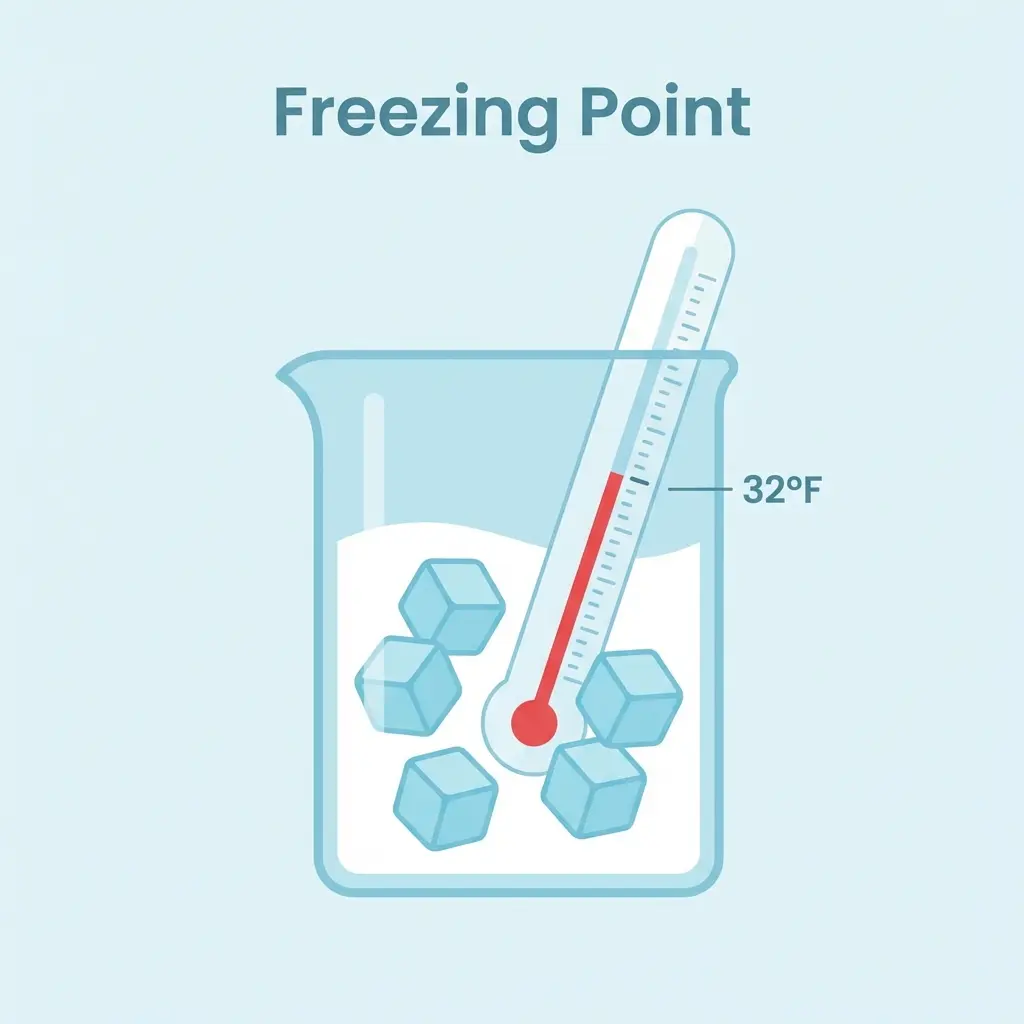
For pure water at sea level under standard atmospheric pressure (14.7 psi / 101.3 kPa):
| Scale | Freezing Point |
|---|---|
| Fahrenheit | 32°F |
| Celsius | 0°C |
| Kelvin | 273.15 K |
This is the temperature at which water and ice coexist in equilibrium — the triple point. Below this temperature, water freezes. Above it, ice melts.
Factors That Change the Freezing Point
1. Dissolved Substances (Freezing Point Depression)
Adding solutes (salt, sugar, alcohol, antifreeze) to water lowers its freezing point. The more solute dissolved, the lower the freezing point.
| Substance | Concentration | Freezing Point |
|---|---|---|
| Pure water | 0% | 32°F (0°C) |
| Ocean water | 3.5% salt | 28°F (-2°C) |
| Very salty brine | 10% salt | 20°F (-7°C) |
| Maximum salt brine | 23% salt | -6°F (-21°C) |
| Antifreeze (50% glycol) | 50/50 | -34°F (-37°C) |
| Beer (~4% alcohol) | 4% ethanol | 28°F (-2°C) |
Why this matters in the kitchen:
- Homemade ice cream requires reaching below 32°F to freeze cream — use a salt-ice mixture
- Pasta water with significant salt content technically freezes slightly below 32°F (negligible, but real)
- Brines for meat (15–20% salt) won't freeze in a standard fridge but will freeze in your freezer
2. Pressure
Increasing pressure lowers the freezing point very slightly (unlike the boiling point, which changes dramatically with pressure). For practical purposes, altitude and atmospheric pressure variations are negligible on the freezing point — a much smaller effect than on the boiling point.
3. Supercooling
In ideal conditions, very pure water can be cooled below 32°F (0°C) without freezing — a phenomenon called supercooling. Water needs a nucleation site (a microscopic imperfection or particle) to crystallize. Ultra-pure water in a clean container can supercool to 14°F (-10°C) before suddenly freezing. Regular tap water rarely supercools meaningfully due to dissolved minerals.
Application: Road Salt
Road and sidewalk salt (sodium chloride or calcium chloride) works by depressing the freezing point of water below the ambient temperature:
- Sodium chloride (table salt): effective to ~20°F (-7°C)
- Calcium chloride: effective to -25°F (-32°C) — used for extreme cold
When road salt hits ice, it dissolves in the thin layer of liquid water always present on ice surfaces (interfacial water), depressing the freezing point and causing the ice to melt at the ambient temperature.
Freezer Temperature vs. Freezing Point
Your home freezer should be set to 0°F (-18°C) — 32°F below the freezing point. This extra margin:
- Ensures food freezes quickly (smaller ice crystals = better texture when thawed)
- Provides a buffer so the door being opened doesn't push the temperature above freezing
- Keeps bacteria fully dormant (they stop growing below about 28°F/-2°C)
For more on ideal freezer temperatures and storage times, see our freezer temperature guide.
Frequently Asked Questions
At what temperature does water freeze?
Pure water freezes at 32°F (0°C) at standard atmospheric pressure (sea level). This is the triple point where water transitions from liquid to solid. In everyday kitchen terms: your home freezer at 0°F (-18°C) is 32°F colder than the freezing point, which is why your ice stays solid and bacteria are completely dormant at that temperature.
Does salt water freeze at a lower temperature?
Yes. Dissolved salts lower water's freezing point — this is called freezing point depression. Typical ocean water (3.5% salinity) freezes at approximately 28°F (-2°C). Heavily salted water (like ocean brines used commercially) can freeze at 15–20°F (-9 to -7°C). This is why road salt prevents ice formation — it lowers the freezing point below the ambient road temperature.
Why does adding salt to ice make it colder?
When salt dissolves in ice-water, it depresses the freezing point, causing the ice to melt (moving toward equilibrium). Melting requires energy (heat), which is absorbed from the surrounding environment — including whatever food is in your ice cream maker or salted ice bath. The mixture can reach -6°F (-21°C) at optimal salt concentration, much colder than 32°F ice alone.
Does water freeze at the same temperature at high altitude?
The freezing point of water is minimally affected by altitude. Unlike the boiling point (which drops significantly with altitude), the freezing point changes by only a fraction of a degree even at extreme altitudes under normal conditions. High altitude camping doesn't change the 32°F freezing point meaningfully.
What is the freezing point of water in Celsius?
Water freezes at 0°C (Celsius). In fact, 0°C is defined as the freezing point of pure water at standard atmospheric pressure — it's the literal reference point of the Celsius scale. In Kelvin, the freezing point is 273.15 K (adding 273.15 to the Celsius value).