
Common Temperatures Reference Table: Freezing, Boiling, Body Temp in °F, °C & K
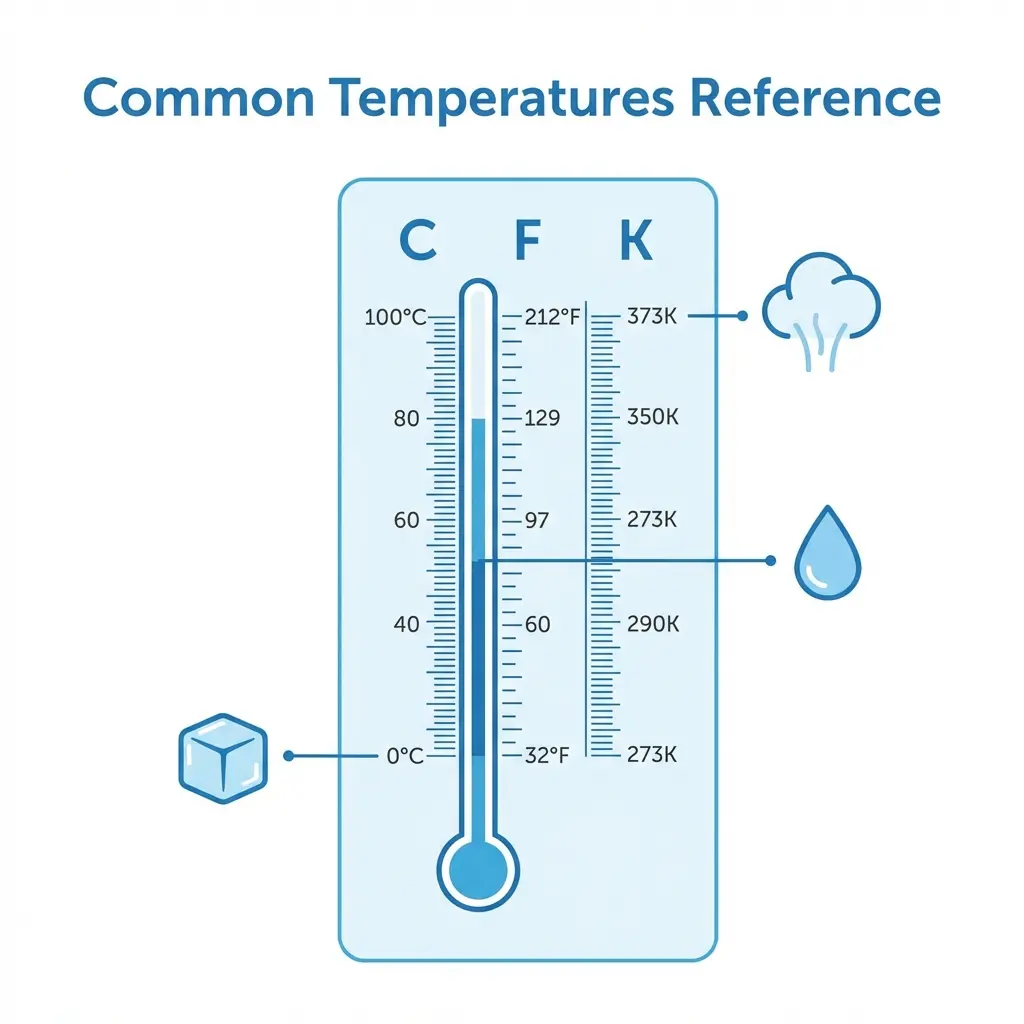
Temperature comes up constantly in cooking, science, and daily life — and switching between Fahrenheit, Celsius, and Kelvin can be confusing. This reference table consolidates the most commonly needed temperature values in all three scales, organized into categories you'll actually use.
Water & Physical Chemistry
| Temperature | °F | °C | K | Notes |
|---|---|---|---|---|
| Absolute Zero | -459.67°F | -273.15°C | 0 K | Theoretical minimum — never achieved |
| Liquid nitrogen | -320°F | -196°C | 77 K | Cryogenic cooling; liquid nitrogen cooking |
| Dry ice | -109°F | -78.5°C | 194 K | Solid CO₂; theatrical smoke effects |
| Freezing Point of Water | 32°F | 0°C | 273.15 K | Pure water at sea level / 1 atm |
| Boiling Point of Water | 212°F | 100°C | 373.15 K | Sea level; lower at high altitude |
| Boiling in Denver (5,280 ft) | 202°F | 94°C | 367 K | Affects cooking times |
Human Body & Health
| Temperature | °F | °C | K | Notes |
|---|---|---|---|---|
| Hypothermia onset | 95°F | 35°C | 308 K | Core body temperature |
| Human Body (average) | 98.6°F | 37°C | 310.15 K | Individual range: 97–99°F |
| Low fever | 99.5°F | 37.5°C | 310.7 K | Mild elevation |
| Fever threshold | 100.4°F | 38°C | 311.15 K | FDA/CDC definition |
| High fever | 103°F | 39.4°C | 312.6 K | Medical attention warranted |
| Dangerous fever | 104°F+ | 40°C+ | 313 K | Emergency category |
Food Safety Reference
| Temperature | °F | °C | K | Notes |
|---|---|---|---|---|
| Safe Fridge Maximum (FDA) | 40°F | 4°C | 277 K | Below this = food safe |
| Danger Zone Bottom | 40°F | 4°C | 277 K | Bacteria start growing |
| Danger Zone Top | 140°F | 60°C | 333 K | Bacteria die rapidly above here |
| Safe Fish / Pork / Beef (whole) | 145°F | 63°C | 318 K | + 3-min rest required |
| Safe Ground Beef | 160°F | 71°C | 344 K | — |
| Safe Poultry (all) | 165°F | 74°C | 347 K | Salmonella killed instantly |
| Reheating standard | 165°F | 74°C | 347 K | All leftovers |
| Hot holding minimum | 140°F | 60°C | 333 K | Buffets, catering |
| Safe Freezer | 0°F | -18°C | 255 K | Bacterial growth fully stopped |
Cooking Reference Temperatures
| Temperature | °F | °C | K | Notes |
|---|---|---|---|---|
| Butter melting point | 90–95°F | 32–35°C | 305–308 K | Depends on milk fat ratio |
| Chocolate tempering | 88–90°F | 31–32°C | 304–305 K | Milk chocolate seeding temp |
| Butter browning (beurre noisette) | 250–265°F | 121–129°C | 394–402 K | Milk solids go golden |
| Maillard reaction (browning) | ~280°F+ | ~138°C+ | ~411 K+ | Crust/browning begins |
| Sugar caramelization | 320°F | 160°C | 433 K | Sugar goes golden |
| Standard baking temp | 325–375°F | 163–191°C | 436–464 K | |
| Deep frying temp | 350–375°F | 177–191°C | 450–464 K | |
| Hard candy (hard crack stage) | 300–310°F | 149–154°C | 422–427 K | |
| Smoke point (olive oil) | 375°F | 190°C | 463 K | Refined: ~465°F |
| Smoke point (avocado oil) | 520°F | 271°C | 544 K | Highest common cooking oil |
| Home oven maximum | 500–550°F | 260–288°C | 533–561 K | |
| Pizza steel / stone target | 550°F+ | 288°C+ | 561 K+ | For NY-style home pizza |
| Wood-fired pizza oven | 750–900°F | 400–482°C | 673–755 K | Neapolitan standard |
Everyday Weather & Comfort
| Temperature | °F | °C | K | Notes |
|---|---|---|---|---|
| Comfortable indoor | 68–72°F | 20–22°C | 293–295 K | ASHRAE recommendation |
| Hot summer day | 95°F | 35°C | 308 K | Heat advisory territory |
| Cold winter day | 14°F | -10°C | 263 K | |
| US record heat (Death Valley 1913) | 134°F | 57°C | 330 K | |
| US record cold (Rogers Pass, MT 1954) | -70°F | -57°C | 216 K |
Conversion Formulas (Quick Reference)
| From → To | Formula |
|---|---|
| °F → °C | (°F − 32) × 5/9 |
| °C → °F | (°C × 9/5) + 32 |
| °C → K | °C + 273.15 |
| K → °C | K − 273.15 |
For detailed conversion calculators and step-by-step walkthroughs, see our Fahrenheit to Celsius guide, Celsius to Fahrenheit guide, and Kelvin to Fahrenheit guide.
Frequently Asked Questions
What is the freezing point of water in Fahrenheit, Celsius, and Kelvin?
Water freezes at 32°F, 0°C, and 273.15K. These three values all represent the same physical temperature — the point at which pure water at sea level transitions from liquid to solid. The Celsius scale was designed with 0°C at this exact point; Fahrenheit was set at 32°F through an older, different reference system.
What is human body temperature in Celsius?
Normal human body temperature is 37°C (98.6°F / 310.15K). This is a statistical average — normal individual body temperature ranges from about 36.1°C to 37.2°C (97°F to 99°F). Temperature varies by time of day (lower in morning, higher in early evening), measurement location, and individual biology. A fever is defined as 38°C (100.4°F) or above.
What temperature does water boil in Fahrenheit?
Water boils at 212°F (100°C) at sea level under standard atmospheric pressure. At higher altitudes, the boiling point decreases: Denver (5,280 feet): 202°F (94°C). This is why high-altitude baking and cooking require adjustments — the water in your food never reaches 212°F, affecting cooking times and baking chemistry.
What is room temperature in Celsius and Fahrenheit?
Room temperature is typically defined as 68–77°F (20–25°C). For scientific purposes, a 'standard room temperature' of 25°C (77°F) is often used. For comfortable living environments, ASHRAE recommends 68–76°F (20–24°C). In chemistry, 'room temperature' often means exactly 25°C (298.15K).
How do you convert Fahrenheit to Celsius quickly?
For a quick mental approximation: subtract 32 from the Fahrenheit degree, then divide by 2 (instead of multiplying by 5/9). This gives you a result within 4–5°F of the actual value. Example: 98.6°F → (98.6 − 32) ÷ 2 = 66.6 ÷ 2 = 33.3°C (actual is 37°C). For precise conversion, use °C = (°F − 32) × 5/9.