
Boiling Point by Altitude: 212°F at Sea Level (Full Chart)
Quick Answer
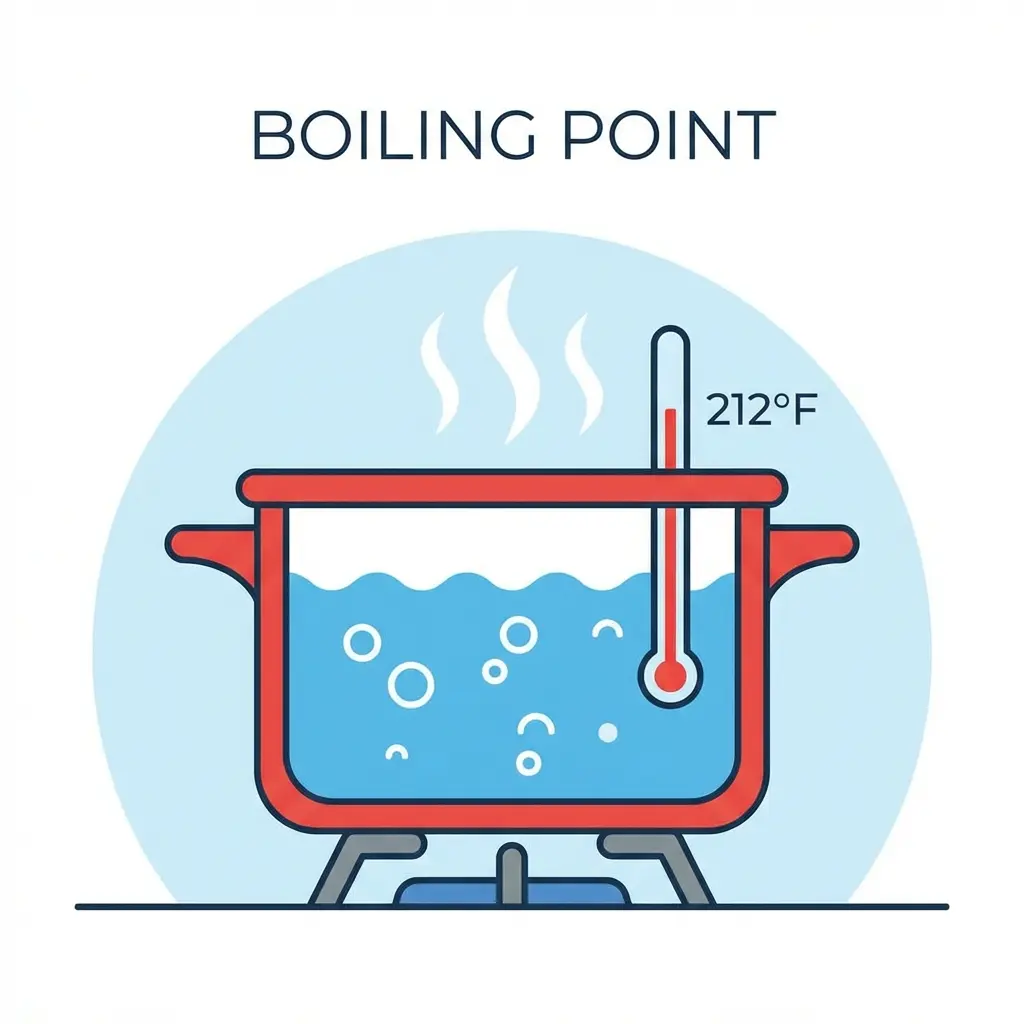
Water boils at 100°C (212°F) at sea level. The boiling point drops about 1°F (0.5°C) for every 500 feet of elevation: at 5,000 ft it's 95°C (203°F), at 10,000 ft it's 90°C (194°F).
Water boiling at 212°F (100°C) is one of the most fundamental facts in cooking and science — but it's only true at sea level. Understanding how pressure and altitude change the boiling point becomes practically important if you cook at high elevation or are curious about why Denver recipes advise longer cooking times.
The Science: Why Water Boils
Boiling happens when the vapor pressure of water equals the atmospheric pressure pushing down on it. At sea level, atmospheric pressure is 14.7 pounds per square inch (psi). Water's internal vapor pressure matches this at exactly 212°F (100°C) — that's the boiling point.
At higher altitudes, there is less air above you, so atmospheric pressure is lower. With less pressure pushing down, the water's vapor pressure can match it at a lower temperature. This is why water boils earlier at altitude.
Boiling Point by Altitude
| Location | Elevation | Boiling Point (°F) | Boiling Point (°C) |
|---|---|---|---|
| Death Valley, CA | -282 ft | 213°F | 101°C |
| Sea Level | 0 ft | 212°F | 100°C |
| New York City | 33 ft | 212°F | 100°C |
| Atlanta, GA | 1,050 ft | 210°F | 99°C |
| Salt Lake City, UT | 4,226 ft | 203°F | 95°C |
| Denver, CO | 5,280 ft | 202°F | 94°C |
| Mexico City | 7,350 ft | 198°F | 92°C |
| Aspen, CO | 7,908 ft | 197°F | 92°C |
| Leadville, CO | 10,152 ft | 194°F | 90°C |
| Kilimanjaro Summit | 19,341 ft | 175°F | 79°C |
| Everest Base Camp | 17,600 ft | 178°F | 81°C |
| Mount Everest Summit | 29,032 ft | 160°F | 71°C |
How Altitude Changes Your Cooking
Lower boiling point means lower cooking temperature in boiling water. Food takes longer to cook because the water is less hot.
Boiled pasta: At 5,000 feet, add 1–2 extra minutes. At 10,000 feet, add 3–5 minutes.
Boiled eggs: At high altitude, hard-boiled eggs require 2–3 extra minutes of cooking time.
Rice: Use slightly more water (add 2 tablespoons extra per cup of rice) and increase cooking time by 5 minutes.
Candy making: Candy thermometers are calibrated for sea level. In Denver, the "soft ball" stage on a candy thermometer is 228°F instead of 238°F. Test your thermometer by measuring the boiling point of water, then subtract the difference from all candy temperature targets.
For food safety purposes: The food temperature danger zone (40°F–140°F / 4°C–60°C) and safe internal cooking temperatures (165°F for chicken, 160°F for ground beef) are the same regardless of altitude. These temperatures describe the temperature inside the food, not the water around it.
Pressure Cookers: The Inverse
A pressure cooker raises atmospheric pressure above the food, increasing the boiling point above 212°F. At the standard 15 psi setting, the boiling point inside is 250°F (121°C). This is why pressure cookers cook food 2–3x faster than standard boiling — the cooking temperature is significantly higher.
At high altitude, pressure cookers experience reduced benefit because they must first overcome the lower starting atmospheric pressure. Add 5% more cooking time for every 1,000 feet above 2,000 feet elevation when using a pressure cooker.
Converting: Celsius and Fahrenheit Boiling Points
| Scale | Boiling at Sea Level |
|---|---|
| Fahrenheit | 212°F |
| Celsius | 100°C |
| Kelvin | 373.15 K |
For detailed Fahrenheit-to-Celsius conversion, see our °F to °C converter. For the Celsius-to-Fahrenheit formula, see our °C to °F guide.
Frequently Asked Questions
At what temperature does water boil?
Water boils at 212°F (100°C) at sea level under standard atmospheric pressure (1 atm / 101.3 kPa). At higher altitudes, the boiling point decreases by approximately 0.9°F (0.5°C) for every 500 feet (152 meters) of elevation gain. In Denver, CO (5,280 feet), water boils at about 202°F (94°C). On Mount Everest (29,032 feet), water boils at approximately 160°F (71°C).
Does water boil faster at high altitude?
Yes, water reaches its boiling point faster at high altitude because the boiling point is lower — less energy is needed to reach 202°F than 212°F. However, because the boiling temperature is lower, food cooked in boiling water cooks slower at altitude. Pasta, vegetables, and eggs all take longer to cook in Denver than at sea level.
How does altitude affect cooking?
At high altitude, water boils at a lower temperature, so boiling-water cooking times increase. Pasta takes 2–3 extra minutes per 5,000 feet of elevation. Eggs take longer. Rice may require more water and a slightly longer time. Baking is also affected — leavening gases expand faster at altitude, requiring less baking powder and often more liquid in recipes.
What temperature does water boil at 5000 feet?
At 5,000 feet (1,524 meters) elevation, water boils at approximately 203°F (95°C). At 10,000 feet, water boils at approximately 194°F (90°C). The boiling point decrease is approximately 1°F per 550 feet of altitude gain, or about 0.5°C per 150 meters.
Does salt raise the boiling point of water?
Yes, but only marginally. Adding 1 teaspoon of salt to a quart of water raises the boiling point by about 0.04°F (0.02°C) — essentially negligible. You would need to dissolve 58 grams of salt per liter to raise the boiling point by 1°F. The primary reason to salt pasta water is flavor, not to raise boiling temperature.