
Celsius to Fahrenheit: Formula, Easy Chart & Mental Math Trick
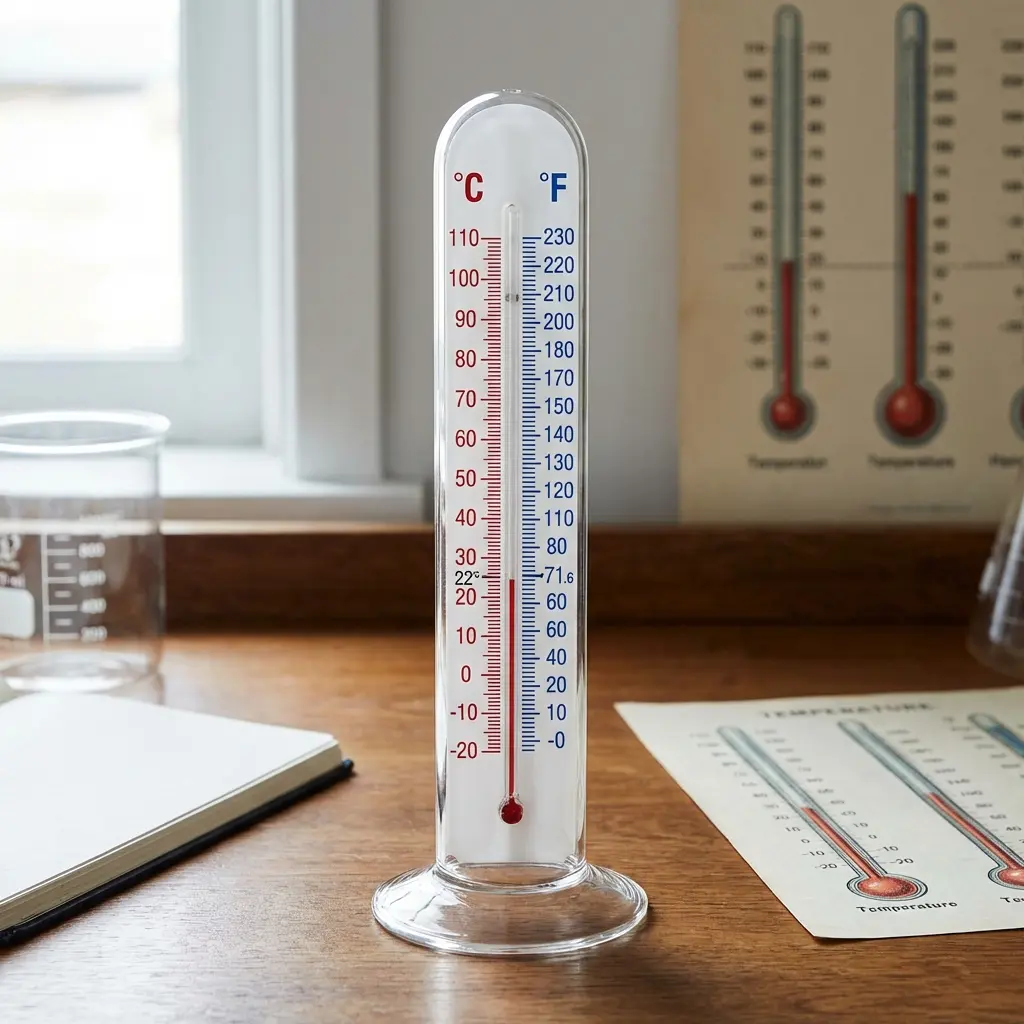
In the culinary world, the divide between the Metric system (Celsius) and the Imperial system (Fahrenheit) causes more ruined dishes than perhaps any other error. A recipe from London calls for an oven at 200°C. An American cook sets their oven to 200°F. The result? Raw dough after an hour of baking.
Understanding how to bridge this gap is essential for international cooking, travel, and scientific literacy.
In this guide, we provide a complete reference chart, the exact mathematical formula, and—most importantly—a "Mental Math Hack" that lets you convert temperatures in your head in seconds.
The Formula
To convert Celsius (°C) to Fahrenheit (°F), use this precise formula:
°F = (°C × 1.8) + 32
Alternatively, using fractions: °F = (°C × 9/5) + 32
Why 1.8 and 32?
- 1.8 Scale Difference: A change of 1 degree Celsius is equal to a change of 1.8 degrees Fahrenheit. The Celsius degrees are "larger."
- 32 Offset: The zero point of Celsius (freezing water) is 32 degrees higher on the Fahrenheit scale.
The Mental Math Hack (Approximation)
Don't have a calculator? Use this quick trick. It isn't perfect, but it is close enough for checking the weather or setting an oven.
Rule: Double the Celsius, add 30.
Example: Convert 180°F82°C (Standard Poaching Temp)
- Exact Formula: (82 × 1.8) + 32 = 179.6°F
- Mental Math: (82 × 2) = 164. 164 + 30 = 194°F Okay, for high temperatures, the gap widens.
Let's try a room temperature example: 20°F68°C
- Exact Formula: (20 × 1.8) + 32 = 68°F
- Mental Math: (20 × 2) = 40. 40 + 30 = 70°F Much closer!
The "Double and Add 30" rule is excellent for weather and room temperatures. For cooking temperatures (above 100°F212°C), it loses accuracy. For cooking, remember key benchmarks instead.
Standard Temperature Reference Table
Here are the most common temperature milestones used in daily life and cooking.
| Description | Celsius (°C) | Fahrenheit (°F) |
|---|---|---|
| Absolute Zero | -273.15 | -459.67 |
| Freezer Temp | -18 | 0 |
| Water Freezes | 0 | 32 |
| Fridge Temp | 4 | 40 |
| Room Temperature | 20–22 | 68–72 |
| Body Temperature | 37 | 98.6 |
| Danger Zone Limit | 60 | 140 |
| Water Boils | 100 | 212 |
| Maillard Reaction | 154 | 310 |
| Sugar Caranmelizes | 170 | 338 |
| Standard Oven | 180 | 350 |
| Hot Oven (Roasting) | 200 | 400 |
| Broiling / Pizza | 250+ | 500+ |
Quick Conversion Lookup Table (Cooking Range)
Use this table for quick recipe conversions.
| Celsius (°C) | Fahrenheit (°F) | Use Case |
|---|---|---|
| 120°C | 250°F | Low & Slow BBQ |
| 135°C | 275°F | Slow Roasting |
| 150°C | 300°F | Gentle Baking |
| 160°C | 325°F | Standard Roasting |
| 180°C | 350°F | Cookies, Cakes |
| 190°C | 375°F | Baking |
| 200°C | 400°F | Roasting Vegatables |
| 220°C | 425°F | Pizza, Pastry |
| 230°C | 450°F | Searing, Bread |
| 260°C | 500°F | Broiling |
Note that oven dials often round these numbers. A recipe asking for 175°C is effectively asking for 350°F (176.6°F), and the oven variance will cover the difference.
Why Do We Have Two Systems?
Celsius (Metric): Invented by Anders Celsius in 1742. It is based on water.
- 0 = Freezing point of water.
- 100 = Boiling point of water.
- It is logical, decimal-based, and used by almost every country on Earth and the entire scientific community.
Fahrenheit (Imperial): Invented by Daniel Gabriel Fahrenheit in 1724.
- 0 = The stabilizing temperature of an ice/water/salt brine mixture (the coldest thing he could replicate in a lab).
- 32 = Freezing water.
- 96 = Human body temperature (originally; it was later adjusted to 98.6).
- Pro: Fahrenheit offers more "resolution" for air temperature. The difference between 70°F and 71°F is subtle, whereas the jump from 21°C to 22°C (almost 2 degrees F) feels larger.
Frequently Asked Questions (FAQ)
Q: At what temperature are Celsius and Fahrenheit the same?
A: -40 degrees. At -40, the scales intersect. -40°C is exactly the same temperature as -40°F. It is extremely cold.
Q: Why do recipes call for 180°C or 350°F? They aren't exact matches.
A: 180°C converts to 356°F. However, oven dials are usually marked in 25-degree increments (325, 350, 375). 350°F is the standard rounding. The 6-degree difference is negligible in baking.
Q: How do I convert for Gas Marks?
A: That is a third system!
- Gas Mark 4 ≈ 180°C / 350°F.
- Gas Mark 6 ≈ 200°C / 400°F. Always check your oven's manual.
Q: Is Kelvin different?
A: Yes. Kelvin is the scientific scale. It uses the same "degree size" as Celsius, but starts at Absolute Zero. 0 Kelvin = -273.15°C. Freezing water (0°C) is 273.15K.
More Questions
What is the formula to convert Celsius to Fahrenheit?
The exact formula is: °F = (°C × 1.8) + 32. For example, 100°C becomes (100 × 1.8) + 32 = 212°F. Alternatively you can use the fraction form: °F = (°C × 9/5) + 32.
Is there an easy way to convert Celsius to Fahrenheit in my head?
Yes — double the Celsius temperature and add 30. For example, 20°C: (20 × 2) + 30 = 70°F (actual: 68°F). This shortcut is accurate enough for weather and room temperatures, but loses precision above 100°C.
At what temperature are Celsius and Fahrenheit the same?
Celsius and Fahrenheit are equal at exactly -40 degrees. -40°C = -40°F. This is the point where the two scales intersect.
What is 180°C in Fahrenheit? (Standard oven temperature)
180°C = 356°F, which rounds to the common oven setting of 350°F. This is the standard temperature for baking cakes, cookies, and most pastries.