
Kelvin to Fahrenheit Converter + Chart (K to °F)
Quick Answer
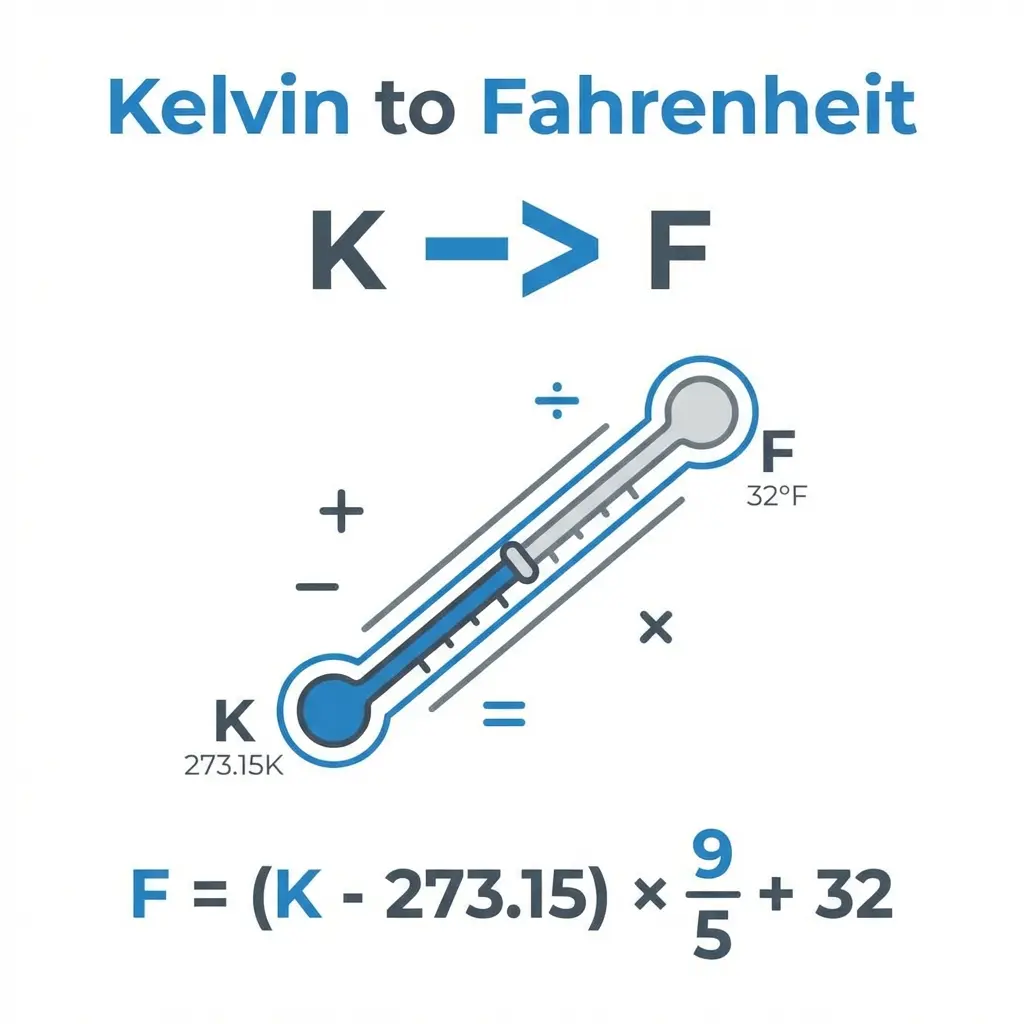
Convert Kelvin to Fahrenheit: °F = (K − 273.15) × 9/5 + 32. Subtract 273.15 to get Celsius, multiply by 1.8, then add 32. Examples: 273 K = 32°F, 300 K = 80.3°F, 373 K = 212°F.
Kelvin is the SI (International System of Units) base unit for temperature, used universally in physics, chemistry, engineering, and astronomy. Unlike Fahrenheit or Celsius, Kelvin is an absolute scale — 0 K (absolute zero) is the true minimum temperature where all molecular motion stops.
The Conversion Formula
°F = (K − 273.15) × 9/5 + 32
Or equivalently:
°F = (K − 273.15) × 1.8 + 32
Step-by-Step Example: Convert 300 K to °F
- Subtract 273.15: 300 − 273.15 = 26.85°C (this step converts to Celsius)
- Multiply by 9/5: 26.85 × 1.8 = 48.33
- Add 32: 48.33 + 32 = 80.33°F
Result: 300 K = 80.33°F (a warm summer day)
Kelvin to Fahrenheit Conversion Chart
| Kelvin (K) | Fahrenheit (°F) | Celsius (°C) | Context |
|---|---|---|---|
| 0 K | -459.67°F | -273.15°C | Absolute Zero |
| 2.7 K | -454.7°F | -270.5°C | Cosmic microwave background |
| 40 K | -387.7°F | -233.2°C | Liquid neon range |
| 77 K | -320.4°F | -196.2°C | Liquid nitrogen |
| 80 K | -313.2°F | -193.2°C | Liquid nitrogen (upper range) |
| 195 K | -108°F | -78°C | Dry ice (solid CO₂) |
| 233 K | -40°F | -40°C | -40°F = -40°C |
| 255 K | 0°F | -18°C | Standard freezer temp |
| 273 K | 32°F | 0°C | Freezing point of water |
| 293 K | 68°F | 20°C | Room temperature |
| 298 K | 77°F | 25°C | Standard chemistry room temp |
| 300 K | 80°F | 27°C | Warm day |
| 310 K | 98.6°F | 37°C | Human body temperature |
| 338 K | 149°F | 65°C | Very hot water |
| 347 K | 165°F | 74°C | Safe poultry temperature |
| 373 K | 212°F | 100°C | Boiling point of water |
| 450 K | 350°F | 177°C | Baking temperature |
| 500 K | 440.3°F | 226.9°C | High-heat baking |
| 533 K | 500°F | 260°C | Pizza oven (home) |
| 755 K | 900°F | 482°C | Wood-fired pizza oven |
| 3000 K | 4940.3°F | 2726.9°C | Incandescent filament |
The Reverse Formula: Fahrenheit to Kelvin
K = (°F − 32) × 5/9 + 273.15
Or equivalently: Convert °F to °C first, then add 273.15.
Example: Convert 212°F (boiling water) to Kelvin:
(212 − 32) × 5/9 + 273.15 = 180 × 0.556 + 273.15 = 100 + 273.15 = 373.15 K
Why You Can't Have Negative Kelvin (Under Standard Physics)
Fahrenheit and Celsius can have negative numbers — they're arbitrary scales. Kelvin cannot go below 0 because 0 K represents a physical state (no molecular motion), not just an arbitrary zero point. Under standard thermodynamic definitions, negative Kelvin is physically impossible.
(There are exotic quantum physics states where some systems can be described as having "negative absolute temperature," but this is a nuance of quantum statistical mechanics that doesn't apply to everyday thermal physics.)
Common Kelvin References for Science Students
| K Value | °F | Use Case |
|---|---|---|
| 2.7 K | -454.7°F | Cosmic microwave background temperature of space |
| 77 K | -320°F | Normal boiling point of liquid nitrogen |
| 273.15 K | 32°F | Standard melting point of ice (0°C) |
| 298 K | 77°F | Standard room temperature in chemistry (25°C exactly) |
| 373.15 K | 212°F | Standard boiling point of water (100°C) |
| 5778 K | 9940°F | Surface temperature of the Sun |
For the reverse conversion (Fahrenheit to Kelvin), see our °F to K guide. For Kelvin to Celsius, see our K to °C converter.
Frequently Asked Questions
How do you convert Kelvin to Fahrenheit?
To convert Kelvin to Fahrenheit, use the formula: °F = (K − 273.15) × 9/5 + 32. Step by step: subtract 273.15 from the Kelvin value to convert to Celsius, then multiply by 9/5 (or 1.8), then add 32. Example: Convert 300 K → (300 − 273.15) × 9/5 + 32 = 26.85 × 1.8 + 32 = 48.33 + 32 = 80.33°F.
What is 0 Kelvin in Fahrenheit?
0 Kelvin (absolute zero) is equal to -459.67°F (-273.15°C). This is the theoretical lowest possible temperature — the point at which all molecular motion stops. It has never been achieved experimentally; the coldest temperature ever achieved in a lab was within billionths of a degree above absolute zero.
What is 373 Kelvin in Fahrenheit?
373 Kelvin is approximately 212°F (100°C) — the boiling point of water at sea level. More precisely, 373.15 K = 212°F = 100°C. Kelvin 373 corresponds to these standard cooking and chemistry reference points.
What is 310 Kelvin in Fahrenheit?
310 Kelvin is approximately 98.6°F (37°C) — average human body temperature. This is why 310 K is used as a reference temperature in biology and medicine. The conversion: (310 − 273.15) × 9/5 + 32 = 36.85 × 1.8 + 32 = 66.33 + 32 = 98.33°F ≈ 98.6°F.
Why is temperature measured in Kelvin in science?
Scientists use Kelvin because it's an absolute scale — it starts at absolute zero (0 K) where all molecular motion stops. This makes mathematical relationships involving temperature linear and proportional. Celsius and Fahrenheit have arbitrary zero points (0°C = water freezing, 32°F = arbitrary historical reference) that don't reflect actual energy content, making them less useful for physics and chemistry equations.