
Fahrenheit to Kelvin Converter + Chart (°F to K)
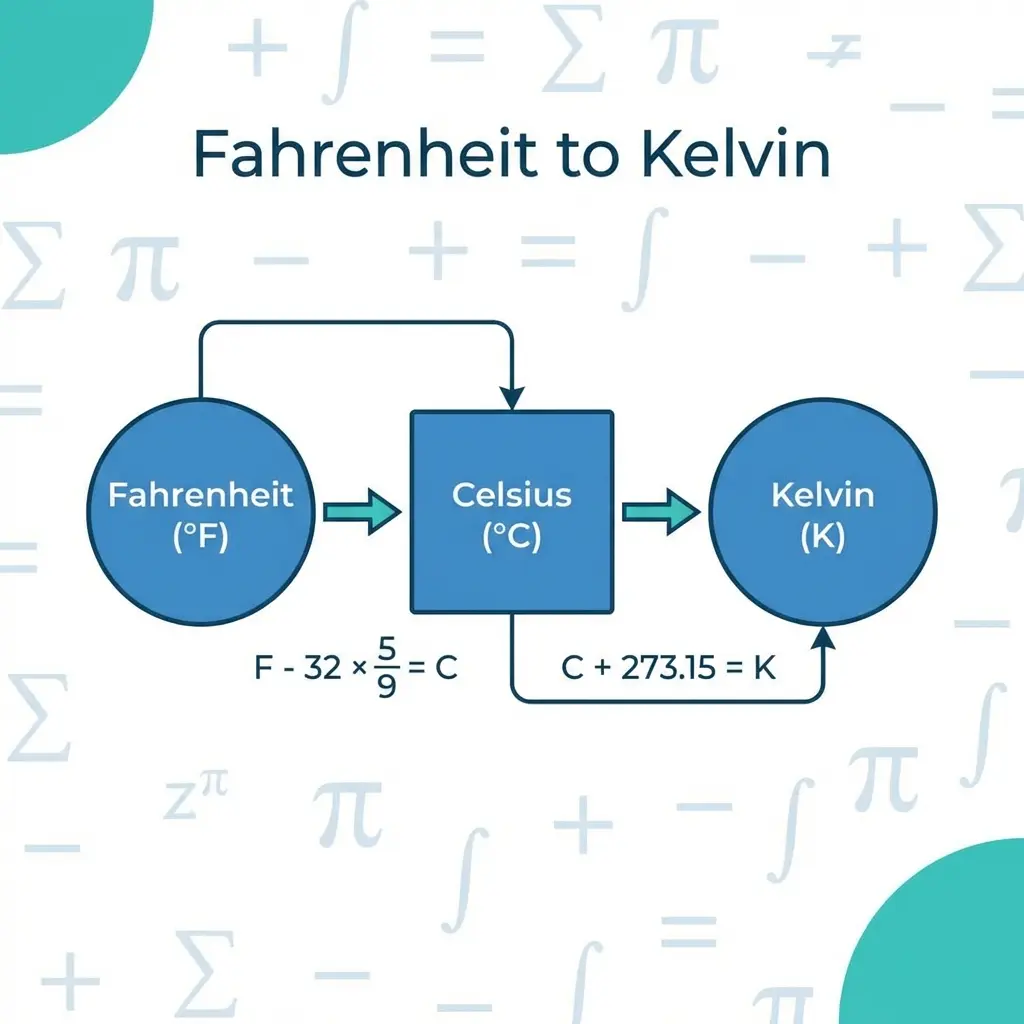
Kelvin is the thermodynamic temperature scale used in physics, chemistry, and engineering. Converting from Fahrenheit — the everyday scale used in the United States — requires two steps: first converting to Celsius, then adding 273.15 to reach Kelvin.
The Formula
K = (°F − 32) × 5/9 + 273.15
This works by:
- Removing the Fahrenheit offset (subtracting 32) to align with Celsius's zero point
- Scaling from Fahrenheit degree size to Celsius degree size (×5/9, since 9°F = 5°C)
- Shifting from Celsius to Kelvin by adding 273.15 (the number of Celsius degrees above absolute zero that the freezing point of water sits)
Step-by-Step Examples
Example 1: Room Temperature (72°F)
- Subtract 32: 72 − 32 = 40
- Multiply by 5/9: 40 × 0.5556 = 22.22°C
- Add 273.15: 22.22 + 273.15 = 295.37 K
Example 2: Safe Chicken Temperature (165°F)
- Subtract 32: 165 − 32 = 133
- Multiply by 5/9: 133 × 0.5556 = 73.89°C
- Add 273.15: 73.89 + 273.15 = 347.04 K
Example 3: Boiling Water (212°F)
- Subtract 32: 212 − 32 = 180
- Multiply by 5/9: 180 × 0.5556 = 100°C
- Add 273.15: 100 + 273.15 = 373.15 K
Fahrenheit to Kelvin Conversion Chart
| Fahrenheit (°F) | Celsius (°C) | Kelvin (K) | Context |
|---|---|---|---|
| -459.67°F | -273.15°C | 0 K | Absolute Zero |
| -40°F | -40°C | 233.15 K | Crossover point of °F and °C |
| 0°F | -17.78°C | 255.37 K | Standard freezer temperature |
| 32°F | 0°C | 273.15 K | Freezing point of water |
| 40°F | 4.4°C | 277.59 K | Maximum safe fridge temp |
| 72°F | 22.2°C | 295.37 K | Room temperature |
| 88°F | 31.1°C | 304.26 K | Hot summer day |
| 98.6°F | 37°C | 310.15 K | Human body temperature |
| 140°F | 60°C | 333.15 K | Food danger zone upper limit |
| 160°F | 71°C | 344.15 K | Safe ground beef temperature |
| 165°F | 74°C | 347.15 K | Safe poultry temperature |
| 212°F | 100°C | 373.15 K | Boiling point of water |
| 350°F | 177°C | 450.15 K | Typical baking temperature |
| 500°F | 260°C | 533.15 K | High-heat cooking / pizza |
The Reverse: Kelvin to Fahrenheit
°F = (K − 273.15) × 9/5 + 32
Example: 373 K → (373 − 273.15) × 9/5 + 32 = 99.85 × 1.8 + 32 = 179.73 + 32 = 211.73°F (≈212°F boiling point)
For the full reverse conversion guide, see our Kelvin to Fahrenheit guide.
Why Kelvin Has No "Degrees"
Kelvin temperatures are written as "373 K" not "373°K." The degree symbol (°) is omitted because Kelvin is a base unit, not a relative unit. Saying "373 degrees Kelvin" is technically incorrect in SI usage, although colloquially common.
For all three scale references in a single table, see our common temperatures reference.
The Quick Mental Shortcut
For a fast estimate without a calculator: halve the Fahrenheit value after subtracting 32, then add 273. This uses ½ instead of 5/9, so it runs slightly low — but for everyday values it lands within a few kelvin. Example: 165°F → (165 − 32) ÷ 2 = 66.5, + 273 ≈ 340 K (exact: 347 K). Good enough to sanity-check a homework answer; use the full formula when precision matters.
The Reverse Conversion
Going back from Kelvin to Fahrenheit inverts the steps: °F = (K − 273.15) × 9/5 + 32. Subtract 273.15 to get Celsius, scale by 9/5, then add the 32 offset. Example: 300 K → (300 − 273.15) × 1.8 + 32 = 26.85 × 1.8 + 32 = 80.3°F — a warm summer day. Full walkthrough and chart in the Kelvin to Fahrenheit guide.
One habit worth keeping: Kelvin never takes a degree symbol — it's "300 K," not "300°K." Kelvin is an absolute unit (like meters or grams), not a degree scale, which is exactly why physics equations require it.
Frequently Asked Questions
How do you convert Fahrenheit to Kelvin?
Convert Fahrenheit to Kelvin using: K = (°F − 32) × 5/9 + 273.15. Step by step: subtract 32 from the Fahrenheit value, multiply by 5/9 (or 0.5556) to get Celsius, then add 273.15 to convert to Kelvin. Example: 72°F → (72 − 32) × 5/9 + 273.15 = 40 × 0.5556 + 273.15 = 22.22 + 273.15 = 295.37 K.
What is 32°F in Kelvin?
32°F is equal to 273.15 K. This is the freezing point of water — 0°C = 273.15 K. The Kelvin value is simply the Celsius value plus 273.15. Since 32°F = 0°C, we get 0 + 273.15 = 273.15 K.
What is 212°F in Kelvin?
212°F is equal to 373.15 K — the boiling point of water at sea level. The conversion: (212 − 32) × 5/9 + 273.15 = 180 × 0.5556 + 273.15 = 100 + 273.15 = 373.15 K.
What is 98.6°F (body temperature) in Kelvin?
98.6°F is approximately 310.15 K (exactly 37°C body temperature). The conversion: (98.6 − 32) × 5/9 + 273.15 = 66.6 × 0.5556 + 273.15 = 37 + 273.15 = 310.15 K. Human body temperature at 310 K is a standard reference in biology.
What is absolute zero in Fahrenheit?
Absolute zero (0 Kelvin) is -459.67°F (-273.15°C). This is the theoretical minimum temperature — the point at which all molecular thermal motion stops. It cannot be reached in practice; the coldest temperature achieved experimentally is approximately 0.000000001 K (1 nanokelvin).