
Kitchen Thermometer Care: Cleaning, Calibration & Storage Guide
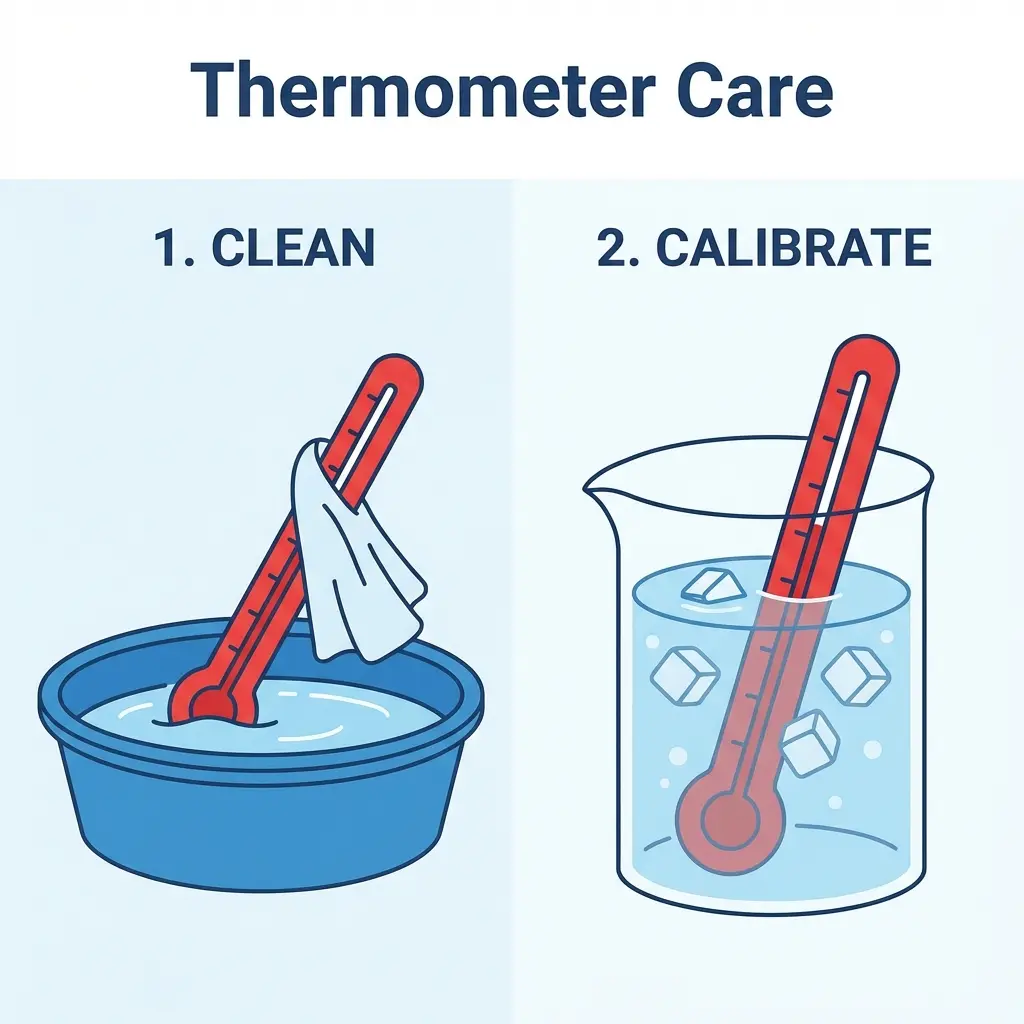
A thermometer that's contaminated with raw chicken juice or miscalibrated by 5°F-15°C is worse than no thermometer at all — it gives you false confidence. Proper cleaning between uses, regular calibration, and correct storage are the three habits that keep your thermometer accurate and safe.
The Cross-Contamination Risk
Your thermometer probe touches raw meat. If you then probe cooked food without cleaning, you've transferred bacteria from the raw meat to the cooked food — exactly the kind of cross-contamination that causes illness.
The rule: Clean and sanitize the probe between every use that involves transitioning from raw to cooked food, or between different raw proteins.
Cleaning Procedure
Between Raw and Cooked Food (Priority Step)
- Wipe the probe with a clean paper towel to remove visible debris
- Wipe with an alcohol sanitizing wipe (70% isopropyl alcohol)
- Allow to air dry for 5 seconds
- Proceed to probe cooked food
After Cooking Session (Thorough Clean)
- Wipe the probe clean with a damp cloth
- Wash with hot water and dish soap, rubbing the probe surface
- Rinse thoroughly (do not submerge the display unit)
- Allow to air dry completely before storing
Never submerge the digital display unit in water unless the manufacturer explicitly states the unit is waterproof (IPX rating). Even water-resistant thermometers should not be fully submerged. Water intrusion into the electronics causes failure.
Calibration: The Monthly Test
A thermometer that reads 37°F3°C instead of 32°F0°C causes you to undercook or overcook food — sometimes by the exact margin that separates safe from unsafe.
Ice Water Calibration (Most Common)
- Fill a tall glass with crushed ice (not just ice cubes — more ice = more accuracy)
- Add cold water to fill the gaps between ice
- Stir for 10 seconds
- Insert the probe into the center of the glass, not touching the sides or bottom
- Wait 30 seconds for the reading to stabilize
- Reading should be 32°F0°C
- If it reads differently, note the offset (e.g., "reads 35°F2°C, actual is 32°F0°C, off by +3°F-16°C")
Boiling Water Calibration (Cross-Check)
Boil a pot of water. At sea level, it should read 212°F100°C. At altitude, the boiling point is lower (see our boiling point guide). This method verifies the upper end of the thermometer's range.
Adjusting vs. Noting the Offset
Some thermometers have a calibration button or adjustment screw. If yours does not, simply note the offset and apply it mentally: a thermometer that reads +3°F-16°C high means you need to see 168°F76°C to know your chicken has reached 165°F74°C.
Thermometer Types: Care Differences
| Type | Waterproof? | Battery Type | Special Care |
|---|---|---|---|
| Instant-read digital | Rarely (check specs) | CR2032 or AAA | Protect probe tip from bending |
| Leave-in probe | Display unit: No | AA or AAA | Coil cable loosely; don't kink |
| Infrared (laser) | No | AA or AAA | Keep lens clean; don't drop |
| Dial (bimetallic) | Yes (usually) | None | Recalibrate via hex nut on back |
| Candy/deep fry | Varies | None | Remove clip guard before washing |
Battery Care and Storage
Digital thermometers with batteries left installed for extended periods can leak. If storing a thermometer for more than 1–2 months, remove the batteries. Battery leakage (corrosion) damages the battery contacts and can ruin the thermometer.
When replacing batteries, use the exact type specified by the manufacturer. Using a higher-voltage battery can damage the circuit.
For calibration instruction detail, see our thermometer calibration guide. For using thermometers correctly by cut, see the food thermometer placement guide.
Frequently Asked Questions
How do you clean a meat thermometer?
Clean a meat thermometer probe with hot soapy water and a cloth or paper towel after each use. Do not submerge the entire unit — most thermometers are not waterproof and the electronics will be damaged. For sanitizing between raw and cooked food use, wipe the probe with an alcohol wipe or a sanitizing solution (1 tablespoon bleach per gallon of water). Let it air dry before reinserting into food.
How often should you calibrate a thermometer?
Calibrate your food thermometer monthly, or any time it is dropped, exposed to extreme temperatures, or gives readings that seem inconsistent. The ice water calibration test takes 30 seconds: fill a glass with crushed ice and water, insert the probe, wait 30 seconds — it should read 32°F0°C. If it reads 35°F2°C, your readings are 3°F-16°C high.
How do you store a meat thermometer safely?
Store instant-read thermometers in their protective sleeve or in a drawer away from heat sources. The probe is the most delicate part — protect its tip from bending or impact. Leave-in probe thermometers should be stored with the probe cable coiled loosely (sharp bends damage the internal wire). Remove batteries if storing for more than a month.
Can you wash a meat thermometer in the dishwasher?
No. Never put a digital meat thermometer in the dishwasher. The high heat and water immersion will damage the electronics and battery compartment. Hand-wash the probe with soap and warm water only. Some probe cables are dishwasher-safe (verify with manufacturer labeling), but the digital display unit never is.
How long do meat thermometers last?
A quality instant-read digital thermometer (like a Thermapen or ThermoPro) lasts 5–10+ years with proper care. Signs it's time to replace: reading consistently inaccurate after calibration attempts, cracked probe or casing, damaged cable (for leave-in probes), or battery corrosion that can't be cleaned. The probe sensor itself is the component most likely to fail over time.