
Cross-Contamination Prevention: How to Stop Bacteria Spreading in Your Kitchen
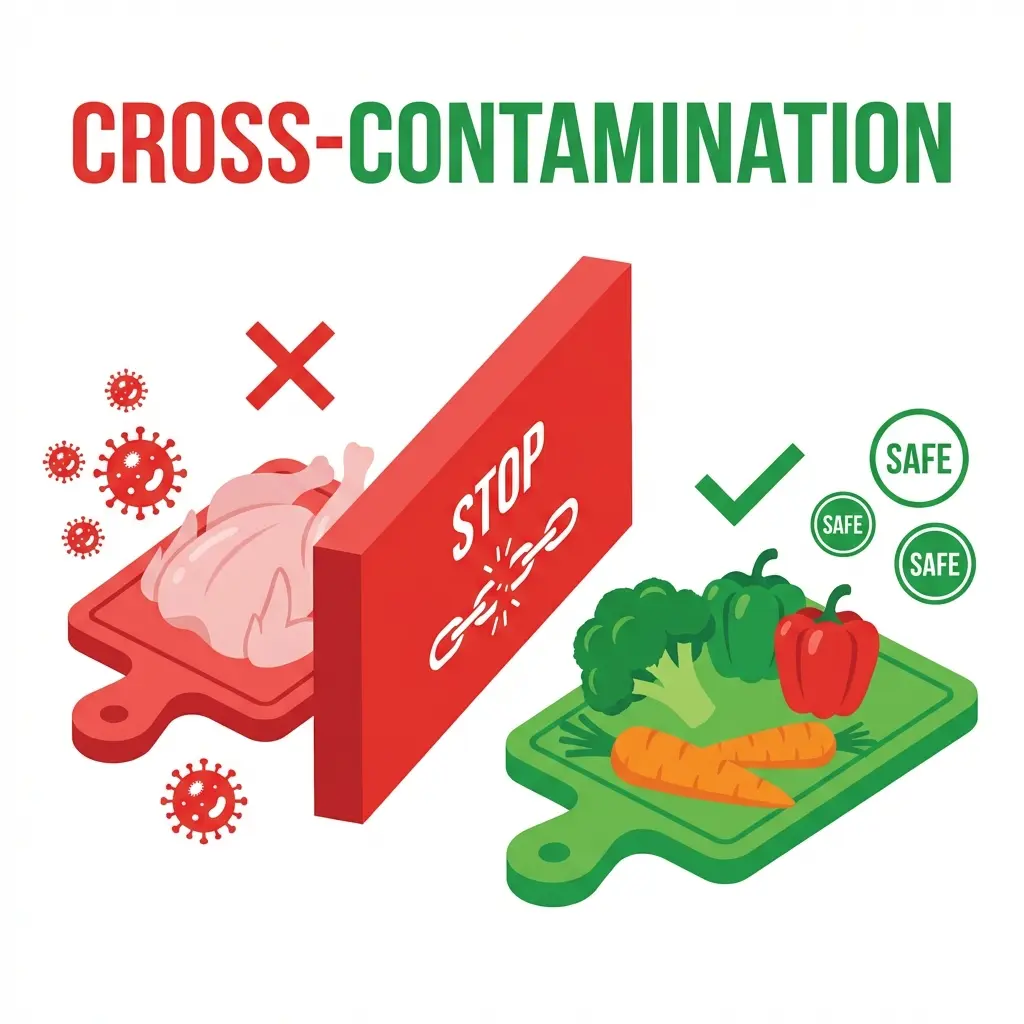
Cross-contamination is the leading cause of foodborne illness in home kitchens — even more than undercooking. The mechanism is simple: bacteria from raw meat travels to food that won't be cooked again, and the bacteria survive to cause illness. The prevention is equally simple once you understand the pathways.
The Three Pathways of Cross-Contamination
1. Food-to-Food
Raw meat, poultry, and seafood carry bacteria on their surfaces. When raw meat drips on, touches, or is stored above ready-to-eat food, those bacteria transfer directly.
Common scenarios:
- Raw chicken stored above lettuce in the fridge — juice drips down
- Raw steak placed on the same plate as a cooked steak for serving
- Unwashed hands touching raw meat, then touching fruit
2. Equipment-to-Food
A surface that touched raw meat becomes a contamination vector if not properly sanitized.
Common scenarios:
- Cutting board used for raw chicken, then used for tomato slicing
- Tongs used to flip raw burgers, then used to serve cooked burgers
- Kitchen sponge used to wipe the counter after raw meat prep, then used on dishes
3. Person-to-Food (Hand Contamination)
Hands are the most common vector. Bacteria from raw meat transfer to any surface a contaminated hand touches.
Common scenarios:
- Touching raw chicken, then opening the fridge door
- Seasoning raw meat with hands, then grabbing a utensil
- Not washing hands between handling raw meat and ready-to-eat ingredients
The Color-Coded Cutting Board System
Professional kitchens use color-coded cutting boards to eliminate confusion:
| Color | Use |
|---|---|
| 🔴 Red | Raw beef |
| 🟡 Yellow | Raw poultry |
| 🔵 Blue | Raw seafood |
| 🟢 Green | Produce / vegetables |
| ⬜ White | Cooked food / dairy / bread |
| 🟣 Purple | Allergen-free foods |
A home kitchen needs at minimum two boards: one dedicated to raw meat/poultry, one for everything else.
Sanitizing vs. Washing
Washing (soap and hot water) removes most bacteria but doesn't kill all of them.
Sanitizing (bleach solution or commercial sanitizer) kills bacteria remaining after washing.
For raw meat contact surfaces: wash with hot soapy water, then sanitize.
Bleach sanitizing solution: 1 tablespoon of unscented bleach per gallon of water. Apply to surface, let sit 30 seconds, air dry (do not rinse).
- Scrape food debris from cutting board or surface
- Wash with hot water and dish soap, scrubbing all surfaces
- Rinse thoroughly with clean water
- Sanitize with bleach solution — wet all surfaces, wait 30 seconds
- Air dry — drying with a cloth can re-contaminate
Hand Washing: The 20-Second Rule
The CDC and FDA recommend washing hands for at least 20 seconds with soap and water — about the time to sing "Happy Birthday" twice — after:
- Handling raw meat, poultry, or seafood
- Using the bathroom
- Touching garbage, pets, or unclean surfaces
- Blowing your nose, coughing, or sneezing
Hand sanitizer gel does not effectively replace hand washing for raw meat handling. Soap physically removes bacteria and disrupts the oily membrane of norovirus. Alcohol-based sanitizers are effective against many pathogens but are less effective with heavy soil load (meat residue on hands). Wash with soap and water first.
Refrigerator Storage to Prevent Cross-Contamination
Bottom shelf rule: Raw meat, poultry, and seafood must be stored on the lowest shelf of the refrigerator, below ready-to-eat foods. Drips flow downward — you want drips landing inside the raw meat container if a bag leaks, not onto your produce.
Sealed containers: Keep raw meat in sealed zip-lock bags or containers with lids. Original store packaging is sealed adequately only if it's not punctured. Double-bag if uncertain.
For raw meat storage times by protein, see our raw meat refrigerator storage guide.
Frequently Asked Questions
What is cross-contamination in food safety?
Cross-contamination is the transfer of harmful bacteria from one food or surface to another. In the kitchen, the most common type is raw meat juice dripping onto or touching ready-to-eat foods (salad, cooked meat, fruit). Bacteria like Salmonella, E. coli, and Listeria from raw poultry, beef, or pork can cause severe illness if transferred to food that won't be cooked again.
How do you prevent cross-contamination?
Key prevention steps: (1) use separate cutting boards for raw meat and produce, (2) wash hands for 20 seconds with soap after touching raw meat, (3) store raw meat on the bottom refrigerator shelf in sealed containers, (4) never put cooked food on a plate that held raw food, (5) sanitize surfaces and utensils after raw meat contact with hot soapy water or a diluted bleach solution.
What are the 3 types of cross-contamination?
The three types of cross-contamination are: (1) Food-to-food — raw meat dripping onto or touching ready-to-eat food; (2) Equipment-to-food — a cutting board or knife used for raw chicken then used for salad without washing; (3) People-to-food — unwashed hands transferring bacteria from raw meat to other food items or kitchen surfaces.
Does cooking kill cross-contaminated bacteria?
Cooking to the correct internal temperature (165°F74°C for poultry, 160°F71°C for ground meat) kills bacteria. However, cross-contamination is dangerous specifically on food that won't be cooked again — salads, fruit, cooked leftovers, bread. If raw chicken juice drips onto your salad greens, cooking isn't an option. Prevention is essential.
Can you wash cross-contaminated produce to make it safe?
Rinsing produce under cold water can reduce surface bacteria but does not eliminate it. If raw meat juice has come into contact with produce, the safest recommendation is to discard it. Bacteria can penetrate cut surfaces and crevices of soft produce. For leafy greens especially, the FDA advises discarding rather than attempting to rinse away contamination.