
4 Types of Meat Thermometers: Instant-Read vs. Leave-In vs. Wireless vs. Infrared
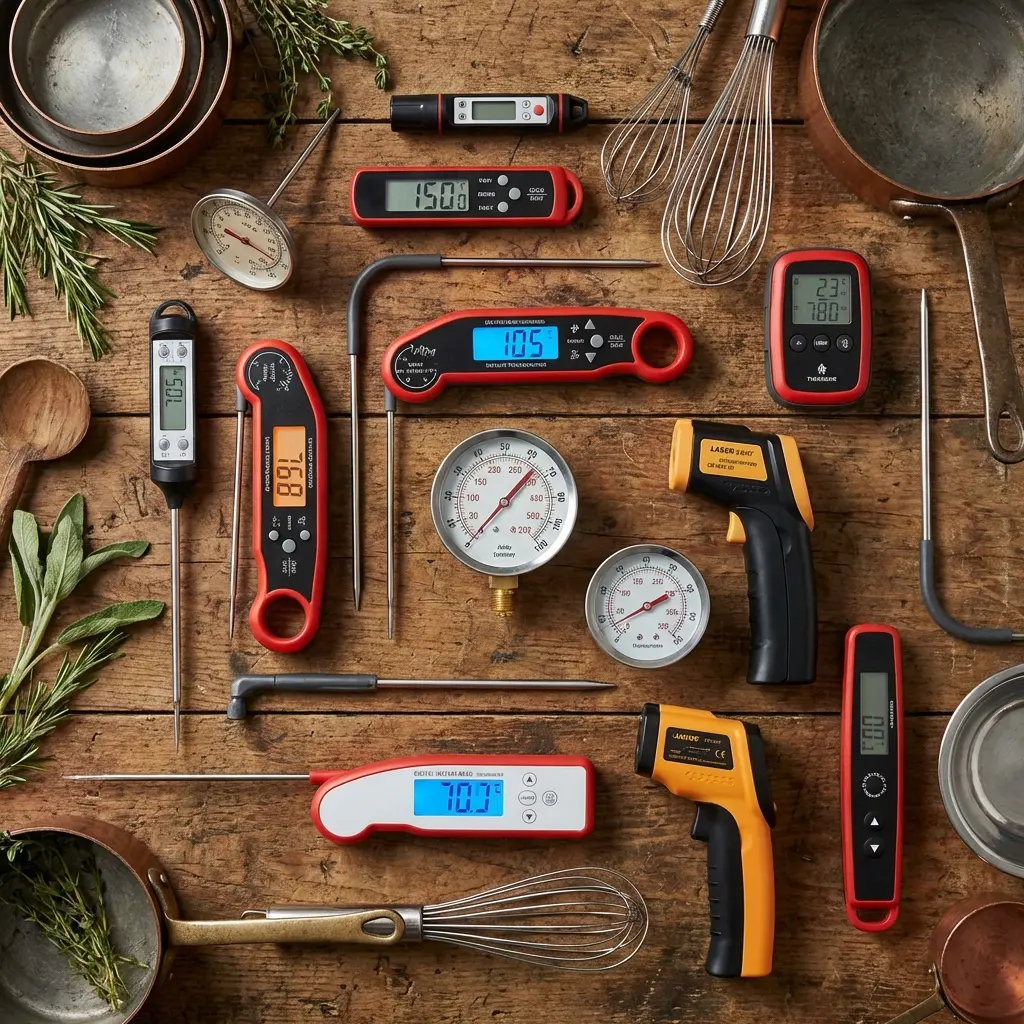
Types of Meat Thermometers: Which One Do You Need?
Walking down the kitchen gadget aisle is overwhelming. There are digital wands, probes with wires, Bluetooth spikes, and laser guns. Which one is for grilling? Which one is for roasting?
The truth is, a well-equipped kitchen usually needs two types.
In this guide, we categorize the four main types of temperature tools, explain their specific use cases, and helping you decide what to buy.
1. The Instant-Read (The Essential)
This is the handheld digital "pen." You open the oven, poke the food, read the number, and close the oven.
- Best For: Steaks, Burgers, Fish, Chops, checking Chicken Breasts.
- Why: It is fast (2-3 seconds). It allows you to check multiple pieces of meat in different spots quickly.
- Limitation: You cannot leave it in the oven (it will melt). You have to open the door to use it, which releases heat.
- Verdict: Mandatory. Every cook needs one.
2. The Leave-In Probe (The Roaster's Friend)
This consists of a metal probe on a long heat-resistant wire that connects to a display unit sitting outside the oven or grill.
- Best For: Large Roasts (Turkey, Prime Rib, Pork Shoulder), Smoked Brisket.
- Why: It tracks the temperature in real-time. You can set an alarm: "Beep when internal temp hits 160°F71°C." You never have to open the oven door, leading to faster, more even cooking.
- Limitation: The wire. It can be cumbersome. High heat (500°F260°C+) can melt the insulation on cheap wires.
- Verdict: Highly Recommended for holiday cooking and BBQ.
3. The Wireless Smart Thermometer (The Tech Upgrade)
The modern evolution of the Leave-In Probe. The "wire" is gone. The probe itself contains a battery and Bluetooth transmitter that sends data to your phone.
- Best For: Rotisserie (no wires to tangle!), Outdoor Grilling (monitor from the couch).
- Why: Convenience. Also, the seal on the oven/grill is tighter without a wire running through the door.
- Limitation:
- Cost: Expensive ($80–$150 per probe).
- Thickness: The probe is much thicker than a standard one to house the electronics, leaving a larger hole in the meat. Not good for thin steaks.
- Battery Life: You have to charge it.
- Verdict: A luxury for tech-lovers and rotisserie enthusiasts.
4. Infrared (Laser) Thermometer (The Surface Specialist)
A gun that shoots a laser beam and reads the heat radiation bouncing off the object.
- Best For: Pizza stones, Cast Iron skillets, checking oil temp for frying.
- Why: It tells you exactly how hot your cooking surface is instantly from a distance.
- Limitation: USELESS FOR MEAT SAFETY. It only measures the surface. It will tell you your frozen chicken is 400°F204°C on the outside while the inside is still ice.
- Verdict: Great tool for pizza and searing, but does not replace a food probe.
5. The Disposable "Pop-Up" Timer
Often found in turkeys. A plastic stick with a spring held down by a metal that melts at a specific temp.
- Best For: The trash can.
- Why: Inaccurate. Usually set excessively high (185°F85°C). Single-use plastic waste.
- Verdict: Ignore them.
Summary: What Should You Buy?
The Starter Kit
- Good Instant-Read: ($30–$50). This handles 90% of tasks.
The BBQ/Roast Kit
- Good Instant-Read: For spot checking.
- Dual-Probe Leave-In: ($40). One probe for the meat, one probe to monitor the air temp of the smoker/oven.
Frequently Asked Questions (FAQ)
Q: Can I use a candy thermometer for meat?
A: Generally, no. Candy thermometers are usually glass (fragile) and designed to clip onto a pot rim. They respond slowly.
Q: Why did my probe wire melt?
A: You likely used it on a grill with a flare-up. Most probe wires are rated for 400°F204°C–500°F260°C. Direct flame is 1000°F538°C+. Wrap wires in foil or route them away from flames.
Q: Are analog dials ever good?
A: Only for leaving in a large roast if you have absolutely no other option. They are better than nothing, but barely. They are hard to read and slow. Upgrade to digital.