
Temperature Reference Chart: Freezing, Boiling, Body Temp in °F, °C & K
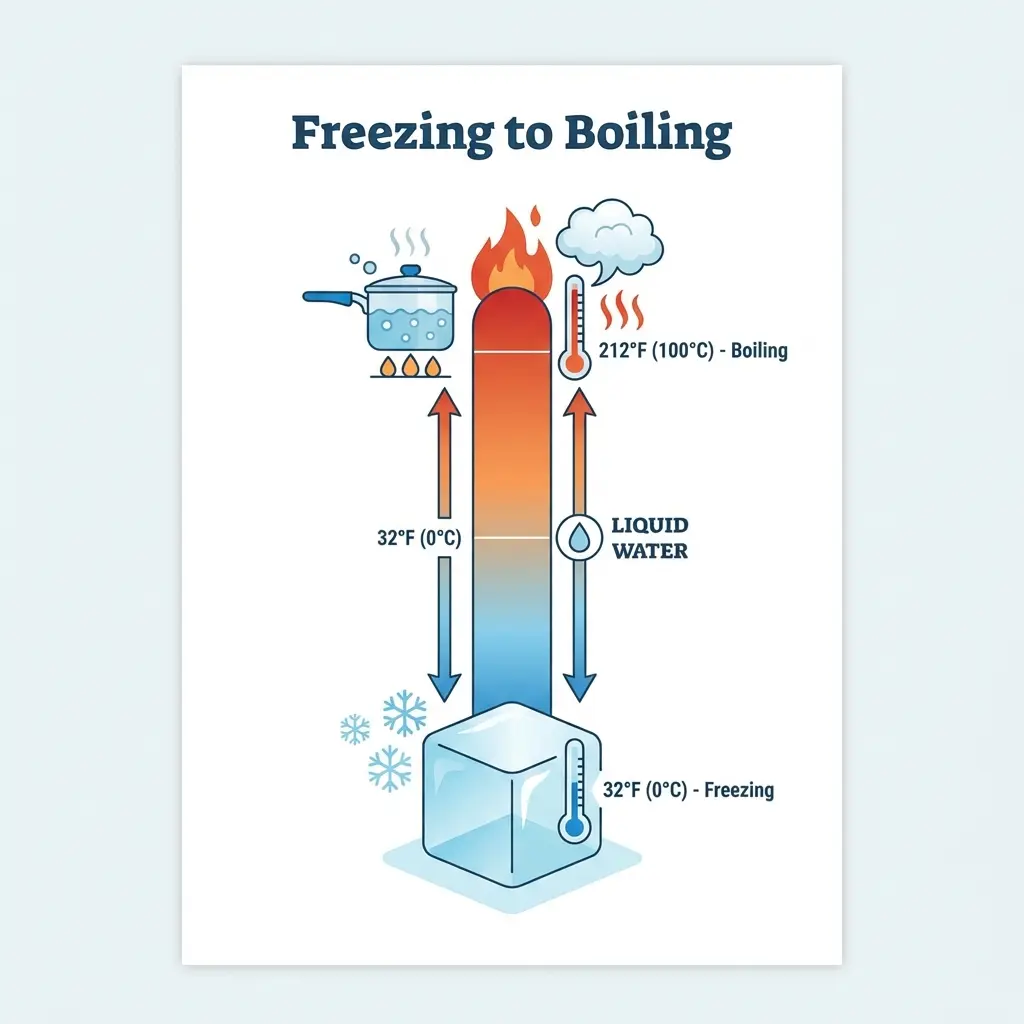
Temperature references span an enormous range — from the coldest temperature in the universe to the surface of the sun. For everyday cooking and home use, the most useful references cluster between -20°F and 500°F. Here is the complete reference chart across all three major scales, with context for each value.
The Complete Temperature Reference Chart
| Temperature Event / Context | Fahrenheit (°F) | Celsius (°C) | Kelvin (K) |
|---|---|---|---|
| Absolute Zero | -459.67°F | -273.15°C | 0 K |
| Liquid helium (boiling) | -452°F | -269°C | 4 K |
| Liquid nitrogen (boiling) | -320°F | -196°C | 77 K |
| Dry ice (solid CO₂) | -109°F | -78.5°C | 194 K |
| Standard Home Freezer | 0°F | -18°C | 255 K |
| The -40 Crossover Point | -40°F | -40°C | 233 K |
| Record US winter temp (Rogers Pass, MT 1954) | -70°F | -57°C | 216 K |
| Mercury freezing point | -38°F | -39°C | 234 K |
| Freezing Point of Water | 32°F | 0°C | 273.15 K |
| Maximum Safe Fridge Temp (FDA) | 40°F | 4°C | 277 K |
| Ideal Refrigerator Temperature | 35–38°F | 2–3°C | 275–276 K |
| Room Temperature (standard) | 68–72°F | 20–22°C | 293–295 K |
| Human Body Temperature | 98.6°F | 37°C | 310 K |
| Fever threshold | 100.4°F | 38°C | 311 K |
| Bacteria grow fastest | 100–115°F | 38–46°C | 311–388 K |
| Food Danger Zone (top) | 140°F | 60°C | 333 K |
| Safe fish / whole pork or beef | 145°F | 63°C | 318 K |
| Safe ground meat | 160°F | 71°C | 344 K |
| Safe poultry temperature | 165°F | 74°C | 347 K |
| Pasteurization (HTST) | 161°F | 72°C | 345 K |
| Hot coffee serving temp | 160–185°F | 71–85°C | 344–358 K |
| Coffee brewing optimal | 195–205°F | 91–96°C | 364–369 K |
| Boiling Water (sea level) | 212°F | 100°C | 373.15 K |
| Water boiling in Denver, CO | 202°F | 94°C | 367 K |
| Maillard reaction starts | ~280°F | ~138°C | 411 K |
| Caramelization of sugar | 320°F | 160°C | 433 K |
| Standard baking temperature | 325–375°F | 163–191°C | 436–464 K |
| Deep frying temperature | 350–375°F | 177–191°C | 450–464 K |
| Home oven maximum | 500–550°F | 260–288°C | 533–561 K |
| Neapolitan pizza oven floor | 750–900°F | 400–482°C | 673–755 K |
| Smoke point of olive oil | 375°F | 190°C | 463 K |
| Smoke point of avocado oil | 520°F | 271°C | 544 K |
| Lead melting point | 621°F | 327°C | 600 K |
| Aluminum melting point | 1,220°F | 660°C | 933 K |
| Surface of the Sun | 9,940°F | 5,505°C | 5,778 K |
The Three Temperature Scales Explained
Fahrenheit (°F)
- Origin: Daniel Gabriel Fahrenheit, 1724 (German physicist)
- Zero point: Temperature of an ice/salt/water solution (brine)
- Water reference: Freezes at 32°F, boils at 212°F
- Degree size: Smaller degree steps than Celsius (9°F = 5°C in magnitude)
- Used in: United States, Belize, Palau, Micronesia
Celsius (°C)
- Origin: Anders Celsius, 1742 (Swedish astronomer)
- Zero point: Freezing point of pure water
- Water reference: Freezes at 0°C, boils at 100°C
- Degree size: Larger than Fahrenheit (1°C = 1.8°F)
- Used in: Every country except the US for everyday use; universal in science
Kelvin (K)
- Origin: William Thomson (Lord Kelvin), 1848 (Irish physicist)
- Zero point: Absolute zero — no possible lower temperature
- Degree size: Same as Celsius (1 K = 1°C in magnitude)
- Note: No degree symbol used — written as "273 K" not "273°K"
- Used in: All scientific work worldwide
Converting Between the Scales
| Conversion | Formula |
|---|---|
| Fahrenheit → Celsius | °C = (°F − 32) × 5/9 |
| Celsius → Fahrenheit | °F = (°C × 9/5) + 32 |
| Celsius → Kelvin | K = °C + 273.15 |
| Kelvin → Celsius | °C = K − 273.15 |
| Fahrenheit → Kelvin | K = (°F − 32) × 5/9 + 273.15 |
| Kelvin → Fahrenheit | °F = (K − 273.15) × 9/5 + 32 |
For interactive converters and specific conversion guides, see our °F to °C guide, °C to °F guide, and Kelvin to Fahrenheit guide.
Frequently Asked Questions
What are the key water temperature reference points in Fahrenheit and Celsius?
The key water temperature reference points: freezing = 32°F (0°C), boiling at sea level = 212°F (100°C). These two points were used to calibrate both the Fahrenheit and Celsius scales. Fahrenheit set freezing at 32 (not 0) based on a salt/ice/water mixture reference. Celsius set freezing at 0 and boiling at 100, creating a more logical 100-point span.
What is absolute zero in Fahrenheit and Celsius?
Absolute zero — the theoretical minimum temperature where all molecular motion stops — is -459.67°F (-273.15°C) or 0 Kelvin. It has never been reached experimentally. The closest achieved in a laboratory is approximately 0.0000000001 Kelvin (100 picokelvins), achieved using laser cooling of atomic gases.
At what temperature are Fahrenheit and Celsius the same?
Fahrenheit and Celsius intersect at -40°. At -40°F = -40°C. This is the only temperature where both scales read the same number. The formula confirms this: -40°F = (-40 − 32) × 5/9 = -72 × 5/9 = -40°C.
What is normal body temperature in Celsius?
Normal human body temperature is 37°C (98.6°F). However, normal body temperature varies by individual, time of day, measurement method (oral, rectal, axillary), and age. A fever is generally defined as 38°C (100.4°F) or above. Hypothermia begins when core temperature drops below 35°C (95°F).
What temperature is a comfortable room temperature in Fahrenheit and Celsius?
Comfortable room temperature for most people is 68–72°F (20–22°C). The ASHRAE (American Society of Heating, Refrigerating and Air-Conditioning Engineers) recommends 68–76°F (20–24°C) for occupied spaces. Office environments typically target 70°F (21°C) as a workplace standard.