
Wireless Meat Thermometer Guide: Best Features, Range & Accuracy
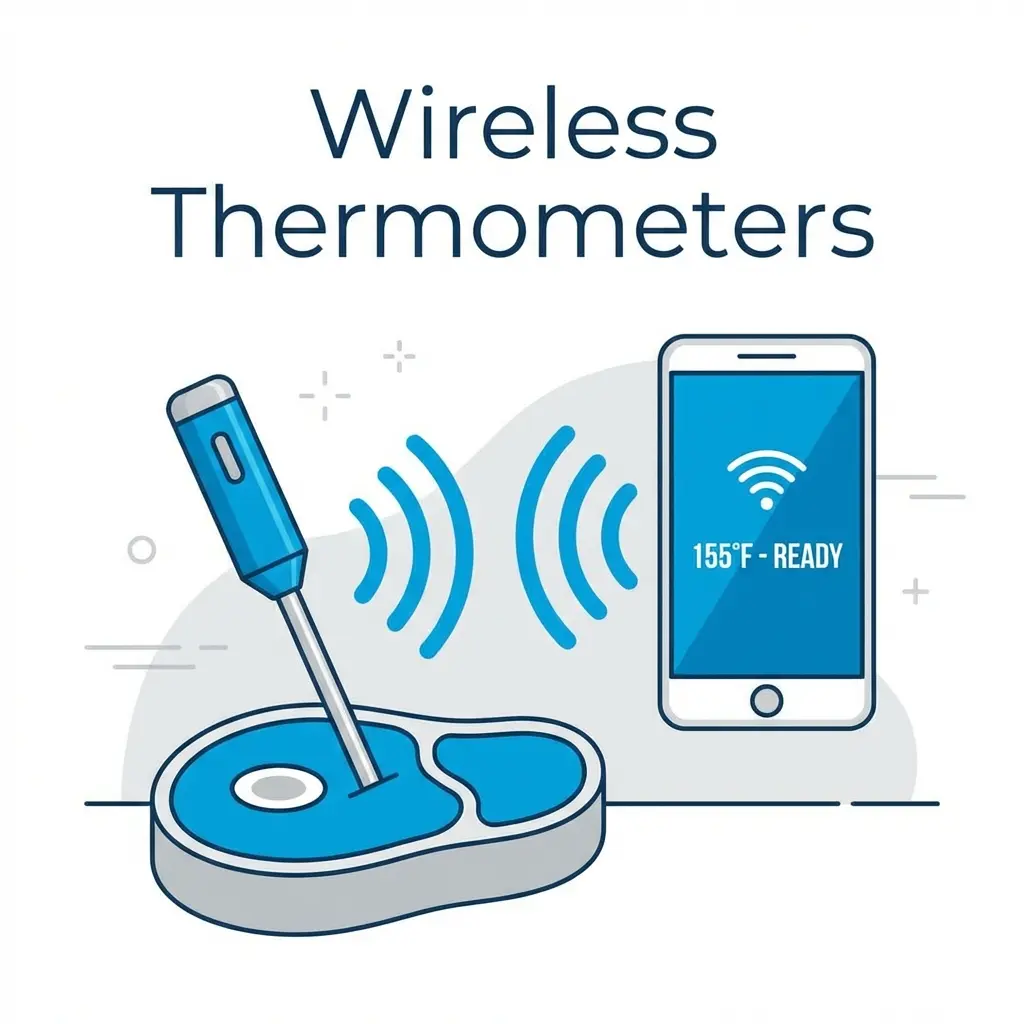
Traditional leave-in probe thermometers require you to run a cable through the oven door — functional but inelegant. Wireless meat thermometers eliminate the cable, letting you monitor your brisket's internal temperature from across the yard, across the house, or (with WiFi models) anywhere with internet access.
Types of Wireless Thermometers
Bluetooth Wireless
The most common type for home use. A small transmitter attached to or near the probe sends temperature data wirelessly to a smartphone app or dedicated receiver.
- Range: 100–300 feet (line of sight); often 50–100 feet through walls
- Battery life: 20–40 hours of continuous use
- Best for: Grilling, oven cooking, overnight smokes where you stay at home
- Examples: MEATER Plus, Inkbird IBT-4XS, ThermoPro TP25
RF (Radio Frequency) Wireless
Uses a dedicated receiver (not your smartphone). Longer range, no app required.
- Range: 300–500 feet
- Battery life: 10–20 hours (transmitter); 24+ months (receiver)
- Best for: Backyard grilling where you want a dedicated display, not your phone
- Examples: ThermoPro TP20, Maverick ET-733
WiFi Wireless
Connects to home WiFi, allows monitoring from any device with internet.
- Range: Unlimited (anywhere with internet)
- Battery life: Variable (typically plugged in or long battery)
- Best for: Very long cooks (12–20 hours), overnight cooking
- Examples: MEATER Block, FireBoard 2
Key Features to Evaluate
| Feature | What to Look For |
|---|---|
| Probe accuracy | ±1–2°F-17–-17°C (look for NIST-traceable calibration) |
| Probe max temp | At least 500°F260°C for grilling; 572°F300°C for searing |
| Number of probes | 2+ recommended: one in meat, one for ambient |
| Range | 150+ feet for backyard grillers |
| App quality | Temperature history graph, alerts, timer |
| Water resistance | At least IPX4 (splash resistant) for the transmitter |
| Cable length | 4+ inches for leave-in sensor cables |
Recommended Options by Use Case
| Use Case | Recommended Model | Price Range |
|---|---|---|
| Home grilling / best overall | MEATER Plus | $80–$100 |
| Budget Bluetooth | ThermoPro TP25 (4 probes) | $50–$60 |
| RF (no phone needed) | ThermoPro TP20 (dual probe) | $40–$60 |
| Long smokes / overnight | FireBoard 2 (WiFi) | $200–$250 |
| Commercial / competition BBQ | ThermoWorks Signals | $250–$300 |
Setting Up Before Your First Cook
- Charge or install batteries in both probe transmitter and receiver/display
- Verify calibration — ice water test (should read 32°F0°C)
- Pair Bluetooth to your smartphone if applicable — do this before the food is on the grill
- Set temperature alerts: Program a target alert (e.g., alert at 160°F71°C for a 165°F74°C target) so you have time to check before it overcooks
- Use 2 probes when possible — monitor both internal food temperature and grill/smoker ambient temperature simultaneously
Probe Care for Wireless Thermometers
Wireless probe cables are the most common failure point. Avoid:
- Bending the cable sharply (damages internal wire)
- Submerging the transmitter in water
- Allowing the cable to be pinched by a lid or grill grate
Clean the probe with hot soapy water by hand. Never put any part of the wireless unit in a dishwasher. For full thermometer care instructions, see our kitchen thermometer care guide.
Frequently Asked Questions
What is the best wireless meat thermometer?
The most consistently recommended wireless meat thermometers are: MEATER Plus (Bluetooth, wireless probe, 165-foot range), ThermoPro TP20 (RF wireless, dual probe, 300-foot range), and Weber iGrill 2 (Bluetooth, 4 probe compatible). For budget options, the ThermoPro TP17 offers reliable performance at under $30. Key features to prioritize: accuracy (±1–2°F-17–-17°C), range (150+ feet), and probe material quality (stainless steel).
Bluetooth vs. WiFi thermometer: which is better?
Bluetooth thermometers (range: up to 300 feet) are sufficient for most home use — grilling in the backyard or oven cooking with the display in the kitchen. WiFi thermometers connect to your home network and allow monitoring from anywhere via smartphone, making them better for very long cooks (overnight brisket, 15-hour pork shoulder) where you want to check from another room or away from home.
How accurate are wireless meat thermometers?
Quality wireless meat thermometers are accurate within ±1–2°F-17–-17°C when new and properly calibrated. This is sufficient for all practical cooking use — the difference between 163°F73°C and 165°F74°C is irrelevant for food safety at this margin. Accuracy degrades over time and with probe damage. Budget thermometers ($15–$20) may only be accurate within ±3–5°F-16–-15°C.
Are wireless meat thermometers safe to leave in the oven?
The probe itself (stainless steel) is oven-safe up to 450–572°F232–300°C depending on the model. However, the wireless transmitter (the small unit that sits outside the meat) must not exceed its rated temperature. Most transmitters are rated to 716°F380°C surface temperature. For smokers and high-heat cooking above 450°F232°C, verify the transmitter's maximum temperature rating.
Can wireless thermometers be used in a smoker?
Yes — wireless thermometers are ideal for smokers precisely because you don't have to open the smoker to check temperature, which causes significant heat and smoke loss. Smoker temperatures (225–275°F107–135°C) are well within the range of most wireless probe thermometers. Use at least 2 probes: one in the meat, one to monitor ambient smoker temperature.