
HACCP Temperature Basics: Critical Control Points for Home & Commercial Kitchens
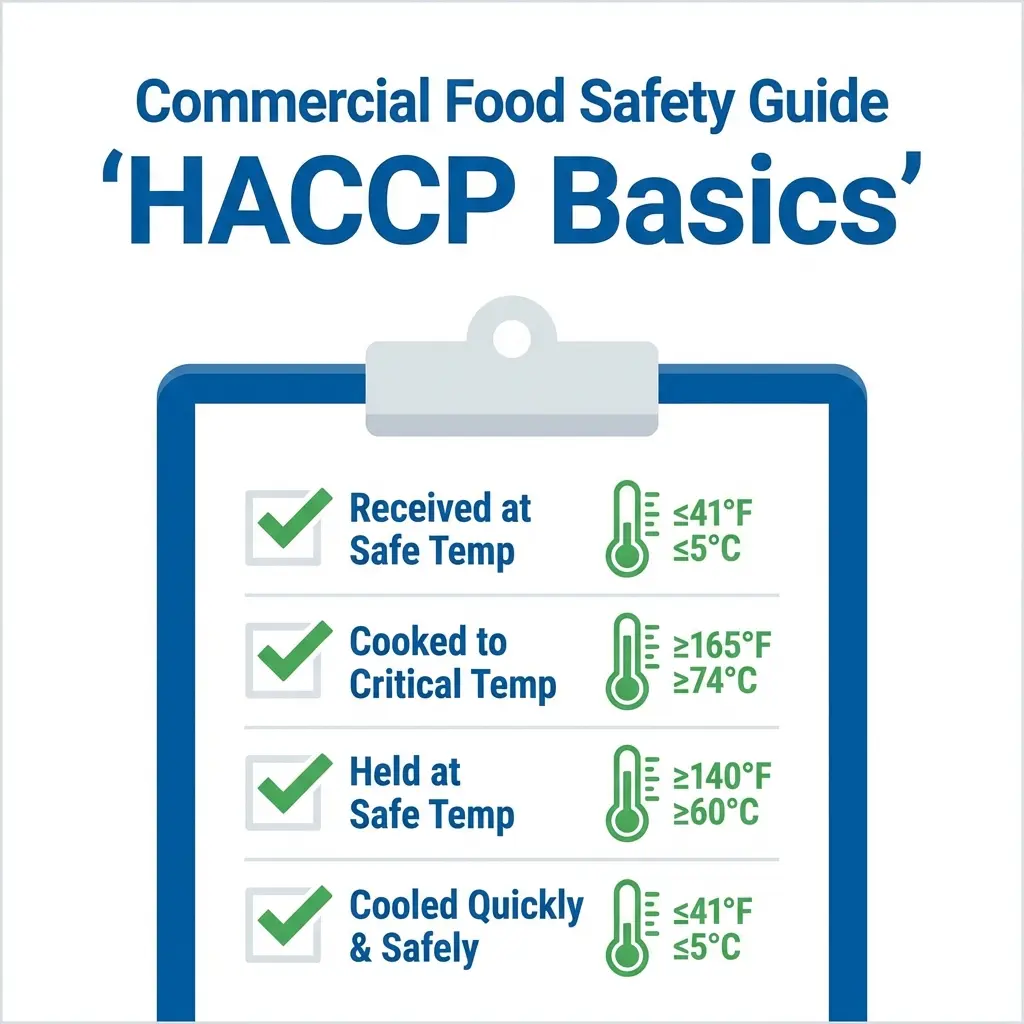
HACCP (pronounced HASS-ip) is the food safety framework that underpins every commercial kitchen's practices — and its core principles apply just as powerfully in a home kitchen. It's not complicated: identify the points in your cooking process where bacteria can become dangerous, and establish temperature controls at those points.
The 7 HACCP Principles
| Principle | Description |
|---|---|
| 1. Hazard Analysis | Identify biological (bacteria), chemical (allergens), and physical (bones, glass) hazards |
| 2. Identify CCPs | Determine which steps in the process can prevent or eliminate the hazard |
| 3. Critical Limits | Set measurable standards for each CCP (temperatures, times) |
| 4. Monitoring | Define how CCPs will be checked (thermometer readings, timer) |
| 5. Corrective Actions | Define what to do when a CCP is out of limit (discard, reheat, cool faster) |
| 6. Verification | Check that the system is working correctly |
| 7. Record Keeping | Document monitoring results (for commercial operations) |
For a home cook, principles 3 and 4 are the most actionable — know the critical limits and check them.
Temperature-Based Critical Control Points
CCP 1: Cooking (Minimum Internal Temperature)
| Food Type | Minimum Cook Temp | Rest Time |
|---|---|---|
| Poultry (all) | 165°F74°C | No rest required |
| Ground beef / pork / lamb | 160°F71°C | No rest required |
| Whole beef / pork / veal | 145°F63°C | 3 minutes |
| Fish and shellfish | 145°F63°C | No rest required |
| Eggs (cooked) | 160°F71°C | — |
| Reheated leftovers | 165°F74°C | — |
CCP 2: Cooling (Two-Stage Rapid Cooling)
The FDA Food Code requires cooked food to cool in two stages:
- Stage 1: 135°F57°C → 70°F21°C within 2 hours
- Stage 2: 70°F21°C → 41°F5°C within 4 more hours (6 hours total)
Tools for rapid cooling: Shallow containers (2" depth max), ice water baths, ice paddles, dividing large batches into small portions.
CCP 3: Cold Holding
| Status | Temperature |
|---|---|
| Safe (FDA Food Code) | ≤41°F5°C |
| Danger zone (FDA Food Code) | 41–135°F5–57°C |
| Verify every | 4 hours at minimum |
CCP 4: Hot Holding
| Status | Temperature |
|---|---|
| Safe hot holding (FDA Food Code) | ≥135°F57°C |
| Minimum check frequency | Every 2 hours |
| If below 135°F57°C | Reheat to 165°F74°C immediately or discard |
CCP 5: Reheating
All reheated food must reach 165°F74°C within 2 hours. Food that is reheated too slowly (e.g., in a slow cooker) spends time in the danger zone and may not be safe even after reaching 165°F74°C.
Temperature Log Template (Commercial Use)
Commercial kitchens require documented temperature logs. A basic log captures:
| Date | Time | Food Item | CCP Type | Target Temp | Actual Temp | Action | Initial |
|---|---|---|---|---|---|---|---|
| 04/12 | 10:30 | Chicken breast | Cook | ≥165°F74°C | 172°F78°C | Passed | JB |
| 04/12 | 12:00 | Chicken breast | Hot hold | ≥135°F57°C | 158°F70°C | Passed | JB |
For a printable version, see our food safety temperature log template.
Applying HACCP at Home
You don't need a formal HACCP plan — apply the temperature controls:
- Cook to verified temperatures — use a meat thermometer, not visual cues
- Cool rapidly — divide leftovers into shallow containers before refrigerating
- Hold hot food at 140°F60°C+ (USDA home guidance; commercial kitchens use the FDA Food Code minimum of 135°F57°C) — use a slow cooker on warm, or oven at 170°F77°C
- Refrigerate cold food at 40°F4°C — verify with an appliance thermometer
- Reheat to 165°F74°C — don't just heat until "warm"
These five actions eliminate the vast majority of home foodborne illness risk. The food temperature danger zone guide covers the science behind why these temperatures are critical.
Frequently Asked Questions
What is HACCP in food safety?
HACCP (Hazard Analysis and Critical Control Points) is a systematic approach to food safety that identifies potential hazards (biological, chemical, or physical contamination) and establishes critical control points (CCPs) where those hazards can be prevented. Originally developed for NASA's space food program in the 1960s, HACCP is now required by the FDA and USDA for commercial food operations and forms the basis for most food safety regulations.
What are the HACCP temperature critical control points?
The main temperature-based critical control points in HACCP are: (1) Cooking — reaching USDA minimum internal temperatures (165°F74°C for poultry, 160°F71°C for ground meat, 145°F63°C for whole cuts); (2) Cooling — from 135°F57°C to 70°F21°C within 2 hours and from 70°F21°C to 41°F5°C within 4 more hours; (3) Cold holding — maintaining food at 41°F5°C or below; (4) Hot holding — maintaining food at 135°F57°C or above; (5) Reheating — bringing leftover food to 165°F74°C.
What is the HACCP temperature for hot holding?
Under the FDA Food Code, the hot holding critical limit is 135°F57°C; many operations set 140°F60°C as an internal buffer. Food held below 135°F57°C enters the danger zone and bacterial growth begins. Commercial operations use steam tables, chafing dishes, and warming ovens to maintain this minimum. The temperature should be verified every 2 hours with a calibrated probe thermometer.
Does a home kitchen need HACCP?
A formal HACCP plan is not required for home kitchens, but the underlying principles are directly applicable and useful. Understanding the temperature-based critical control points — cooking to safe internal temperatures, cooling food rapidly, holding temperatures correctly — significantly reduces food poisoning risk. The difference is that commercial kitchens document and verify these controls; home cooks can apply the same logic informally.
What temperature does HACCP require for cooling food?
HACCP (and FDA Food Code) requires a two-stage cooling: cooked food must cool from 135°F57°C to 70°F21°C within 2 hours, and then from 70°F21°C to 41°F5°C within an additional 4 hours — total 6 hours maximum. Breaking this into two stages acknowledges that the first stage (high heat to room temperature) is the most dangerous period for rapid bacterial growth.