
How Long Does Frozen Food Last? Safety vs. Quality Storage Chart
Quick Answer
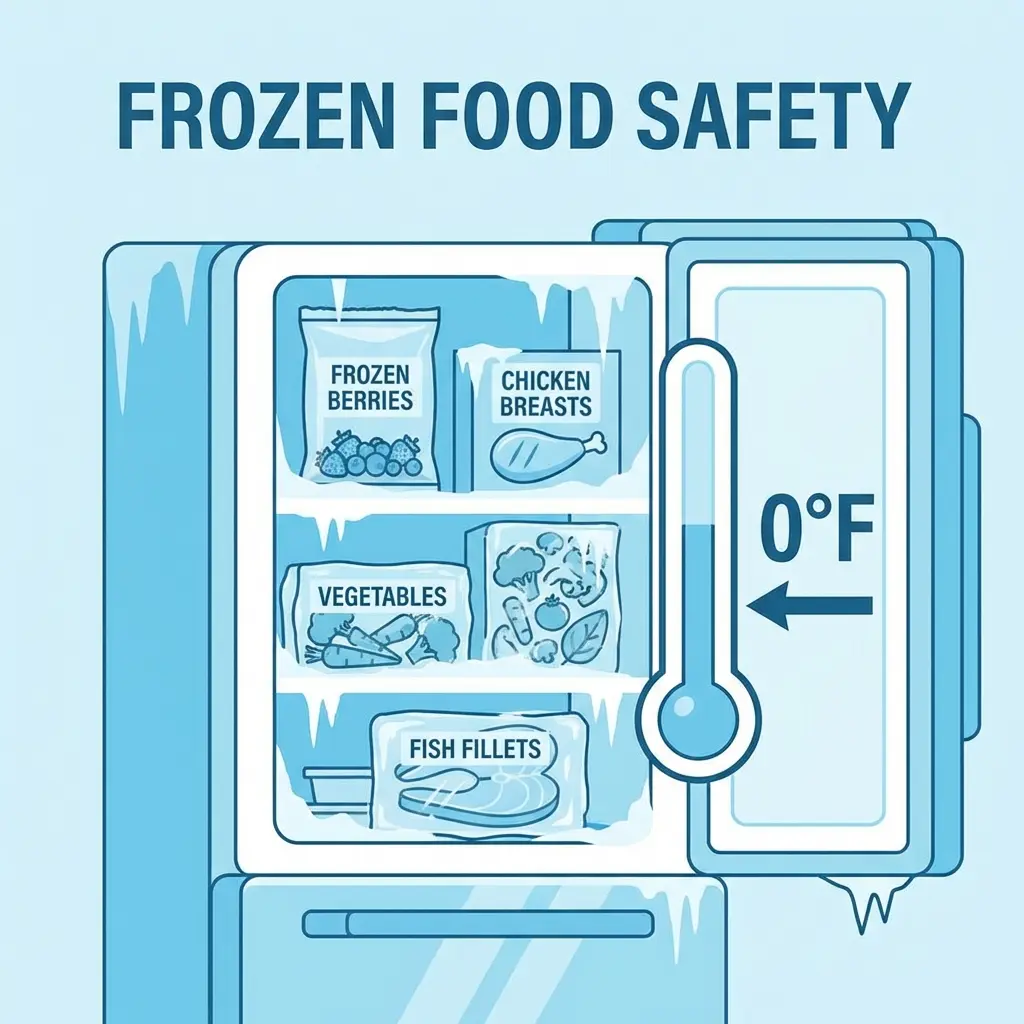
Food kept frozen at 0°F-18°C is safe to eat indefinitely — freezing stops bacterial growth completely. Quality is what fades: ground meat is best within 3–4 months, chicken pieces within 9 months. Discard food only if it thawed above 40°F4°C.
Freezing is the most effective long-term food preservation method available to home cooks. At 0°F-18°C, biological time effectively stops — bacteria cannot grow, mold cannot form, and enzymatic spoilage is dramatically slowed. The food safety principle is simple: frozen food stored at 0°F-18°C is safe indefinitely.
The quality principle is different: frozen food degrades over time even at safe temperatures, through enzymatic reactions, fat oxidation, and moisture loss (freezer burn). Storage time recommendations are about quality, not safety.
Frozen Food Safety vs. Quality Timeline
| Food | Safe (Bacterial) | Best Quality |
|---|---|---|
| Ground beef / pork | Indefinitely at 0°F-18°C | 3–4 months |
| Beef steaks / roasts | Indefinitely at 0°F-18°C | 6–12 months |
| Lamb | Indefinitely at 0°F-18°C | 6–9 months |
| Pork chops | Indefinitely at 0°F-18°C | 4–6 months |
| Whole chicken | Indefinitely at 0°F-18°C | 1 year |
| Chicken parts | Indefinitely at 0°F-18°C | 9 months |
| Ground chicken/turkey | Indefinitely at 0°F-18°C | 3–4 months |
| Whole turkey | Indefinitely at 0°F-18°C | 1 year |
| Fatty fish (salmon) | Indefinitely at 0°F-18°C | 2–3 months |
| Lean fish (cod, tilapia) | Indefinitely at 0°F-18°C | 6 months |
| Shrimp / scallops | Indefinitely at 0°F-18°C | 3–6 months |
| Cooked leftovers | Indefinitely at 0°F-18°C | 2–3 months |
| Bread / baked goods | Indefinitely at 0°F-18°C | 2–3 months |
| Vegetables (blanched) | Indefinitely at 0°F-18°C | 8–12 months |
| Fruits | Indefinitely at 0°F-18°C | 8–12 months |
Why "Indefinitely Safe" Has a Practical Limit
While bacteria can't grow at 0°F-18°C, other processes still occur slowly:
- Fat oxidation (rancidity): Fats react with oxygen even at freezer temperatures, producing off-flavors. Bacon and fatty sausage go rancid faster than lean cuts
- Freezer burn: Sublimation (ice evaporating directly to vapor) dehydrates the food surface, creating dry, leathery, gray-brown patches
- Protein denaturation: Protein structure degrades slowly even when frozen, affecting texture after thawing
- Enzyme activity: Enzymes in fruits and vegetables (blanching stops this) continue degrading color and nutrients at very slow rates
When to Actually Discard Frozen Food
Frozen food should be discarded when:
- Fully thawed at room temperature — if meat sat out for more than 2 hours at room temperature before being refrozen, discard it. Bacteria grew during the thaw period
- Power outage-related full thaw — frozen food that fully thawed during a power outage and reached room temperature should be discarded (raw meat, fish, poultry)
- Strong off-odors after thawing — a sour, rancid, or rotten smell after thawing indicates the food was already spoiling before freezing, or was stored at improper temperatures
- Visible mold — mold cannot grow at 0°F-18°C but can survive freezing. If mold was present before freezing, it may appear after thawing
Freezer burn alone is NOT a reason to discard food. Food with freezer burn is safe — just less tasty. Trim the affected areas (the gray-brown, leathery patches) before cooking and use the remaining food normally.
Safe Thawing After Long Freezer Storage
For food that has been frozen for an extended time, use the refrigerator thawing method — it's the slowest but safest for longer-frozen foods whose quality may already be borderline. See our thawing food safely guide for step-by-step instructions by protein type.
Regardless of how long the food was frozen, cook it to the appropriate safe internal temperature. Freezing does not sterilize food.
Frequently Asked Questions
Is it safe to eat food that has been frozen for a year?
Food stored continuously at 0°F-18°C is safe to eat indefinitely from a food safety standpoint — bacteria cannot grow at 0°F-18°C. However, quality (flavor, texture, moisture) degrades over time. Beef roasts and whole chickens maintain good quality for up to 1 year. Ground meat and fatty fish decline faster (3–4 months). Food stored beyond recommended times is safe but may taste poor.
What frozen foods should be discarded?
Discard frozen food that: was thawed at room temperature and refrozen (bacteria may have grown during thawing), shows signs of extreme freezer burn with strong off-odors after thawing, was stored in a freezer that failed and food fully thawed (especially meat and fish), or smells sour or rotten after thawing. Food with only surface freezer burn is safe — trim those areas before cooking.
How long can you keep frozen chicken?
Frozen chicken maintains best quality for: whole chicken (1 year), chicken pieces and parts (9 months), ground chicken (3–4 months). These are quality guidelines — frozen chicken stored beyond these times is still safe to eat at 0°F-18°C but will have degraded texture and flavor, particularly from freezer burn and protein denaturation.
Does freezing kill bacteria in food?
No. Freezing puts bacteria into a dormant state — they stop reproducing and producing toxins, but they do not die. When food thaws and re-enters the temperature danger zone (40°F4°C–140°F4°C–60°C), bacteria 'wake up' and resume growing. Food that was contaminated before freezing remains contaminated after thawing. Cooking to safe internal temperatures is still required.
Can you refreeze food after thawing?
Food thawed in the refrigerator (at 40°F4°C or below) can be safely refrozen before cooking. Quality will suffer from moisture loss during the freeze-thaw-refreeze cycle, but it's safe. Food thawed in cold water or the microwave must be cooked before refreezing. Food thawed on the counter should not be refrozen — discard it.