
Best Instant-Read Thermometer: What to Look For (Speed, Accuracy & Price Tiers)
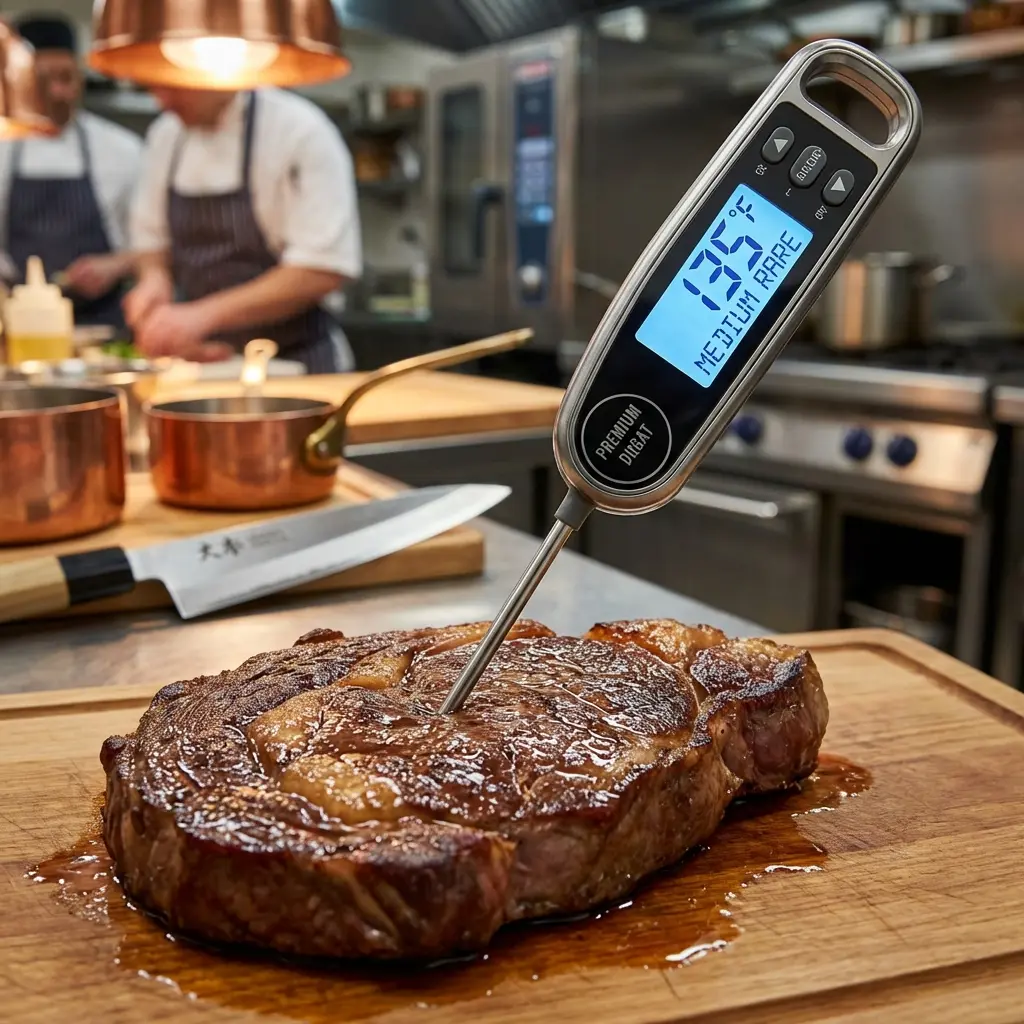
If you take away nothing else from this website, take this: You need a digital instant-read thermometer.
It is the only tool that allows you to cook with confidence. It replaces "guessing" with "knowing." But the market is flooded with $10 knock-offs and $100 professional tools. Which one do you need?
In this guide, we break down the technology (Thermocouple vs. Thermistor), the critical features you should look for, and why speed is the most important factor.
The Two Technologies
1. The Thermistor (Cheap & Slow)
Most $15 thermometers found in grocery stores use a thermistor.
- Mechanism: A resistor that changes resistance with heat.
- Speed: Slow. Takes 10–20 seconds to give a final reading.
- Sensor: The sensor is often huge, meaning you need to insert it 1 inch deep to get a reading.
- Verdict: Skip it. By the time it reads the temp, your hand is burned, or the oven heat has escaped.
2. The Thermocouple (Fast & Precise)
This is what professionals use (e.g., The Thermapen).
- Mechanism: Two different metals welded at the tip create a voltage when heating.
- Speed: Instant. 2–3 seconds.
- Sensor: Tiny. The sensor is at the very tip (needle point). You can measure a thin burger or a shrimp.
- Verdict: Buy this. You can find budget thermocouples ($30-$50) that perform 95% as well as the high-end ones.
Key Features to Look For
1. Speed (Response Time)
You want a reading in under 3 seconds. Why? Because if you are checking 10 steaks on a hot grill, you can't hold your hand over the fire for 15 seconds per steak. Speed equals safety (for your knuckles) and accuracy.
2. Accuracy ([±1|±0.5] Degree)
A good thermometer should be accurate to within 0.9°F0.5°C degrees. If it is off by 5°F3°C degrees, it's useless for candy making or safety checks.
3. Thin Tip (Probe Diameter)
Look for a "stepped down" probe tip. The very end should be as thin as a needle. This minimizes the hole in the meat (keeping juices in) and allows you to probe delicate items (like fish fillets).
4. Calibration
Can you adjust it? Eventually, all thermometers drift. Quality models have a "Cal" button or screw (usually tested in ice water at 32°F0°C). If you can't calibrate it, it is disposable.
5. Durability & Magnetism
- Waterproof: You will drop it in the sink, or leave it out in the rain near the BBQ. IP65 or IP67 rating is essential.
- Magnet: It should stick to the fridge so you never lose it.
The "Analog Dial" Myth
Throw away your analog (bimetallic strip) thermometer. You know the one—the round dial with the big needle.
- Problem 1: It takes 45 seconds to settle.
- Problem 2: The sensor coil is 2 inches long. You have to stab it halfway through a turkey to get a reading. It cannot read a steak or burger.
- Problem 3: They lose calibration if dropped once.
How Much Should You Spend?
- Budget ($25–$35): You can get a solid thermocouple (like a Javelin or a ThermoPop). It might take 3-4 seconds instead of 2, but it is accurate.
- Pro ($90–$100): The industry standard (Thermapen ONE). It reads in 1 second. It wakes up when you pick it up. It has a 5-year warranty. If you cook daily, it is worth every penny.
Summary Checklist
When shopping, look for:
- Thermocouple technology (not thermistor).
- 2–3 second response time.
- Accuracy ±0.9°F-17°C.
- IP65 Waterproofing.
- Backlit Display (for grilling at night).
- Rotating Display (so you can read it upside down / left-handed).
Frequently Asked Questions (FAQ)
Q: Can I use a laser thermometer (Infrared)?
A: NO. Infrared guns measure surface temperature only. They essentially tell you how hot the pan is, not the internal temperature of the chicken. They are great for pizza ovens, useless for meat safety.
Q: Can I leave the instant-read thermometer in the oven?
A: NO. The plastic body will melt, and the battery will explode. You want a "Leave-In Probe" (wired) thermometer for that. Instant-reads are for spot-checking only.
Q: How often should I calibrate?
A: Once every 6 months, or whenever you drop it hard. Use the Ice Water Test (32°F0°C).