
Ground Beef Temperature: 160°F71°C — Why Burgers Need More Heat Than Steaks
Quick Answer
Ground beef (burgers, meatloaf, meatballs) must be cooked to 160°F71°C — no exceptions. Unlike steaks, grinding mixes surface bacteria throughout the meat. Color is not a reliable indicator — use a thermometer.
We all love a juicy burger. But unlike a steak, which can be safely enjoyed rare, a hamburger poses a unique set of safety challenges. The rule of thumb you might use for a ribeye does essentially not apply to ground beef.
Understanding why this distinction exists—and respecting the temperature rules—is critical for preventing serious foodborne illnesses like E. coli O157:H7.
In this guide, we dive deep into the microbiology of ground meat, the non-negotiable safety temperature of 160°F71°C, and the techniques chefs use to keep burgers moist even when fully cooked.
The Magic Number: 160°F71°C
According to the USDA, all ground meat—whether it is beef, pork, veal, or lamb—must be cooked to an internal temperature of 160°F71°C.
At this temperature, harmful bacteria are destroyed almost instantly.
Why is Ground Beef Different?
The difference lies in surface area.
- Whole Muscle (Steak): Bacteria live on the outside surface of the meat. The inside is sterile. When you sear a steak, the high heat kills the surface bacteria, making the rare center safe to eat.
- Ground Meat (Burger): When meat is ground, the surface (bacteria included) is mixed throughout the entire batch. The bacteria that were on the outside are now in the dead center of your patty.
The "Sear" Is Not Enough: Because bacteria are distributed throughout the patty, searing the outside leaves the pathogens in the center alive. You must cook the center to the kill temperature of 160°F71°C.
Risks of Undercooked Ground Beef
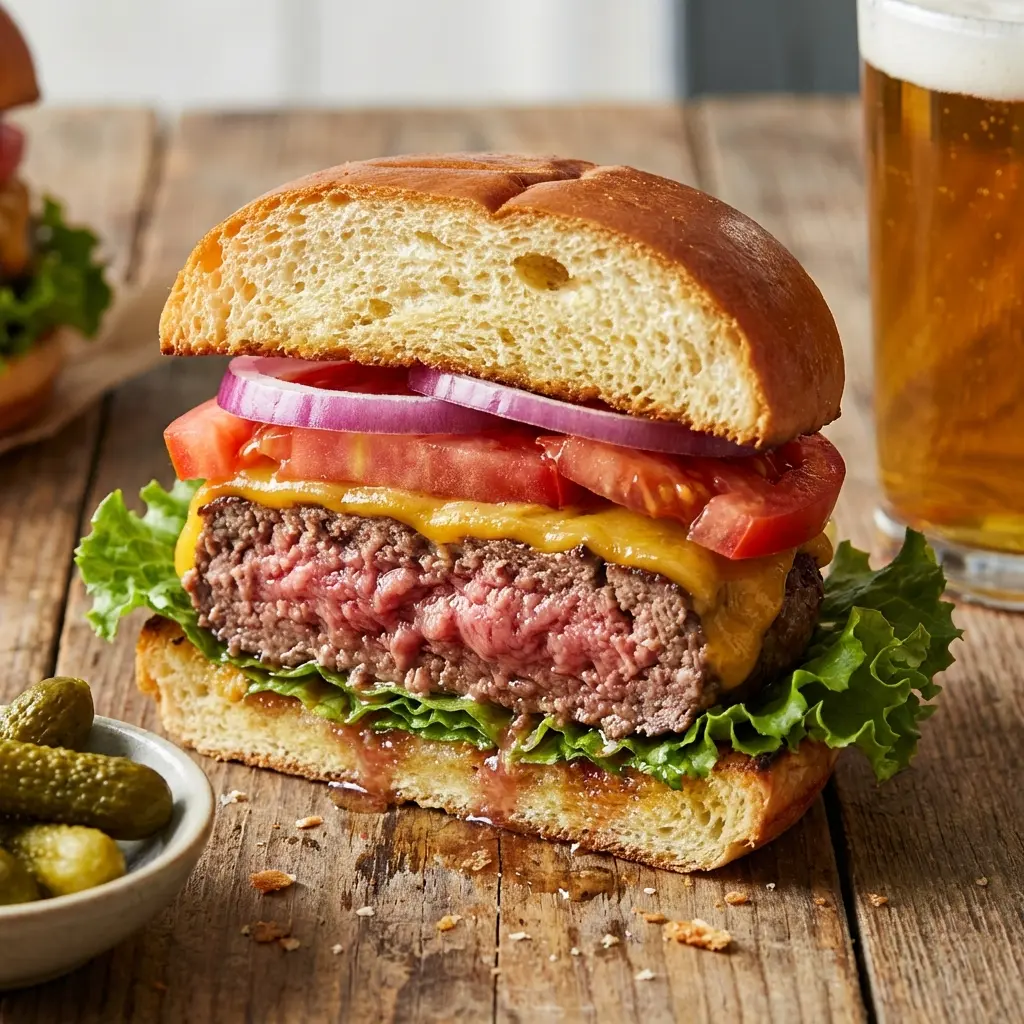
Eating a pink, rare burger (125°F52°C) is playing Russian Roulette with E. coli. While many upscale restaurants serve rare burgers, they often grind their own meat on-site from whole muscles to minimize risk. Supermarket ground beef, however, may contain meat from hundreds of different cows mixed together, exponentially increasing the chance of contamination.
Standard Symptoms of E. coli infection include severe abdominal cramps, bloody diarrhea, and vomiting. In severe cases (Hemolytic Uremic Syndrome), it can lead to kidney failure, especially in children and the elderly.
The Bottom Line: A little pink color is not worth a kidney transplant. Cook to 160°F71°C.
The Color Myth: Why "Brown" Does Not Mean "Done"
One of the most dangerous myths in cooking is that you can tell if a burger is done by looking at the color inside.
Research proves widespread inconsistency:
- Premature Browning: Some chemical compositions in meat can cause it to turn brown/gray at temperatures as low as 135°F57°C. If you stop cooking because it "looks done," you are serving unsafe bacteria-laden meat.
- Persistent Pink: Conversely, meat with high pH levels or certain nitrate exposures can remain pink even when cooked to a safe 170°F77°C!
Trust the Thermometer, Not Your Eyes. Insert an instant-read thermometer into the side of the patty to the center. If it reads 160°F71°C, it is done, regardless of color. See our meat thermometer guide for proper technique.
How to Keep Burgers Juicy at 160°F71°C
The complaint most people have is that "safe burgers are dry burgers." This is a valid concern—if you use lean meat. The secret to a juicy well-done burger is fat content.
1. The Fat Content Rule
- 95/5 or 90/10 (Lean): Good for diet, terrible for burgers. At 160°F71°C, these will be dry hockey pucks. Use these for meat sauces (Bolognese) or tacos where liquid is added.
- 85/15 (Standard): Decent balance.
- 80/20 (Ideal): This is the burger sweet spot. The 20% fat renders as the meat cooks, lubricating the protein fibers. Even at 160°F71°C, an 80/20 burger remains moist and flavorful.
2. The Indentation Trick
As burgers cook, the centers puff up. This turns your patty into a tennis ball.
- Technique: Before cooking, press a small dimple into the center of the raw patty with your thumb. This allows the meat to expand evenly, ensuring the center cooks at the same rate as the edges.
3. Do Not Press!
Never use your spatula to "squish" the burger while it cooks. That sizzling sound? That is moisture and flavor leaving your burger and vaporizing on the grill. Let it be.
Meatloaf & Meatballs
The 160°F71°C rule applies to all ground meat dishes, including meatloaf and meatballs.
Meatloaf Specifics: Because meatloaf is a large, dense brick of meat, it cooks slowly.
- Carryover Cooking: Pull your meatloaf from the oven when it reaches 155°F68°C. Let it rest for 10-15 minutes. The internal temp will rise to 160°F71°C, and the juices will redistribute, making it easier to slice without crumbling.
Meatballs: Simmering meatballs in sauce is a great safety net. Even if they aren't fully cooked after browning, 10-15 minutes in simmering sauce (185°F85°C+) ensures they reach safe internal temperatures while soaking up flavor.
Temperature Chart for Ground Meats
| Meat Type | Minimum Safe Internal Temp | Notes |
|---|---|---|
| Ground Beef | 160°F71°C | Medium-well to Well Done |
| Ground Pork | 160°F71°C | No pink allowed |
| Ground Lamb | 160°F71°C | Pink means risk |
| Ground Veal | 160°F71°C | Delicate texture, but stick to safe temp |
| Ground Turkey/Chicken | 165°F74°C | Higher temp required! Poultry has higher Salmonella risk. |
Poultry Exception: Note that ground chicken and turkey must go to 165°F74°C, not 160°F71°C. Poultry pathogens are more heat-resistant than beef pathogens.
Frequently Asked Questions (FAQ)
Q: Can I eat a medium-rare burger if I grind the meat myself?
A: It is safer than supermarket meat, but not risk-free. If you buy a whole chuck roast, dip it in boiling water for 30 seconds (to kill surface bacteria), trim the gray exterior, and then grind the sterile center, you have significantly reduced the risk. However, the USDA still officially recommends 160°F71°C.
Q: Why does my burger shrink so much?
A: Meat is mostly water and fat. As you cook it, water evaporates and fat renders. If you cook it to high temperatures (like 170°F77°C+), the protein fibers contract tightly, squeezing out volume. Higher quality meat with less added water shrinks less.
Q: How do I measure the temperature of a thin patty?
A: If the burger is thin (like a smash burger), it is very difficult to probe. The good news is that smash burgers are thin enough that the high searing heat usually cooks them through instantly. For standard 1-inch patties, insert the probe through the side.
Q: Is "Pink Slime" real?
A: "Pink Slime" (Lean Finely Textured Beef) is a beef additive treated with ammonia to kill bacteria. It is safe to eat but controversial. The best way to avoid additives is to buy ground beef labeled "100% Beef" or simply grind your own.
Q: How long can raw ground beef sit in the fridge?
A: Only 1–2 days. Because of the high surface area, bacteria multiply much faster in ground meat than in steaks. The temperature danger zone applies here. Cook it or freeze it immediately.
More Questions
What is the safe internal temperature for ground beef?
The USDA recommends cooking all ground beef to an internal temperature of 160°F71°C. This applies to hamburgers, meatloaf, meatballs, and any other dish made from ground beef. Unlike whole-muscle steaks, ground beef must be fully cooked because the grinding process distributes surface bacteria throughout the patty.
What temperature should a burger be cooked to?
Burgers (hamburgers) should reach 160°F71°C internal temperature, per USDA guidelines. Use an instant-read thermometer inserted through the side of the patty to the center. Do not rely on color — beef can turn brown before reaching a safe temperature, and can remain pink even when fully cooked.
Can ground beef be pink at 160°F71°C?
Yes. A burger can be pink in the center even when it has reached 160°F71°C. This is because some ground beef, depending on its pH or exposure to nitrates, retains a pink color even when fully cooked. Always verify doneness with a meat thermometer, not color.
What temperature is medium ground beef?
There is no safe medium for ground beef. Unlike steaks, ground beef must reach 160°F71°C — which equates to medium-well to well done — because bacteria from the exterior are mixed throughout the patty during grinding. The USDA does not consider any internal temperature below 160°F71°C safe for ground beef.
How do I keep burgers juicy at 160°F71°C?
Use ground beef with at least 20% fat content (80/20 blend). The fat renders as the burger cooks, keeping the patty moist even at 160°F71°C. Avoid pressing the patty with a spatula while cooking — this squeezes out moisture. Also press a small dimple into the center of the raw patty before cooking to prevent it from puffing up.