
Celsius to Kelvin: Instant Converter, Formula & Reference Table
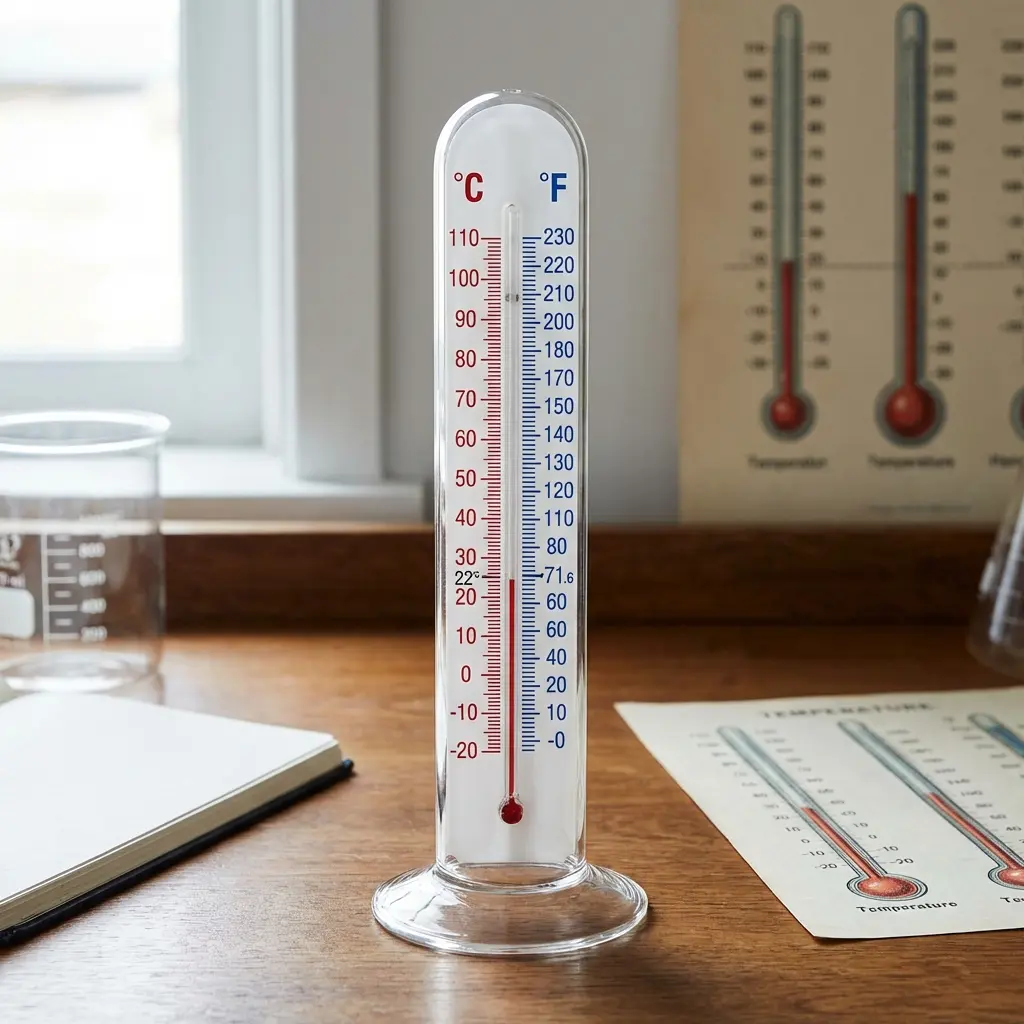
While Celsius is the standard for daily life in most of the world, and Fahrenheit holds on in the US, there is a third scale that rules the universe of science: Kelvin (K).
You won't find Kelvin on your oven dial (usually), but understanding it is essential for physics, chemistry, and high-tech cryogenic cooking. Unlike Celsius and Fahrenheit, which are "relative" scales rooted in arbitrary points (freezing water), Kelvin is an "absolute" scale.
In this guide, we explain the remarkably simple conversion and why Kelvin has no "degrees."
The Formula
Converting Celsius to Kelvin is surprisingly easy because the "step size" is identical. A change of 1 degree Celsius is exactly the same magnitude as a change of 1 unit Kelvin.
The only difference is the starting point.
K = °C + 273.15
°C = K - 273.15
Example: Boiling Water
- Celsius: 100°C
- Formula: 100 + 273.15
- Kelvin: 373.15 K
Example: Freezing Water
- Celsius: 0°C
- Kelvin: 273.15 K
Why No "Degree" Symbol?
You will notice we write 300 K, not 300°K.
- Celsius and Fahrenheit are degrees relative to a zero point.
- Kelvin is an absolute unit of thermodynamic energy.
- Saying "degrees Kelvin" is grammatically incorrect in physics, though people will understand you.
Absolute Zero: The Foundation
The Kelvin scale starts at Absolute Zero (0 K). This is the theoretical point where all molecular motion stops. It is the coldest possible temperature in the universe. There are no negative numbers in Kelvin.
- 0 K = -273.15°C (or -459.67°F).
Because negative temperatures make math difficult in thermodynamic equations (like the Ideal Gas Law: PV=nRT), scientists prefer Kelvin so all values are positive.
Conversion Reference Table
| Description | Celsius (°C) | Kelvin (K) |
|---|---|---|
| Absolute Zero | -273.15 | 0 |
| Liquid Nitrogen | -196 | 77 |
| Dry Ice | -78.5 | 194.6 |
| Freezer (Home) | -18 | 255 |
| Water Freezes | 0 | 273.15 |
| Room Temperature | 20 | 293 |
| Human Body | 37 | 310 |
| Water Boils | 100 | 373.15 |
| Oven (350°F) | 180 | 453 |
| Paper Burns | 233 | 506 |
The Scale Comparison (Graph)
Think of it like a ladder.
- The "Celsius Ladder" and the "Kelvin Ladder" have rungs spaced exactly the same distance apart.
- The Kelvin ladder just sits 273 rungs lower in the ground.
Frequently Asked Questions (FAQ)
Q: Why 273.15?
A: This specific number is derived from the properties of gases. Through experimentation (Charles's Law), scientists extrapolated that if you cooled a gas until its volume theoretically reached zero, the temperature would be -273.15°C.
Q: Do I need Kelvin for cooking?
A: Generally, no. Unless you are doing molecular gastronomy with liquid nitrogen (making instant ice cream at 77 K), your kitchen stays firmly in the Celsius/Fahrenheit world.
Q: Is Fahrenheit related to Kelvin?
A: Not directly. To convert Fahrenheit to Kelvin, you usually convert to Celsius first.
- (F - 32) ÷ 1.8 = C
- C + 273.15 = K There is also the Rankine scale, which is the Absolute version of Fahrenheit, but nobody uses that except aerospace engineers.
Q: Can Kelvin be negative?
A: In classical thermodynamics, no. 0 K is the floor. Note: Quantum physicists have created "negative temperature" systems in lasers, but that is way beyond the scope of boiling an egg.
More Questions
What is the formula for converting Celsius to Kelvin?
K = °C + 273.15. That is the complete formula. Add 273.15 to any Celsius temperature to get Kelvin. To reverse it: °C = K − 273.15.
Why is 273.15 added when converting Celsius to Kelvin?
The number 273.15 represents the difference between Absolute Zero (the coldest possible temperature, 0 K) and the freezing point of water (0°C). At 0 Kelvin, all molecular motion stops — it is -273.15°C. Adding 273.15 shifts the Celsius scale up to start at true zero.
What is 100°C (boiling water) in Kelvin?
100°C = 373.15 K. Use the formula: 100 + 273.15 = 373.15 K.
Can Kelvin be negative?
No. In classical thermodynamics, 0 K (Absolute Zero, equivalent to -273.15°C) is the lowest possible temperature. The Kelvin scale has no negative values because it starts at the coldest point in the universe.