
Pork Tenderloin Temperature: Pull at 140°F60°C, Rest to 145°F63°C (It's Not Pork Loin)
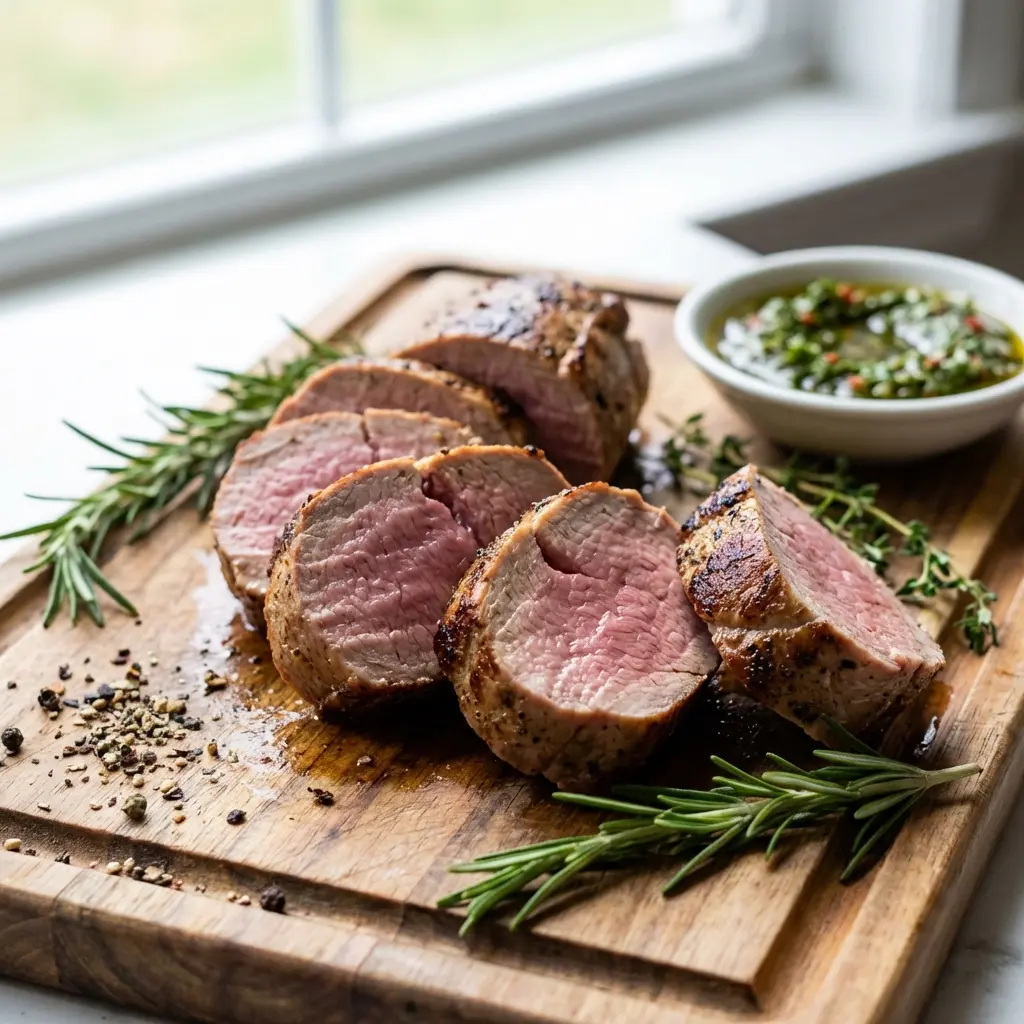
First, let's clear up the confusion: Pork Tenderloin is NOT the same thing as Pork Loin.
- Pork Loin: A thick, wide roast (like a Prime Rib). Weighs 4-5 lbs.
- Pork Tenderloin: A long, narrow cylinder (like a snake). Weighs 1 lb.
The Tenderloin is the "Filet Mignon" of the pig. It does zero work, so it is incredibly tender but has very little fat. If you overcook it, it turns to dust.
The Ideal Temp: 145°F63°C
Like chops, the tenderloin should be served with a blush of pink.
The Strategy:
- Sear: Brown the outside quickly in a pan (2 mins per side).
- Roast: Finish in a 400°F204°C oven.
- Pull: Remove at 140°F60°C.
- Rest: 10 minutes. Final temp: 145°F63°C.
Why High Heat (400°F204°C)?
Because the tenderloin is so thin (2–3 inches wide), it cooks very fast. If you roast at low heat (325°F163°C), the exterior won't brown before the interior is done. High heat blasts the crust while the center gently rises. Total cooking time is usually only 15–20 minutes.
The "Tail" Problem
The tenderloin is tapered. It has a thick head and a thin tail. Problem: By the time the thick head is 145°F63°C, the tail is 180°F82°C (burnt).
Solution: Tuck the thin tail underneath itself and tie it with twine to create a uniform thickness. Or, simply accept that the tail piece is the "Chef's Snack" (or for the kids who like well-done meat).
Slicing for Service
Always slice against the grain into "medallions." At 145°F63°C, the medallions will be moist, glistening, and barely pink. At 135°F57°C (if you dare), they are steak-like. At 160°F71°C, they are white dry disks.
Frequently Asked Questions (FAQ)
Q: Can I put tenderloin in the slow cooker?
A: Please don't. Tenderloin has no collagen to break down. Slow cooking is for tough cuts (Shoulder/Butt). Slow cooking a tenderloin just boils the expensive tender meat until it shreds into dry strings. Use a cheap Pork Shoulder for pulled pork.
Q: How do I probe such a narrow piece?
A: Go in through the END. Insert the probe into the cut face of the thickest end, pushing it lengthwise deep into the center. This is much more accurate than poking from the side where the sensor might pop out the other side.
Q: Why does it smell funny?
A: "Boar Taint" (a musk smell) is rare in commercial pork. Usually, funny smells come from Cryovac packaging (sulfur smell). Rinse the meat and let it air out for 5 minutes. If it still smells bad, it’s spoiled.
Q: Is grilling recommended?
A: Yes! But use distinct zones. Sear over direct fire, then move to indirect heat to finish. It cooks in about 12 minutes total.
Doneness Reference
| Doneness | Internal Temp | Center Color | Verdict |
|---|---|---|---|
| Medium-Rare | 135°F57°C–140°F60°C | Rosy pink | Juicy — for confident cooks |
| Medium (USDA) | 145°F63°C | Blush of pink | The standard — safe since 2011 |
| Medium-Well | 150°F66°C–155°F68°C | Trace of pink | Noticeably drier |
| Well Done | 160°F71°C+ | White-gray | Dry — the old-fashioned mistake |
Leftovers Without the Dryness Penalty
Cooked tenderloin keeps 3–4 days refrigerated, but reheating a lean cut usually finishes the drying job the oven started. The better plays: slice it thin and eat it cold (it makes exceptional sandwiches), or reheat medallions gently in a covered pan with a spoonful of broth just until warm. If you must microwave, 50% power in 30-second bursts — full power turns medallions into erasers within a minute.
More Questions
What temperature should pork tenderloin be cooked to?
Pork tenderloin is best cooked to 140–145°F60–63°C internal temperature. The USDA updated its pork safety standard in 2011 to 145°F63°C with a 3-minute rest — a slight pink center at this temperature is safe and normal. Pull the tenderloin at 137–140°F58–60°C and rest for 5–10 minutes; carryover cooking will bring it to 145°F63°C. Cooking beyond 155°F68°C makes this lean cut dry.
How long to cook pork tenderloin in the oven?
At 400°F204°C: roast pork tenderloin for 20–25 minutes for a standard 1–1.5 lb tenderloin. At 425°F218°C: 18–22 minutes. Start checking at 18 minutes with a thermometer — pull at 140°F60°C. The sear-then-roast method (2 minutes per side in a hot pan, then 15–18 minutes in 400°F204°C oven) produces better browning and more even cooking than oven-only.
What is the difference between pork tenderloin and pork loin?
Pork tenderloin and pork loin are completely different cuts. Tenderloin is a small (1–2 lb), extremely lean muscle from along the spine — it's the psoas muscle, which does almost no work, making it the most tender cut on the animal. Pork loin is a much larger (2–4 lb+), wider cut from the back. Loin is less tender but more versatile. They require different temperatures: tenderloin to 145°F63°C, bone-in loin roast the same but longer cook times.
Should pork tenderloin be pink inside?
Yes. Pork tenderloin cooked to 145°F63°C with a 3-minute rest will have a slight pink center — this is the USDA-approved safe standard since 2011. The old standard of 160°F71°C (well done) was revised because food safety research confirmed that 145°F63°C destroys Trichinella and other pathogens when combined with the rest period. A pink tenderloin at 145°F63°C is safe and significantly more moist than one cooked to 160°F71°C.
Why does pork tenderloin have a silver skin, and should I remove it?
Silver skin is a tough, inedible connective membrane that covers one side of a pork tenderloin. It doesn't break down during cooking like collagen — instead, it tightens and causes the tenderloin to bow and cook unevenly. Always remove it before cooking: slide a sharp boning knife under the silver skin at one end, angle the blade slightly upward, and stroke the knife along the skin while pulling it taut with your other hand.