
Brisket Temperature Guide: The Stall, The Wrap, & The Finish
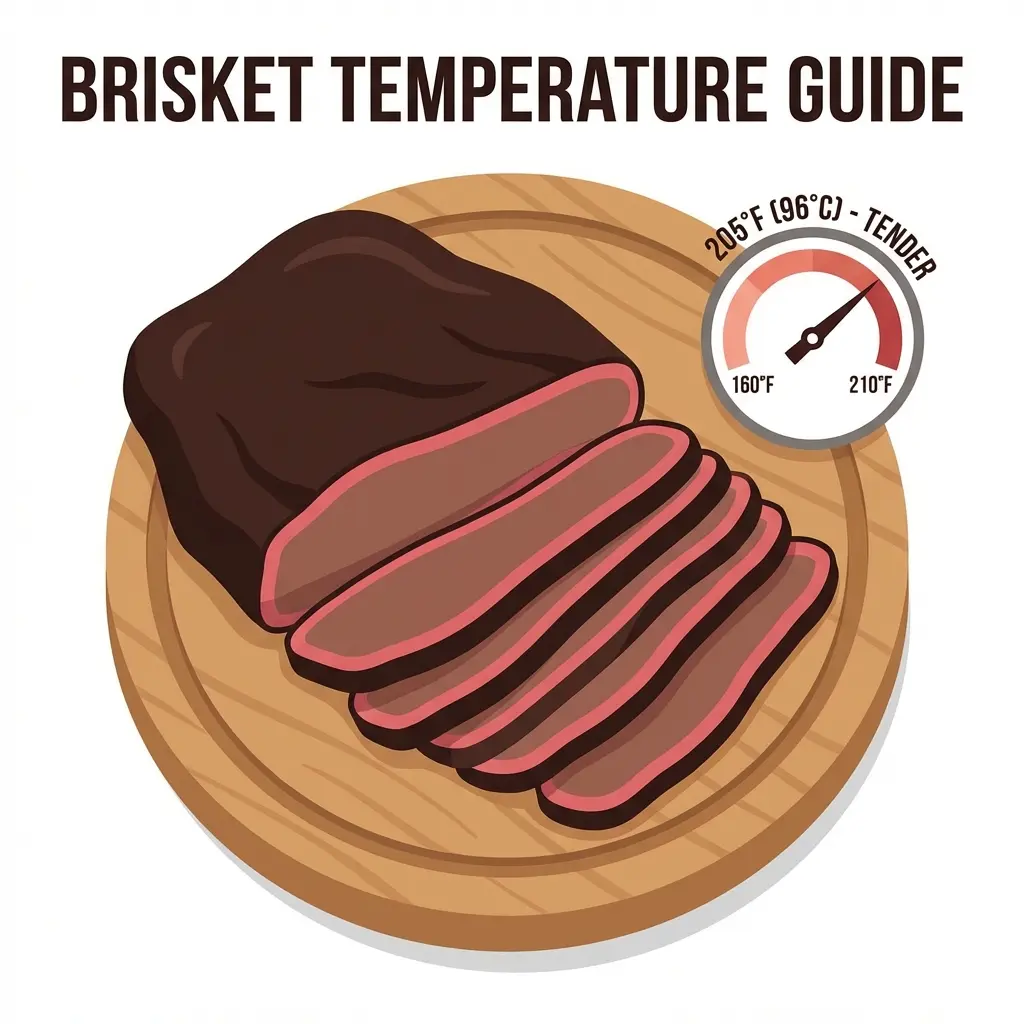
Brisket is the toughest cut of meat on the cow. It is a weight-bearing chest muscle loaded with collagen. If you cook it like a steak to 135°F57°C, it will be inedible rubber.
To transform it into meltingly tender BBQ, you need heat, time, and precise temperature monitoring.
The Magic Number: 203°F95°C
Unlike steak or poultry, brisket is not done when it is "safe" to eat. It is safe at 145°F63°C, but it is tough.
- Done Temp: 200°F93°C to 205°F96°C.
- The Feel: When you probe it, it should feel like "warm butter." If there is resistance, it needs more time, even if the temp says 203°F95°C.
The Stages of Brisket
Cooking a brisket is a journey through specific temperature zones.
| Stage | Internal Temp | What's Happening | Action |
|---|---|---|---|
| The Smoke | 40°F4°C to 150°F66°C | Meat absorbs smoke. Bark forms. | Spritz with apple/cider vinegar every hour. |
| The Stall | 150°F66°C to 170°F77°C | Evaporative cooling stops the temp from rising. | Panic? No. Either wait it out or "The Crutch" (Wrap). |
| The Render | 170°F77°C to 190°F88°C | Collagen turns to gelatin. | Keep cooking steady. |
| The Finish | 195°F91°C to 205°F96°C | Final tenderness achieved. | Probe for "butter feel." |
| The Rest | Down to 140°F60°C | Juices redistribute. | Wrap in towel, place in cooler for 1–4 hours. |
What is "The Stall"?
Around 160°F71°C, the brisket will stop cooking. The internal temperature might sit at 162°F72°C for 4 hours.
This is Evaporative Cooling (essentially, the brisket is sweating). The moisture evaporates from the surface, cooling the meat as fast as the fire heats it.
The Texas Crutch: To speed up the stall, wrap the brisket tightly in foil or butcher paper at 165°F74°C. This traps the moisture, stops evaporation, and powers through the stall. Warning: Foil softens the bark; butcher paper preserves it.
The Holdup (Resting)
You cannot skip the rest. A brisket taken off the smoker at 203°F95°C and sliced immediately will dry out in seconds.
- Rest Time: Minimum 1 hour. Ideal 2–4 hours.
- Method: Wrap the foil-wrapped brisket in an old towel and place it in a dry cooler (with no ice). The cooler acts as a warmer, holding the meat at a safe temp while the collagen finishes settling.
Frequently Asked Questions (FAQ)
Q: Why is my brisket dry?
A: Usually undercooking. It sounds counterintuitive, but brisket gets moister the longer you cook it (up to a point) because the gelatin needs to melt. If you pull it at 190°F88°C, the collagen is still hard. It could also be that you sliced it too hot.
Q: Fat side up or down?
A:
- Heat from bottom: Fat side down (protects meat).
- Heat from side/top: Fat side up (bastes meat).
Q: How long does it take?
A: The golden rule of BBQ: "It's done when it's done." Estimate 1.5 hours per pound at 225°F107°C, but always cook to temperature, not time.
More Questions
What temperature is brisket done?
Brisket is done at 195–203°F91–95°C internal temperature — not at the USDA minimum of 145°F63°C for beef. At 195°F91°C, brisket begins to become probe-tender but may still feel slightly tight. The sweet spot is 200–203°F93–95°C where the thick collagen seams (interstitial fat and connective tissue) have fully converted to gelatin. Probe the thickest part of the flat and the point — both must be probe-tender (the probe slides in with no resistance, like warm butter).
What temperature does brisket stall at?
Brisket stalls (stops rising in internal temperature) around 150–175°F66–79°C. This 'stall' is caused by evaporative cooling — as internal moisture evaporates from the brisket's surface, it absorbs heat energy and holds the temperature steady despite continuous cooking. The stall can last 2–7 hours. Break the stall by wrapping in foil (the Texas Crutch) or butcher paper to stop evaporative cooling.
How long does it take to smoke a brisket?
At 225°F107°C, plan approximately 1–1.5 hours per pound for a whole packer brisket. A 14-pound brisket typically takes 14–18 hours total. At 250°F121°C, the same brisket takes 12–15 hours. Always cook to temperature and probe tenderness — not to time. A fully trimmed 14-lb brisket that finished the stall early could be done in 12 hours; an untrimmed one could take 20+.
Should brisket be wrapped in foil or butcher paper?
Butcher paper (pink/peach) is preferred by most competition pitmasters because it's breathable — it stops evaporative cooling without trapping steam, allowing the bark to remain intact rather than softening. Aluminum foil (Texas Crutch) breaks the stall fastest and retains the most moisture but softens the bark significantly. Wrap when the brisket reaches an internal temperature of 165°F74°C and the stall has begun.
How long should brisket rest after smoking?
Brisket should rest for a minimum of 1 hour; 2–4 hours is ideal. The long rest allows the collagen-gelatin matrix (created during cooking) to set, making slicing much cleaner. Wrap tightly in foil, then in a towel, and place in a cooler (no ice) — the brisket will hold at 140°F60°C+ for 4–6 hours this way. Slice perpendicular to the grain; the flat and point run in different directions, so change angle at the separation point.