
Candy Temperature Chart: Syrup Stages & Altitude
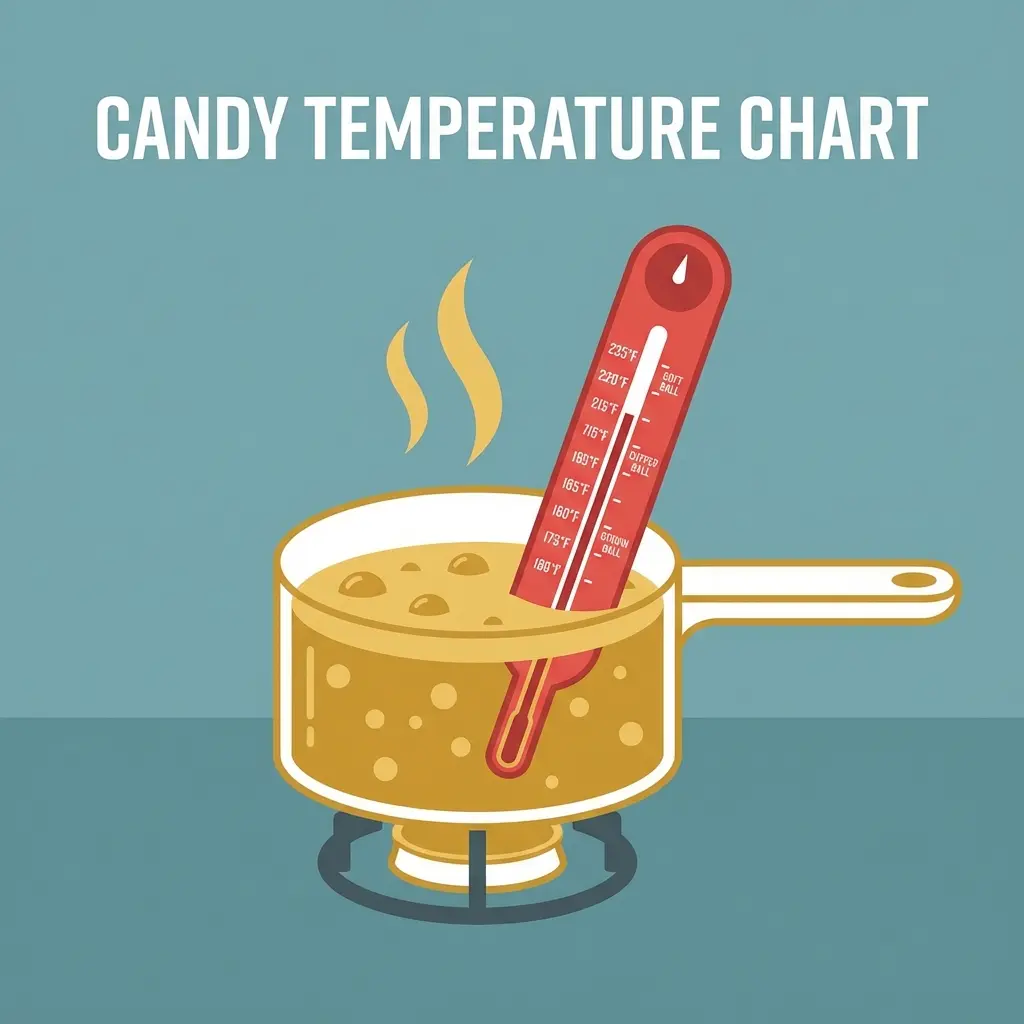
Candy making is simply managing the water content in sugar syrup. As water boils off, the sugar concentration rises, and the boiling point increases.
If you miss your target by 2 degrees, your fudge becomes grit or your caramel becomes a lollipop.
The Stages of Sugar
| Stage | Temperature Range | Texture | Uses |
|---|---|---|---|
| Thread | 230°F110°C–235°F113°C | Liquid threads | Syrup, Glaze |
| Soft Ball | 235°F113°C–240°F116°C | Squishy ball | Fudge, Fondant |
| Firm Ball | 245°F118°C–250°F121°C | Malleable ball | Caramels |
| Hard Ball | 250°F121°C–265°F129°C | Sticky/Hard | Marshmallows, Gummies |
| Soft Crack | 270°F132°C–290°F143°C | Flexible strands | Taffy, Butterscotch |
| Hard Crack | 300°F149°C–310°F154°C | Brittle snap | Lollipops, Brittle |
| Caramel | 320°F160°C–335°F168°C | Golden to Brown | Caramel Sauce |
The Cold Water Test (No Thermometer)
Drop a spoonful of hot syrup into a glass of ice water. Fish it out with your fingers.
- Does it form a ball? Does it flatten? Does it snap?
- This ancient method is reliable because it tests the actual physical properties.
High Altitude Adjustment
Crucial: Water boils at lower temps at high altitude. This throws off the chart.
- Rule: Subtract 1°F0.5°C for every 500 feet above sea level.
- Example: Developing Hard Crack (300°F149°C) in Denver (5,000 ft).
- 5000/500 = 10. Subtract 10°F5°C. Target is 290°F143°C.
Frequently Asked Questions (FAQ)
Q: Why did my sugar crystallize (turn gritty)?
A: One rogue sugar crystal fell from the side of the pot and started a chain reaction.
- Fix: Wash down the sides of the pot with a wet pastry brush while boiling. Do NOT stir once it boils. Add Corn Syrup (interfering agent) to prevent crystallization.
Q: Thermometer says 212 forever?
A: That's physics. As long as there is a lot of water, it stays at 212°F100°C. It will only rise once most water evaporates. Be patient.
Choosing (and Trusting) Your Thermometer
Candy work happens at temperatures where ordinary meat thermometers max out, and where a small error ruins the batch:
- Use a dedicated candy/deep-fry thermometer rated to at least 400°F204°C, or a lab-style digital probe. Most instant-reads top out around 300°F149°C–390°F199°C — check yours before starting. See the thermometer types guide.
- Test it first: clip it into boiling water. At sea level it should read 212°F100°C. If it reads high or low, apply that offset to every target — how to calibrate.
- Keep the bulb off the pan bottom. The pan floor runs far hotter than the syrup; a touching probe reads high and your candy comes off the heat early and soft.
Humidity: The Invisible Saboteur
Sugar is hygroscopic — it pulls water out of the air. On a humid or rainy day, finished candy reabsorbs moisture and turns sticky within hours. Hard candies and brittle suffer most.
- Best conditions: below 50% humidity.
- Rainy-day trick: cook 2°F1°C higher than the chart to drive off extra water and compensate.
- Storage: airtight containers immediately after cooling, with parchment between layers. Never refrigerate hard candy — condensation forms when it comes out, and stickiness follows.